
Rankings and traffic are no longer the starting point. They’re the outcome of decisions made before a user ever reaches the SERP. AI-driven systems now determine what information gets surfaced, which version is relevant for each market and how identical keywords map to entirely different intent depending on context.
That shift fundamentally rewrites how you compete in international SEO.
The real advantage now comes from how you systematize those differences. That means building frameworks to detect intent shifts at scale, segment markets based on search behavior (not geography) and feed those signals into how pages are structured, linked and localized.
This article breaks down how to do exactly that. Get scalable frameworks for detecting cross-market differences and practical ways to adapt your content, architecture and strategy to match how AI actually evaluates relevance today.
TL;DR
International SEO is the practice of optimizing a website for many countries and languages at the same time, taking into account all local differences to rank the right content to the right audience. It is needed to improve UX for different audiences, eliminate duplication and cannibalization and meet expectations of each targeted market.
You likely need it if you already get international traffic or want to expand globally.
A solid international SEO checklist should include these steps:
- Avoid forced redirects that block crawling
- Select the right markets based on real data
- Do keyword research per country (search behavior differs)
- Localize content
- Choose a scalable URL structure
- Manage duplicates with canonical + hreflang
- Ensure fast global delivery (CDN)
What Is International SEO & Does Your Business Need It?
International SEO is the process of optimizing a website to achieve strong organic visibility across multiple countries and languages. It goes beyond single-market optimization since it aligns technical structure, content and authority signals with the expectations of global search engines and diverse user audiences and market sizes.
Your main focus might be ranking on Google, but depending on where your audience (or at least a significant part of it) is based and which language they speak, optimizing for other search engines may be equally important. For instance, Baidu is where most Chinese users start searching online. Czech people prefer Seznam and Naver is the go-to browser for South Koreans, while DuckDuckGo is the go-to search engine for privacy-oriented people.
At its core, international SEO ensures that search engines can understand three elements:
- which markets you’re targeting
- which languages you support
- which version of your content should be served to each user
This allows search engines to deliver the most relevant pages based on a user’s location, language preferences and search behavior.
Which brings us to an important question: does your business need international SEO?
If your audience is already international, your SEO strategy needs to reflect that reality.
But international SEO is also essential if your business attracts or intends to attract, customers across different countries or languages.
To get a clear idea of where you stand, the first thing you should analyze is your existing traffic. If a meaningful share of your website visitors comes from outside your primary market, speaks different languages or both, it’s a clear sign you’re not satisfying all your users’ expectations.
So, let’s see how you can develop a complete international SEO strategy.
Best Practices for an International SEO Strategy – Including for AI Visibility
1. Identify and Prioritize Your International Markets
When deciding on the right international markets, start by aligning business reality with search opportunity across four areas:
- Existing organic performance: Identify which countries and languages already have traction. These markets have lower barriers to entry and a stronger baseline for international SEO investment.
- Search visibility audit: Use Google Search Console to surface where your site is generating impressions and which queries are driving them. You’ll find underinvested markets with early-stage momentum.
However, raw GSC data only tells part of the story. JetOctopus’ GSC on Steroids extracts significantly more value from your Search Console data, surfacing impressions, clicks, CTR, rankings , and page-level performance broken down by country and device.
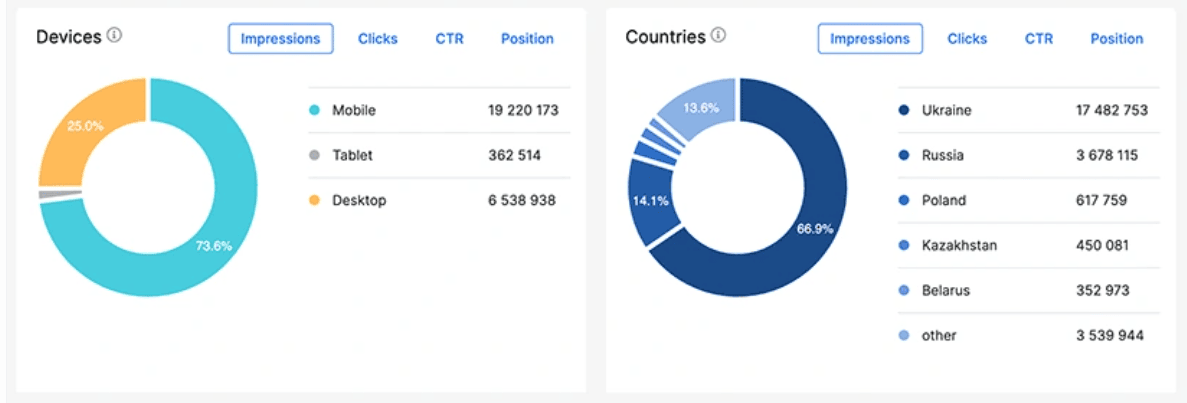
The AI Dashboard also tracks AI bot activity, traffic from AI chat platforms and your visibility in Google’s AI search results. This tells you where you rank and which content is gaining traction with both search engines and AI-driven systems – critical intelligence when prioritizing updates across multiple markets.
See exactly how JetOctopus works and how effortlessly it integrates with GSC:
- Next, layer in competitor and market analysis: Map competitor performance across regions to identify gaps, saturation levels and differentiation opportunities before committing resources.
- Local search behavior: The same intent often manifests differently across languages and cultures. For example, companies searching for enterprise IT consulting can show very different behavior across markets:
- US: “IT consulting services for businesses”
- Germany: “IT Systemintegration für Unternehmen”
- Singapore: “managed IT support for scaling teams”
Understanding how users search is a safe bet in gaining traction and winning over locally optimized competitors.
2. Do Keyword Research for Each International Market
After you’ve identified your markets, it’s time to do keyword research for each of them. It sounds like overkill, but this step ensures your global SEO strategy reflects how people actually search in each market, not how you assume they do.
- Identify how your target audience describes your product or service. For example, if you run a cleaning service, Americans will typically search for “house cleaning services” or “home cleaners near me”, while people in the UK are more likely to type “domestic cleaning services” or “household cleaners”.
- Run competitor keyword analysis for each market to surface proven queries and identify gaps where you can compete.
- Use keyword tools, like Google Ads’ Keyword Planner, to validate demand using country-level filters and assess search volume, trend direction and competitive density.
- Prioritize keywords that balance relevance, demand and realistic ranking potential.
- Go deeper by studying search intent. Review top-ranking pages to understand what type of content performs best in each market. You might discover that some markets prefer detailed guides, while others respond better to concise or visual content.
Once you understand what resonates, you can go further and segment your SEO data by market, language or site section. This is a clear way to discover which pages, keywords or regions need improvement. Segmentation is especially useful for large websites like ecommerce, where grouping data into meaningful clusters helps uncover opportunities that would be missed in a site-wide analysis.
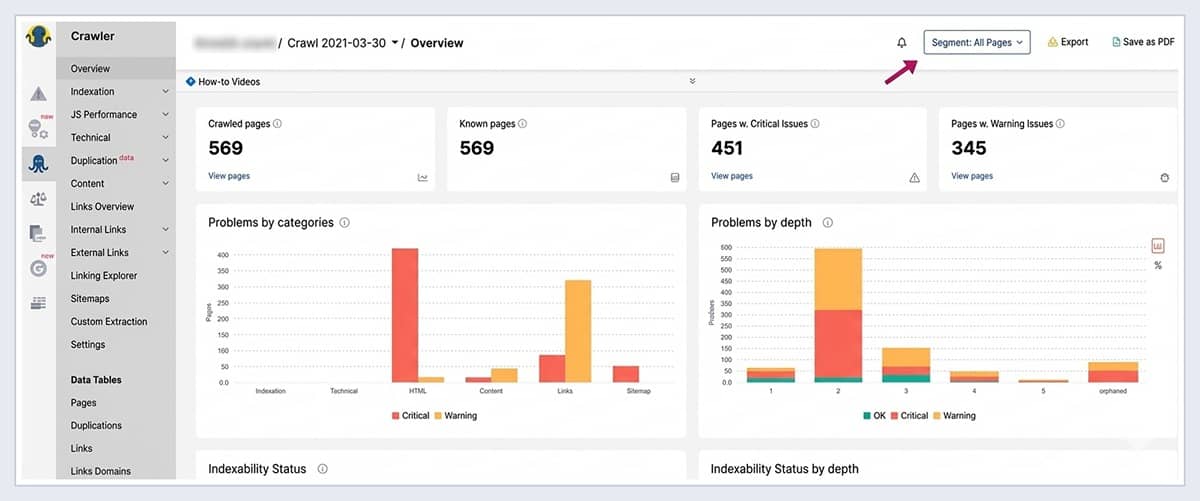
The dashboard from JetOctopus reflects a technical SEO audit snapshot for a site, with the option to segment data into meaningful groups, allowing you to fix high-priority pages.
3. Adapt and Localize Content
Beyond the simple translation that preserves meaning across languages, localized content aligns your entire digital presence with the cultural, linguistic and regulatory expectations of each target market.
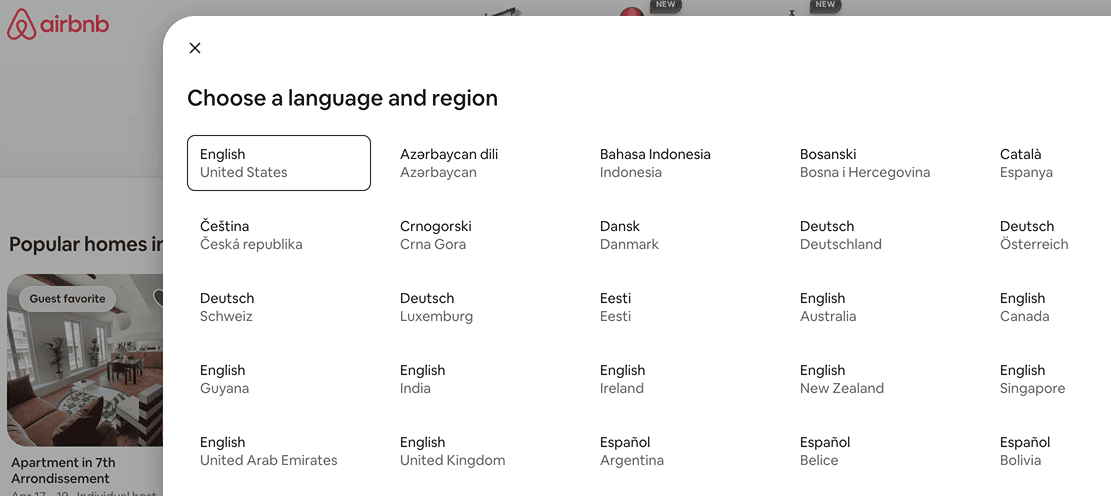
Airbnb is a strong reference point here as the brand maintains a consistent core message while adapting it for different regions that share the same language.
Uber went even further when it introduced UberESPAÑOL in California to better serve the state’s substantial Spanish‑speaking population. The initiative enabled riders to request Spanish‑speaking drivers directly through the app, without adding cost or complexity for the user.
At the content level, tone, imagery and examples should resonate locally, whether that means referencing regional context, adjusting for local humor or speaking to market-specific pain points. The same applies to transactional details: currency, units of measurement, payment methods and contact information should all reflect local standards.
At scale, most enterprise teams combine native content creation with translation management systems to automate routine localization tasks and integrate with existing workflows, keeping a high quality without slowing down delivery.
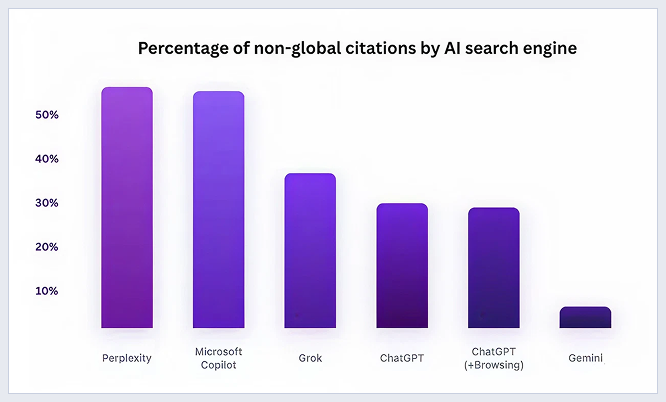
Plus, localized content is a direct accelerator for AI‑driven SEO. It aligns your pages with the way modern AI engines evaluate relevance, prioritizing cultural context, semantic depth and region‑specific nuance.
Perplexity and Copilot routinely show up to 56% non‑global citations when localization is executed well.
4. Define Your International SEO URL Structure
Choosing the right international SEO URL structure is a foundational decision that directly impacts scalability, search visibility (including in AI crawlers and citation potential in AI-generated responses) and operational efficiency.
Each structure sends different signals to search engines and users, so it’s essential to align it with your market strategy.
Your options boil down to three strategic URL models:
| Approach | Details | The Perks | The Downsides |
|---|---|---|---|
| Country code top-level domain (ccTLDs)Example: amazon.de | Provides the strongest geo-targeting signal | Build immediate user trustRank higher than generic domains | Increased investment → Independent authority building for each domain |
| Subdomain on a global top-level domain (gTLD)Example: https://blog.hubspot.es/ | Offers more flexibility and can support region-specific hostingActs as a separate property, with separate crawl, signals and GSC profile | Easier, cheaper and faster to deploy than ccTLDs | Introduces added technical complexity May require separate crawling and SEO alignment |
| Subdirectory Example: apple.com/uk/ | The most efficient and widely adopted model | Consolidates authority within a single domain Simplifies analytics and maintenance Enables faster rollout of localized content | Provides a weaker geo-targeting signal compared to ccTLDs. Reduces the potential for de‑anonymizing GSC data |
More complex hybrids, combining subdomains and subdirectories, allow granular targeting but often introduce unnecessary complexity and resource strain.
In practice, the right choice depends on your growth model, resources and market priorities. You should create distinct, crawlable URLs that map cleanly to localized content while maintaining a structure that your organization can scale and manage effectively.
Other International SEO Best Practices
Handle Duplicated Content & Cannibalization Issues
Imagine you’re running a campaign where two ads accidentally compete against each other for the same audience: nobody wins and your ROI tanks. The same goes for duplicate content and keyword cannibalization; both need to be managed as they’re essential for keeping international search visibility clean, consistent and strategically aligned.
When regional pages reuse near‑identical templates or product copy, you’re essentially forcing search engines to choose between multiple competing URLs. Global sites are especially prone to this (localized pages often differ only superficially), making duplication the default state of the architecture.
Canonicalization correctly removing duplicates is the primary control mechanism for resolving that conflict, but it’s only as effective as your visibility into where duplication actually occurs. That’s where JetOctopus gives you a genuine operational edge.
The dedicated Duplication report highlights exact matches, partial duplicates , and low-uniqueness ratios across every layer of the page: titles, meta descriptions, H1s, H2s and full HTML content, with configurable thresholds so you define what constitutes a problem for your specific site architecture.
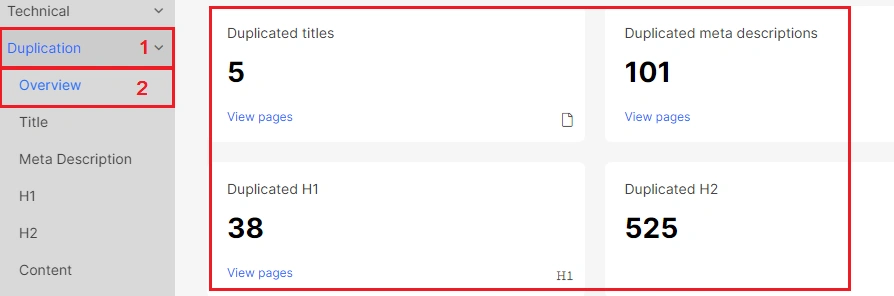
Every flagged issue maps directly to a complete list of affected URLs, making remediation systematic rather than reactive.
Additionally, JetOctopus provides a wide range of crawl settings, giving you full control over what gets crawled, how and under what conditions — so your audit reflects exactly what search engines access.
For example, if you own a SaaS company with US and UK product pages that share nearly identical descriptions, search engines may rank the wrong version in each market or neither effectively. JetOctopus will flag both as duplicates, show you exactly which elements overlap and map every affected URL.
Implement Hreflang Tags
Hreflang tags guide users and search engines to the correct language and regional version of your content.
Each hreflang tag defines an alternate version of a page using three elements:
- target URL
- the language and region code (for example, fr – for users who have their browser set to French or fr-ca – for Canadian users with browsers set to French)
All variants, including the original page, must reference each other, so this bidirectional mapping ensures consistency and proper indexing.
Implementation can be handled via the HTML <head>, XML sitemaps or HTTP headers. Regardless of method, use absolute URLs with HTTPS and include an x-default for unmatched regions.
Getting the implementation right is only half the battle, as hreflang breaks in ways that aren’t always obvious until rankings start behaving unexpectedly.
JetOctopus flags hreflang issues directly in its Crawler’s Indexation report, so nothing slips through:
- Relative URLs – search engines ignore relative paths, but JetOctopus flags them, so you can resolve alternate mappings.
- Non-200 URLs – it surfaces every broken or redirected URL in your hreflang chain, showing exactly where indexing authority gets cut off.
- Non-indexable URLs – JetOctopus exposes pages where noindex silently overrides your hreflang setup (the reason why localized versions vanish from SERPs).
- Invalid language/region codes – it pinpoints incorrect codes that lead search engines to serve the wrong version, undermining relevance and user experience.
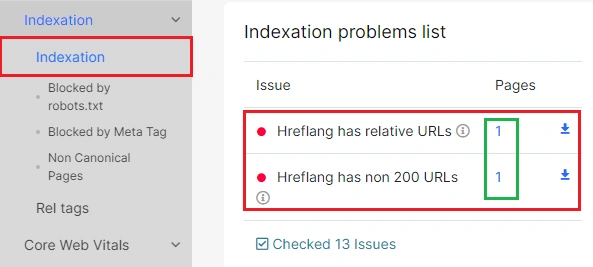
Each flagged issue links directly to a complete list of affected URLs, making prioritization and remediation straightforward, whether you’re managing 5 or 30 languages.
Connect a CDN (Content Delivery Network)
A content delivery network (CDN) is essential if you want to deliver fast, reliable experiences across global markets. Site speed is a direct ranking signal and latency naturally increases when content is served from geographically distant infrastructure. Minimizing round‑trip time and optimizing delivery paths helps you keep search performance across global properties.
Implementation is pretty straightforward. Select a provider (Cloudflare, AWS CloudFront, Akamai, Fastly or Bunny.net), configure DNS to route traffic through the CDN and define caching rules to optimize delivery. Your website will get faster access, improved reliability and stronger international SEO performance without major infrastructure changes.
Monitor Core Web Vitals
Page load time and physical proximity to users directly shape Core Web Vitals, which Google uses as a transparent page‑experience signal and a measurable ranking factor in competitive results. Because CWV relies on real‑user field data from every region, slow delivery in markets with weaker infrastructure or distant servers (Brazil loading at 2.6s versus 1.7s in Germany) pulls down your aggregated CrUX (Chrome User Experience Report) scores and weakens visibility everywhere.
Lightweight architectures, minimized payloads and strategically distributed infrastructure ensure consistently fast rendering, stable layouts and responsive interactions across borders. That’s why you should monitor country‑level performance in Search Console to catch regional degradation early and protect global rankings. Pair that with properly implemented hreflang to ensure localized delivery and keep international UX strong.
Avoid Redirects
Avoid enforcing automatic redirects based on IP, geolocation or browser settings. Forced redirects disrupt user autonomy and introduce significant crawlability issues, which usually prevent search engines from accessing and indexing localized variants correctly.
A better approach is to show a simple prompt suggesting the right language or regional version and let users decide. This maintains full discoverability across all site versions while improving the overall UX. It’s also one of the best practices for international SEO because you keep every version of your site fully accessible to both users and crawlers.
Equally important is to ensure that search engine crawlers encounter the same experience as human users. When every locale can be crawled freely, search engines index your international setup far more accurately and you avoid those frustrating visibility gaps across markets.
Audit Broken Links and 404 Errors
Broken links and 404 errors quietly erode international performance at scale. Every unresolved 404 increases bounce rates, shortens dwell time and wastes crawl budget. These effects amplified across multilingual architectures where a single broken path can cascade through all language versions, multiplying the damage across every market you serve.
To find and fix broken links on multilingual websites, use JetOctopus to scan all language versions (subdomains, subfolders or ccTLDs) separately, then run hreflang-aware audits to catch cross-language issues like relative URLs or tags pointing to 404s. Re‑crawl after fixes and monitor frequently to prevent errors from cascading further across markets.
Keep an Eye on Your Strategy – Before Problems Become Crises
Ongoing monitoring of your global SEO strategy ensures sustained visibility across markets by catching issues early and adapting to algorithm changes.
A misconfigured canonical, a noindex accidentally pushed to production, an hreflang pointing to a non-200 URL, a new JS-rendered component – these errors are routine, but their impact on organic visibility and increasingly, AI-driven search, can take months to recover from.
JetOctopus Alerts eliminates that exposure. The system monitors every critical signal layer in real time:
- On-page SEO: Catch canonical conflicts, hreflang errors and indexability issues the moment they appear
- Googlebot & AI bots: Track crawl frequency, sitemap availability, page load times and flag new or shifting AI crawler patterns, including mobile-first indexing transitions
- SERP efficiency: Surface drops in clicks, impressions, branded query visibility and AI snapshot presence before they compound
- Core Web Vitals: Keep performance regressions from quietly degrading ranking signals
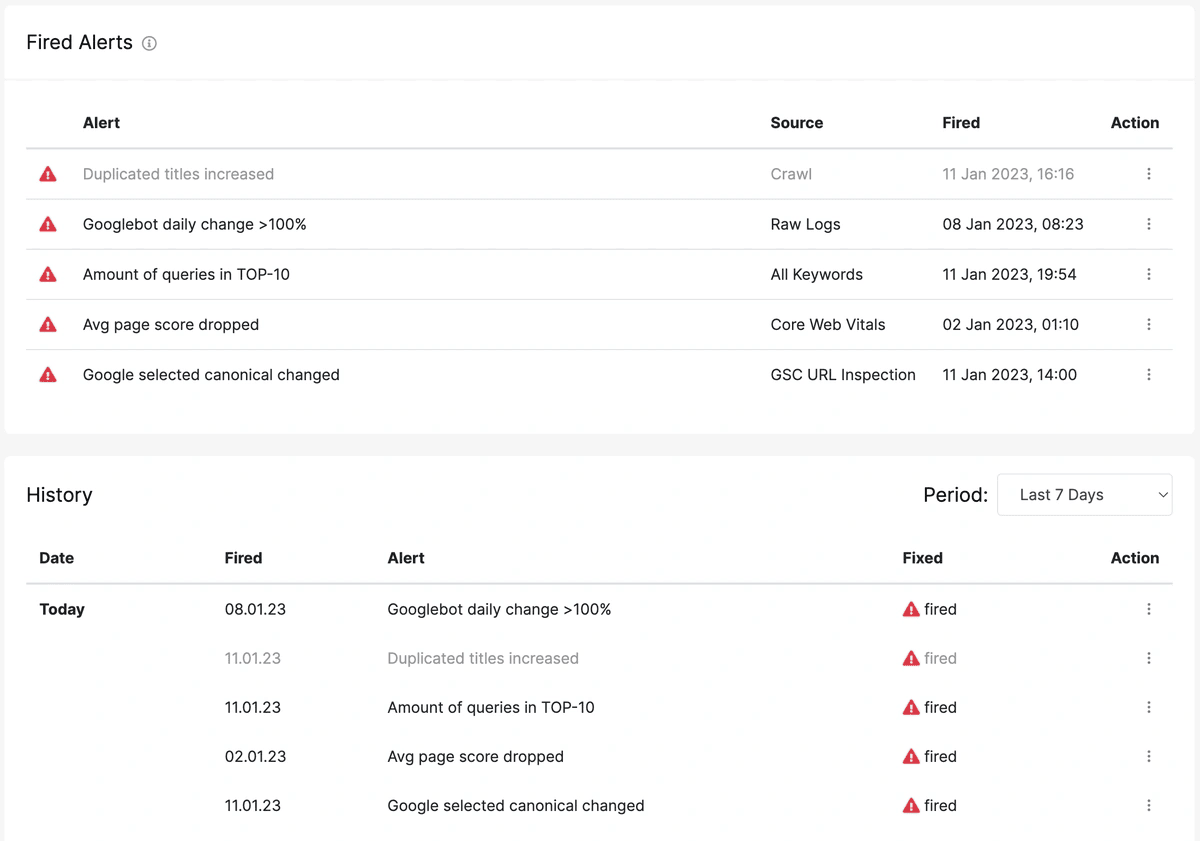
You can also create your custom alert combinations for unlimited flexibility to monitor exactly what matters for your site architecture.
Conclusion
An effective international SEO strategy starts by prioritizing the markets with real growth potential and clear alignment to your business goals, then reinforcing that expansion with a technical infrastructure that holds up across markets.
What separates consistent performers from teams stuck in firefighting mode is visibility. Your superpowers are knowing where duplication is silently diluting authority, catching hreflang errors before they compound, understanding which content is gaining traction with both search engines and AI systems and in which markets.
JetOctopus helps with all of these and more. The platform monitors critical signals in real time and uncovers duplication across your site. Combined with advanced GSC insights and AI visibility tracking, it helps you spot risks, prioritize fixes and turn complex global architectures into clear, actionable workflows across every market.