Localizing a site into multiple languages has shifted from basic translation to influencing how your content is understood, indexed and mapped to intent across global markets. Beyond the words on the page, search engines now evaluate whether each localized version reflects real user behavior, cultural nuance and the technical signals that connect everything.
That’s the core of multilingual SEO.
It’s no longer about installing a plugin and hoping hreflang tags cooperate. Effective multilingual SEO means building a system that preserves meaning across languages, adapts content to local search patterns and keeps your architecture stable as new pages roll out. It treats translation as a marketing function: mapping intent, refining metadata, rewriting slugs and knowing when machine translation works and when you need a human who understands both language and SEO.
This guide walks you through that entire process. You’ll learn how to structure multilingual sites for long‑term stability, how to localize content so it actually ranks and how to build workflows that prevent things from breaking every time you publish something new. You’ll get the complete framework for turning a multilingual site from a maintenance headache into a scalable growth engine.
TL;DR
Multilingual SEO ensures your site ranks and converts across languages. To execute it correctly at scale:
- Build backlinks market by market from language-aligned, niche-relevant domains: local authority signals are non-negotiable for regional ranking
- Define your target markets using GSC data, competitor analysis and crawl intelligence to validate where demand exists before committing resources
- Use subfolder URL structures (/en/, /de/) as the default enterprise configuration; they consolidate authority and simplify governance
- Research keywords natively in each language with native speakers; never rely on direct translation
- Implement hreflang correctly with valid codes, absolute URLs, self-referencing tags, x-default and canonical alignment, then audit for the silent failures that undermine the whole setup
- Localize everything, not just body copy: metadata, alt text, structured data, interface elements and cultural references must all reflect the target market
- Manage duplicate content by assigning dedicated URLs, deploying canonicals, pairing them with hreflang and auditing for cross-language overlap at the title, description and content level
What Exactly Is Multilingual SEO?
Multilingual SEO is the process of optimizing a website so it can rank, be discovered and be understood across multiple languages. It’s a strategic, language‑driven approach that ensures your content is discoverable in organic search for audiences who search in languages beyond your primary one, including markets where English isn’t the default language.
The main focus of SEO for a multilingual website is going beyond just translating text. It means adapting keywords, metadata, structure and content so search engines can correctly index and serve it to the right audiences.
When users search in Spanish, French, German or any other language, a correctly configured multilingual SEO architecture allows your site to appear for those queries and provide an easy-flowing, localized experience.
How It Works
A multilingual SEO strategy typically includes:
- High‑quality language localization, including SEO metadata
- Language‑specific keyword research
- Content adaptation for cultural and search‑intent nuances
- Language‑appropriate link building
- Information architecture designed around languages
- Technical configuration (hreflang, sitemaps, URL structure) to help search engines understand which language version to serve
Now, here’s exactly how to build a correct multilingual SEO strategy.
Build A Multilingual SEO Strategy
Choose Your Target Markets
This step is the strategic baseline and determines which languages you support and how you architect your site, allocate resources and prioritize global expansion.
The idea is to build a language strategy that aligns with real demand, competitive opportunity and your organization’s operational capacity.
In terms of markets that demonstrate clear commercial potential, you can consider:
- Countries with strong search demand for your products or services
- Regions where your brand already receives organic visibility, even without localized content
- Markets where competitors are already active, signaling proven opportunity
Competitor presence is also a powerful indicator of market viability. If your direct competitors have localized sites for China, France or Brazil, it’s a strong signal that those markets are commercially attractive and likely worth evaluating for your multilingual roadmap.
This gives you an external benchmark before turning to your own data. Google Search Console is a reliable tool for identifying where demand already exists.
Step‑by‑step approach:
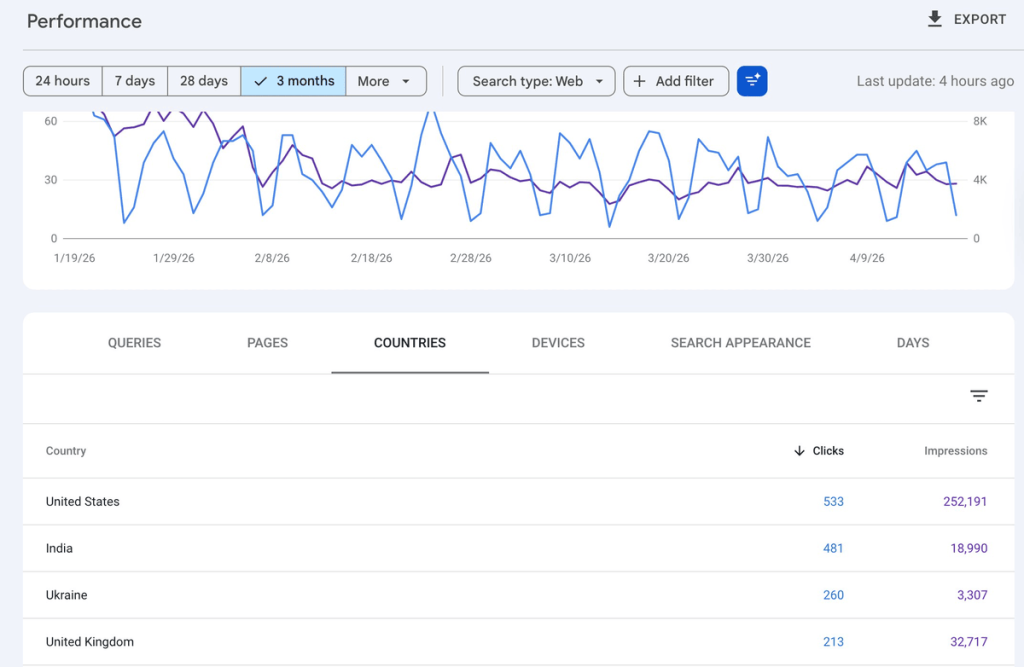
- Within Performance → Search results, filter by Country to view clicks, impressions, CTR and average position.
- Sort by impressions to identify markets where users are already searching for your brand or products. High impressions + low CTR (<2%) often indicate a language mismatch or lack of localized content.
- Identify pages receiving traffic from markets where the content isn’t localized. High bounce rates here often signal poor language relevance.
But there’s a more analytical way to validate which markets are worth pursuing and JetOctopus delivers the insights to do it.
Our platform pulls Google Search Console data directly into your crawl, so you can segment URLs by language and instantly see queries, impressions, clicks and ranking shifts for each locale. Growth‑and‑decline filters reveal markets where local‑language demand is accelerating or collapsing.
JetOctopus layers crawl data with log‑file analysis, exposing high‑traffic regions you’re under‑serving, as well as language sections Googlebot barely touches.
The result is a traffic‑validated, crawl‑budget‑aware view of which languages to scale, which to fix and which to de‑prioritize in your multilingual roadmap.
Make Local Keyword Research
Users in different markets search differently, so your goal is to identify the exact terms native speakers use, not the literal equivalents of your English keywords. Start by confirming which languages you’re localizing for.
Then provide your in‑house team or a translation partner with your top‑performing keywords and request multiple translation variations. Validate each variation using tools like Google Ads Keyword Planner or your enterprise keyword platform to identify the version with the strongest search volume and intent alignment.
Ideally, collaborate with native speakers to generate seed keywords in each target language, then expand them using keyword research tools configured for the correct country.
Avoid relying on automated translation tools; they miss nuance and can introduce errors that undermine performance.
A common mistake is taking your top-performing English keywords and translating them directly. Here’s what that looks like in practice and why it costs you rankings.
| English term | Spanish – literal translation | Spanish – what users actually search |
|---|---|---|
| Running shoes | Zapatos para correr | Zapatillas de running |
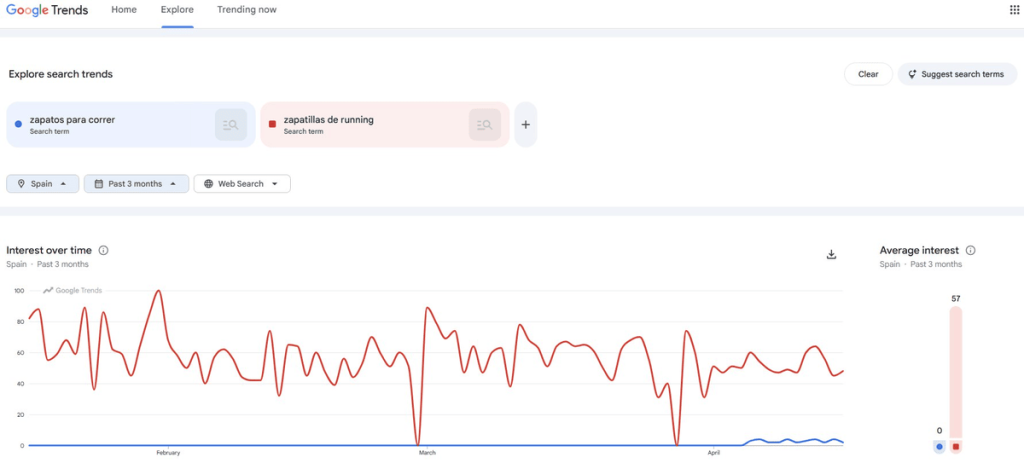
💡 Pro tip: keep a keyword glossary to enforce consistent, high‑impact terminology across all localized content.
Decide on the URL Structure
Selecting a correct URL structure is a critical architectural decision in any multilingual SEO strategy. That’s because your structure must clearly signal language (and optionally locale) to search engines, prevent duplicate‑content conflicts and remain scalable as you expand.
Most companies go for one of the three options below, each with distinct operational and SEO implications.
- ccTLDs (e.g., yourwebsite.fr, yourwebsite.de) offer strong geo‑targeting and localized hosting but require managing multiple domains and building authority separately, high cost and high complexity. Worth noting: some ccTLDs have local registration requirements (Germany’s .de, for instance, requires a local administrative contact), so you may not be eligible to register them at all and competing without the local domain puts you at a structural SEO disadvantage from the start.
- Subdomains (e.g., fr.yourwebsite.com) provide clearer separation but behave like independent properties, diluting SEO equity.
- Subfolders (e.g., yourwebsite.com/fr/) are the recommended enterprise configuration. They consolidate authority under one domain, simplify governance and support flexible language‑ or locale‑targeting without fragmenting SEO performance.
Whatever you choose, keep your URLs easily identifiable and structurally predictable. They should be as short as possible, human‑readable and consistently formatted across markets, whether you localize them or standardize them in one language.
Example: IKEA operates one of the most strategically engineered multilingual URL architectures in enterprise e‑commerce. Instead of fragmenting SEO equity across separate country domains (like ikea.fr or ikea.de), they centralize authority under a unified domain and deploy a disciplined subfolder framework (for example, ikea.com/fi/fi).
Other URL Best Practices
- Use only ISO language codes (en, es, fr).
- Try not to include encoded characters that inflate non‑Latin URLs (for languages like Greek or Arabic) and erode trust.
- If you’re considering locale‑specific versions, introduce them only when markets differ significantly in terms of legal requirements, pricing structures, cultural nuances or product assortments. If the experience is uniform across a language group, a single language version is enough. Start with language‑only folders and introduce locale‑specific versions only when data proves the need.
Apply the Right Hreflang Tags
Hreflang tags are a critical control layer for multilingual SEO, ensuring search engines deliver the correct language‑ and region‑specific version of a page to your audience. For big websites, where content is replicated across dozens of markets, proper hreflang governance prevents duplicate‑content conflicts, consolidates ranking signals and protects international visibility.
The first step when implementing hreflang tags is choosing the hreflang format and codes.
Use language codes and optionally region codes following these examples:
- Language only: en, ro, de, es
- Language + region: en‑gb, en‑us, es‑es, es‑mx
You should always use lowercase (en‑gb, not EN‑GB) and only valid and recommended codes.
Next, apply one of three supported locations:
| Location | Example | Best for |
|---|---|---|
| HTML <head> | <link rel="alternate" href="https://yourwebsite.com/de" hreflang="de" /> | Mid‑sized sites where you can control <head>, like custom CMS or SPA frameworks |
| HTTP headers | <https://yourwebsite.com/de/>; rel="alternate"; hreflang="de“ | PDFs, apps or non‑HTML resources (used only when HTML isn’t an option) |
| XML sitemap | <xhtml:link rel="alternate" hreflang="de" href="https://yourwebsite.com/de/" /> | Large sites where template‑level code is hard (e.g., legacy CMS, multisite setups) |
Other Hreflang Best Practices
- Add x-default to define a fallback for users whose language/region doesn’t match any of your variants:
<link rel="alternate" hreflang="x-default" href="https://yourwebsite.com/en/" /> - Keep self‑referencing and canonical hygiene
Each indexable page should include its own hreflang (e.g., the English page points to hreflang=”en” of itself). - Canonical: The canonical on indexible pages should be self-referencing.
On the English page, it should look like this and not direct to en‑us or en‑gb if they’re separate :<link rel="canonical" href="https://yourwebsite.com/en/" />
This structure signals to Google that each localized URL is a valid variant of the same content, allowing ranking equity to flow across markets.
After implementation, a technical audit should validate syntax and highlight the failure points that quietly undermine the whole setup. This is where JetOctopus adds real operational value: its Crawler flags hreflang issues directly in the Indexation report, giving you a clear, actionable view of exactly what’s broken and where.
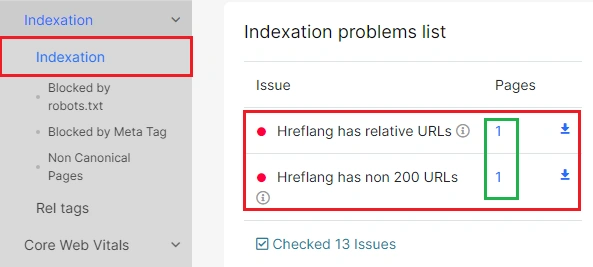
The failure points it catches are precisely the ones most likely to go unnoticed:
- Relative URLs: search engines ignore relative paths in hreflang attributes, so alternate language mappings silently fail to register. JetOctopus flags these so you can resolve them before they affect indexing.
- Non-200 URLs: any broken or redirected URL in your hreflang chain cuts off indexing authority, leaving localized pages orphaned. JetOctopus surfaces every instance, showing exactly where the chain breaks.
- Non-indexable URLs: a noindex tag on a localized page quietly overrides your entire hreflang setup, which is often why specific language versions vanish from SERPs without warning. JetOctopus exposes these conflicts directly.
- Invalid language/region codes: incorrect codes cause search engines to serve the wrong version to the wrong audience, undermining both relevance and user experience. JetOctopus pinpoints each invalid code so nothing slips through.
Translate and Localize Content
A high‑performance multilingual SEO strategy should go beyond translation. It requires disciplined, culturally aware localization executed for every detail.
| Translation Approach | Best For | Advantages |
|---|---|---|
| Machine learning or AI tools | Low-visibility or high-volume content: press releases, announcements, support articles, technical documentation | Massive scalability at low cost, Fast rollout, Improved SEO coverage |
| AI tools + human editing | Content requiring precision: product descriptions, knowledge bases | Accuracy of translation, Preserve nuance, Adapt elements like measurements, currency, date formats, idioms and tone |
| 100% human translation | Brand sensitive assets: homepages, landing pages, campaigns, SEO-driven articles | Maintain trust and credibility, Preserve brand personality, voice and style, Meet user expectations in each market |
Extend translation beyond on‑page copy. Fully localize metadata: titles, meta descriptions, URLs, image alt text, structured data and all interface elements, including forms, error messages and checkout flows. Pair this with local keyword research to align content with real search behavior rather than direct dictionary equivalents.
Go further by adapting content to cultural norms, market priorities and platform preferences.
Example: An article targeting U.S. audiences might naturally reference Facebook, Instagram or X, but those platforms have little to no traction in markets like China, Japan or Thailand, where WeChat or LINE dominate. Simply translating a piece that says “share this on Instagram” for a Chinese audience is ineffective and signals that the content wasn’t written for them.
Product messaging should also shift accordingly: value and durability for budget-conscious markets, premium quality and craftsmanship for luxury-oriented ones and so on.
A best‑practice approach is to design your content to be as globally adaptable as possible from the start: write clearly, avoid idioms and structure information so it can be efficiently adapted. This ensures every localized version performs, resonates and converts across global markets.
Avoid Duplicate Content
Duplicate content undermines multilingual SEO by diluting authority signals and forcing crawlers to choose between competing versions, often at the expense of your global visibility.
Let’s say you deploy three regional versions (US, UK and Australia) of the same product page: identical body copy, with only currency, a local phone number and a shipping‑policy paragraph changed. Functionally, these pages are clones.
Googlebot crawls them, sees near‑duplicate content across hreflang variants and decides the weaker pages don’t deserve independent indexing. Suddenly, your AU traffic is landing on the UK version or not landing anywhere at all.
In a real Shopify audit, nearly 400 URLs were flagged in Search Console for “Duplicate, Google chose different canonical than user.” Their US‑targeted URLs existed in name only; with no meaningful content differentiation, Google ignored the declared canonicals and collapsed everything into the primary version.
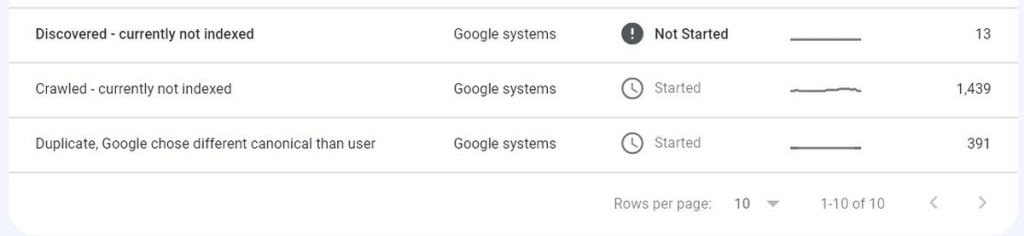
That’s why removing duplicated pages helps search engines consistently deliver the correct language‑ or region‑specific pages, strengthening relevance, engagement and conversion performance. It also consolidates link equity into the pages you actually want to rank, preventing issues like suppressed rankings or accidental deindexing.
JetOctopus helps you manage duplicate content across multilingual environments with enterprise‑grade precision. It provides full visibility into cross-language duplication before it erodes rankings.
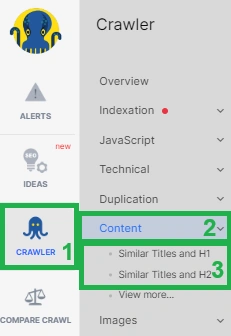
The built-in duplicate title and content analysis modules pinpoint exactly where multilingual deployments introduce duplication risk, at scale and across every market.
Detect pages sharing identical <title> tags or meta descriptions regardless of their language path, whether that’s /en/, /de/ or /fr/. Normalized text comparison goes deeper, flagging pages that are functionally identical despite minor wording variations, like the same template deployed across different language-code paths.
Develop a Backlink Expansion Plan
Backlinks act as authority signals and in multilingual search, they also validate that your localized pages are legitimate, high‑value versions, not thin translations. To compete in each region, you must earn links from relevant, authoritative sites in the target language and market, not generic global domains.
- Analyze the competitive landscape in every locale. Check regional competitors’ backlink profiles to identify high‑authority blogs, news outlets, directories and industry platforms already linking to similar content. This is a sure way to create your list of sites that have proven willingness to reference your niche and are strong candidates for linking to your localized assets.
- Prioritize language and niche‑aligned domains. A French fitness blog linking to your French supplement page is far more valuable than a random high‑DR site in another language. Local influencers, publishers and community hubs can accelerate trust and visibility, especially in markets where cultural context drives engagement.
- Build localized outreach campaigns: pitch region‑specific content, contribute guest articles, participate in local events and set partnerships with reputable publishers. Plus, consider creating link‑worthy assets, like tools, resources, data studies or market‑specific content that naturally attract citations.
Examples: Buffer’s State of Remote Work Reports of Adobe’s various reports, which are frequently cited in academic, business and industry research.
Conclusion
Multilingual SEO is what determines whether your site earns organic visibility in each target market or invisibly allows your local competitors to earn it. A well-implemented multilingual SEO strategy ensures the correct URL ranks for the correct query in the correct country, with the right signals in place to make search engines confident about which page to serve where.
Every step above is load-bearing: the right URL architecture protects authority, disciplined hreflang ensures search engines serve the right version to the right audience and localized content paired with targeted link building converts international visibility into revenue. Miss one layer and the others underperform.
If your business operates across dozens of markets, the cost of misexecution is measurable in lost rankings, diluted equity and markets that never reach their potential. Governance, auditing and continuous monitoring are what separate strategies that sustain performance from those that quietly deteriorate.
JetOctopus is built for exactly this environment. From hreflang validation and cross-language duplicate detection to GSC-integrated traffic analysis and log-file intelligence, it gives SEO teams the visibility to catch problems before they come up in rankings and the precision to scale multilingual performance with confidence.