JetOctopus 2025: Everything We Shipped and What’s Coming in 2026
Search is changing faster than ever – and 2025 was the year that made it impossible to ignore. AI tools are crawling your site, training on your content, and generating answers that either include or exclude your pages. At JetOctopus, we spent the second half of 2025 building the features that help technical SEO teams stay visible, stay in control, and stay ahead.
Here’s a full breakdown of everything we shipped in H2 2025 – and a clear look at where we’re heading in 2026.
By the Numbers: JetOctopus Today
- 35,000+ websites crawled
- 10 billion pages analyzed
- 380 billion log lines processed
- 294 crawl charts, 70 log charts, 104 GSC charts
A Quick Look Back: The Full 2025 Delivery
Before diving into H2, here’s the complete picture of what JetOctopus shipped across all of 2025:
H1 2025
- AI Internal Linker – the first release of our AI-powered linking tool
- AI Bots Report – initial visibility into AI crawler activity
- Robots.txt Multi-Tool – manage and test robots.txt at scale
- Compare Crawls 3.0 – a major upgrade to crawl comparison
- Compare Crawls 3.0 Trendlines & Change Insights
- Page Blocks – granular page-level analysis
H2 2025
- AI Bots Report
- AI Bots Analytics Dashboard
- Global Search across the JetOctopus platform
- AI Keywords Optimizer
- Fan-Out Searches
- Custom Anchors for AI Internal Linker
- Own AI Token (OpenAI API key integration)
H2 2025: Feature Deep Dives
AI Bots Report
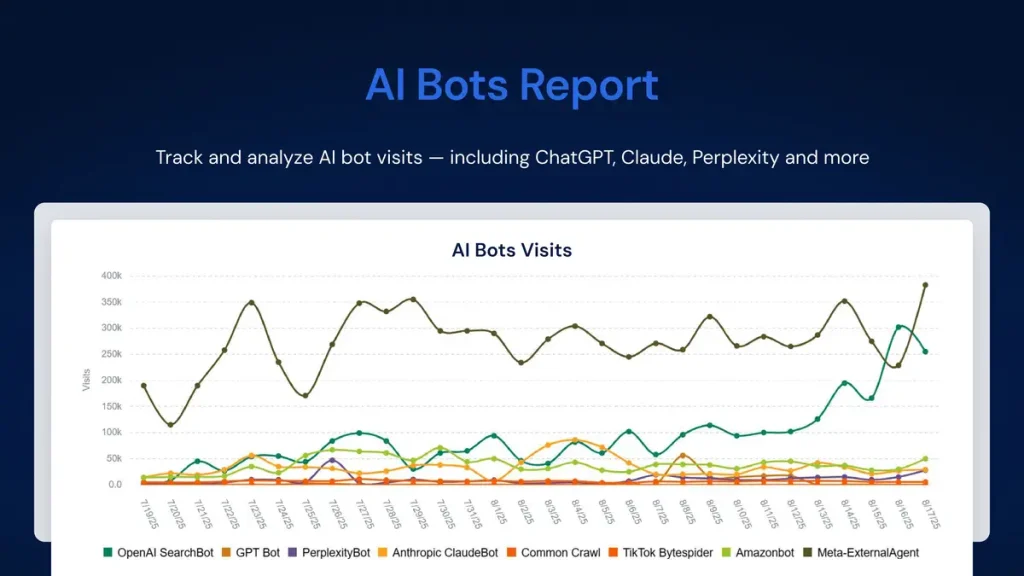
AI tools – ChatGPT, Claude, Perplexity, Amazonbot, TikTok Bytespider, and many others – are now crawling your site regularly. The AI Bots Report gives you full visibility into which bots visit your site, how often they come, and how their activity trends over time.
This matters because AI tools don’t just index your content – they use it to train models and generate search responses. Knowing what they see and how frequently they visit is the first step to optimizing for AI-driven discovery.
AI Bots Analytics Dashboard
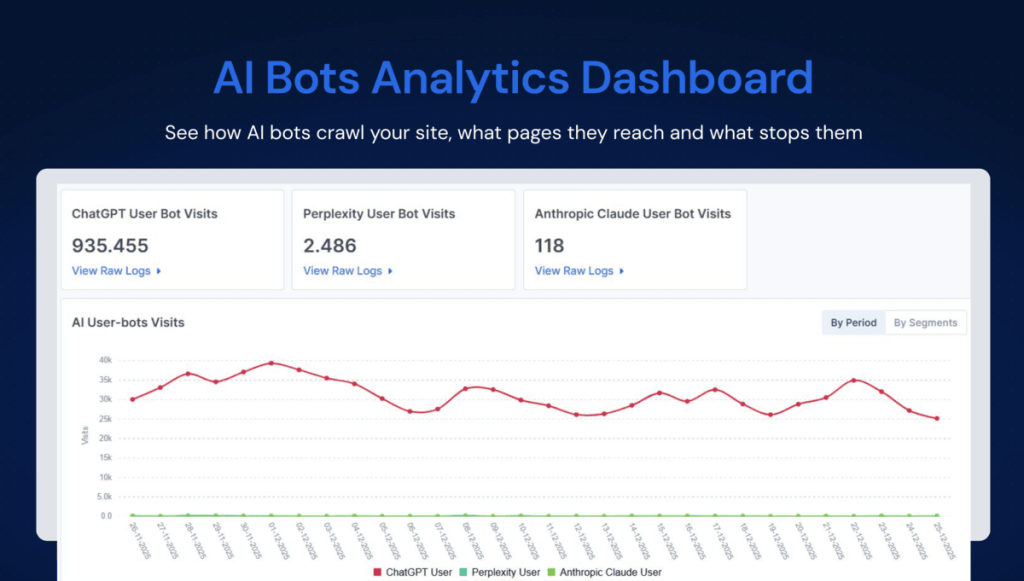
The Analytics Dashboard takes this further with three layers of insight. First, it shows you the AI funnel: how many of your pages are visited by training bots, search bots, and AI user-bots. Second, it breaks down the visit data by specific tools – ChatGPT User Bot, Perplexity User Bot, Anthropic Claude User Bot – so you can see exactly which AI products are sending users to your pages. Third, it surfaces AI Bot Problems: broken pages with 5xx errors, non-indexable pages, redirects, slow load times, hallucinated URLs returning 404s, and pages with duplicate titles.
This is actionable data. Fix the crawl issues AI bots encounter and your content becomes more accessible to AI-driven search.
Global Search — JetOctopus Platform
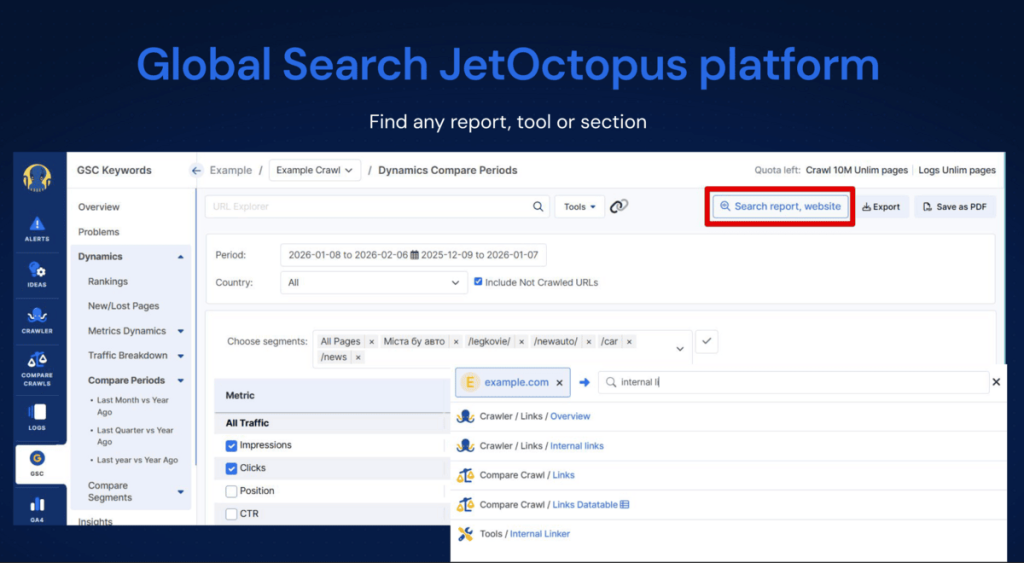
As the platform has grown, navigating across hundreds of reports, dashboards and tools has become a challenge. Global Search solves this with a single search bar accessible from anywhere in the platform. Type ‘internal links’ and instantly find Crawler / Links / Overview, Compare Crawl / Links, or Tools / Internal Linker – with no menu-diving required. This is a quality-of-life upgrade that meaningfully speeds up day-to-day work, especially for teams managing multiple sites.
AI Keywords Optimizer
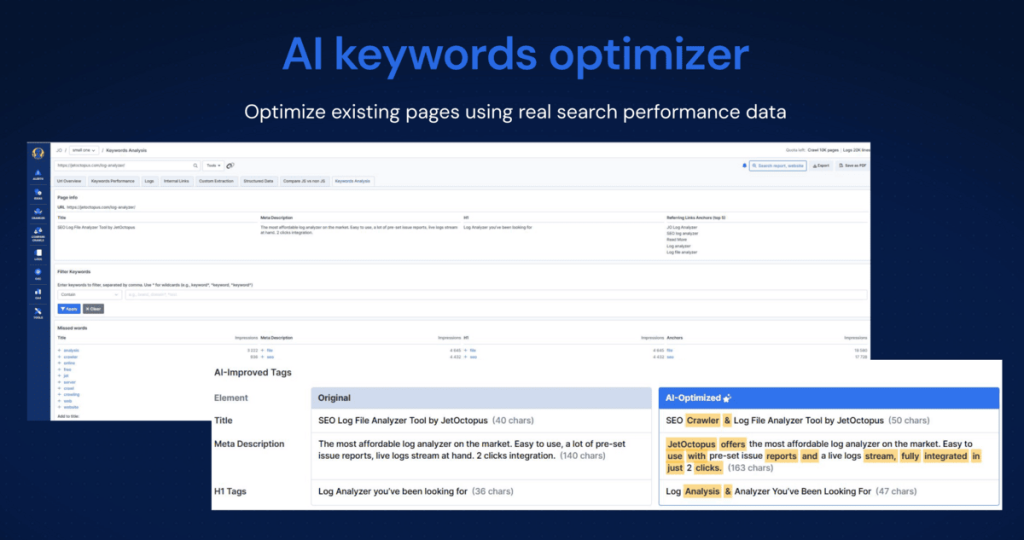
The AI Keywords Optimizer lets you optimize existing pages using real search performance data from Google Search Console. For any URL, the tool shows you which keywords are generating impressions but are missing from your title, meta description, H1, or body. Then, with one click, AI generates optimized versions of all those tags – showing the original alongside the improved version, with character counts and highlighted changes.
The result is a side-by-side comparison of Original vs AI-Optimized tags, ready to export and upload to your CMS. This turns what used to be a slow, manual process into a scalable workflow.
Fan-Out Searches
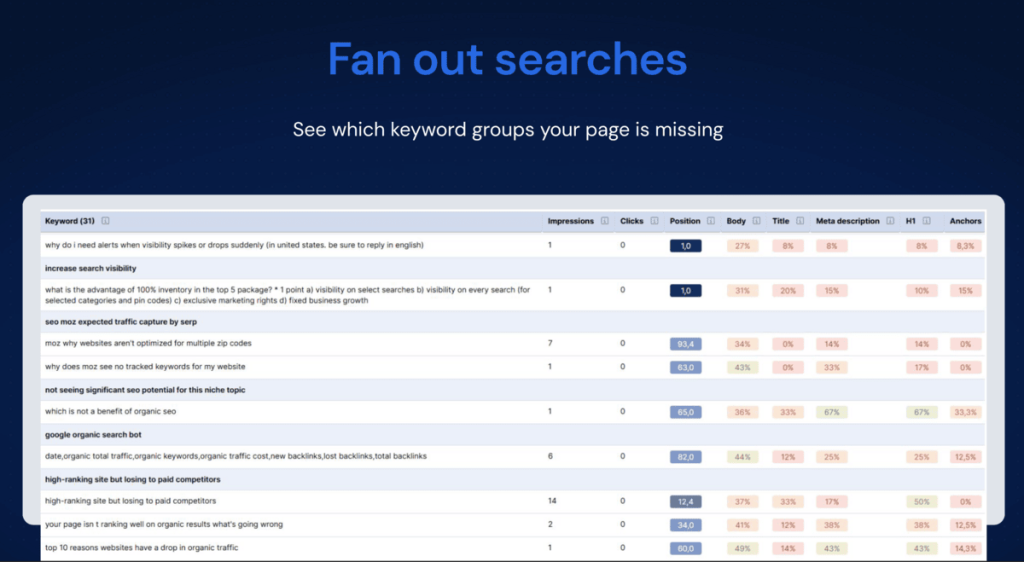
When someone types a question into an AI tool, the model doesn’t search for that exact phrase. It breaks the question down into smaller sub-queries – fan-out searches – and executes multiple searches on behalf of the user. JetOctopus now gives you visibility into these fan-out queries for your pages.
The report shows keyword groups your page is ranking for, along with impression data and how well each term is represented in your title, body, meta description, H1, and anchors. This reveals content gaps you’d never find from GSC alone. Optimizing for fan-out keywords doesn’t just grow your traffic – it improves the quality of answers AI tools can generate from your content.
AI Internal Linker — Crawl Budget Dynamics
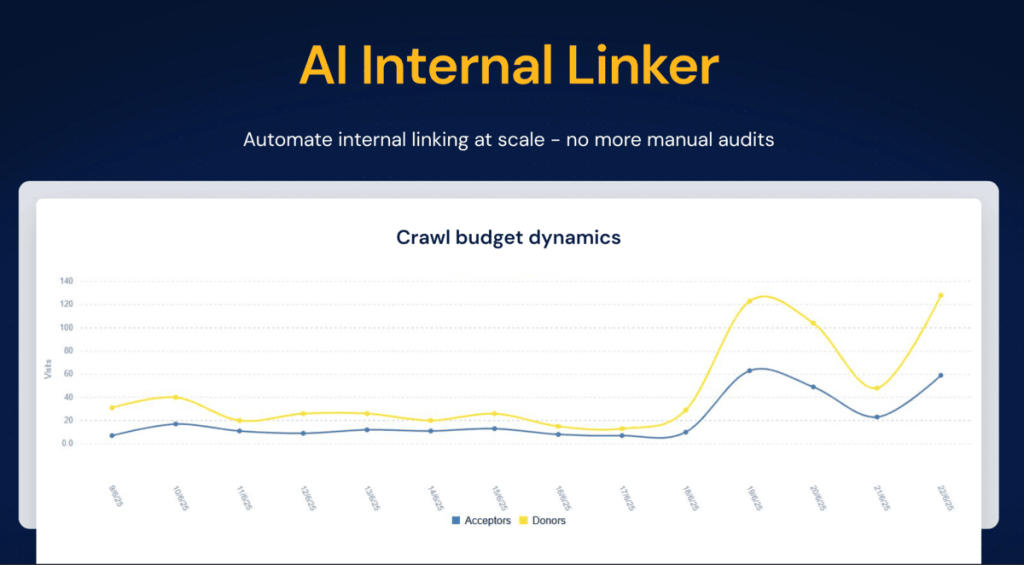
The AI Internal Linker was first launched in H1 2025. In H2, we added a Crawl Budget Dynamics chart that shows the real impact of linking recommendations on bot activity over time. The chart tracks Acceptors (underperforming pages receiving links) and Donors (strong pages passing PageRank) side by side, so you can see exactly how bot visits shift after implementing the linker’s suggestions.
Custom Anchors for AI Internal Linker
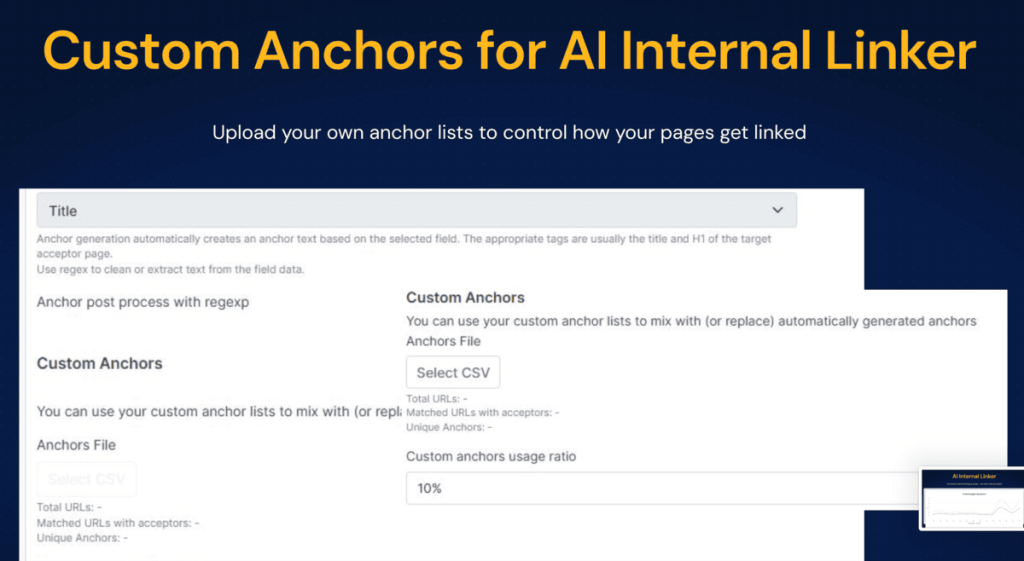
Internal linking isn’t one-size-fits-all. Different sites have brand guidelines, preferred keyword phrasing, or editorial rules around how pages should be linked. Custom Anchors lets you upload a CSV of your own anchor text lists, which the linker will use alongside or instead of automatically generated anchors. You control the custom anchors usage ratio – so you can blend AI-suggested anchors with your own at whatever proportion works for your site.
Use Your Own AI Token
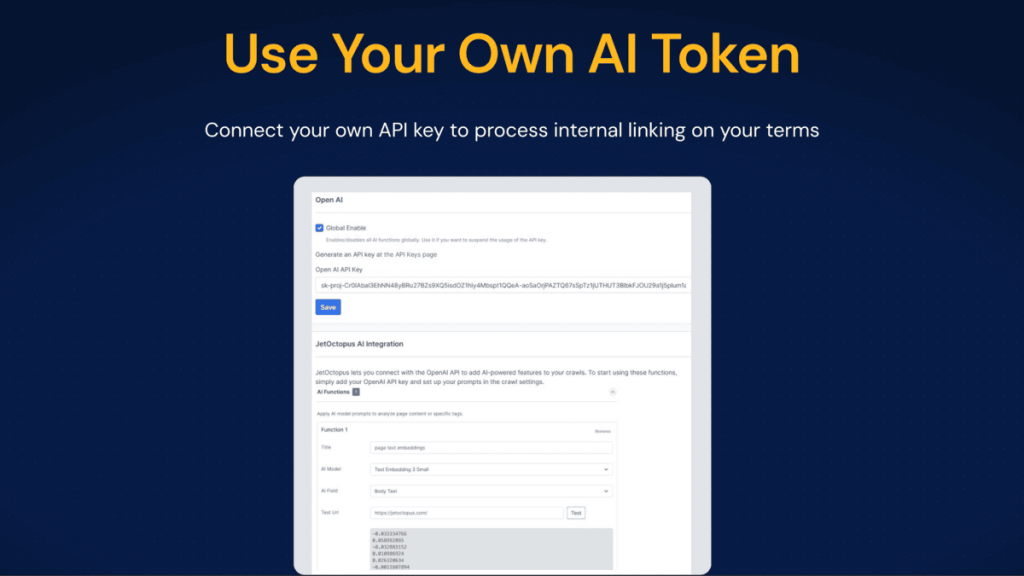
The AI Internal Linker uses AI embeddings to match donor and acceptor pages semantically. By connecting your own OpenAI API key, you process all of this within your own account – saving on usage limits and keeping all AI processing inside your team’s infrastructure. This is particularly useful for large enterprise sites with high page volumes.
Smarter Matching, Zero Empty Results
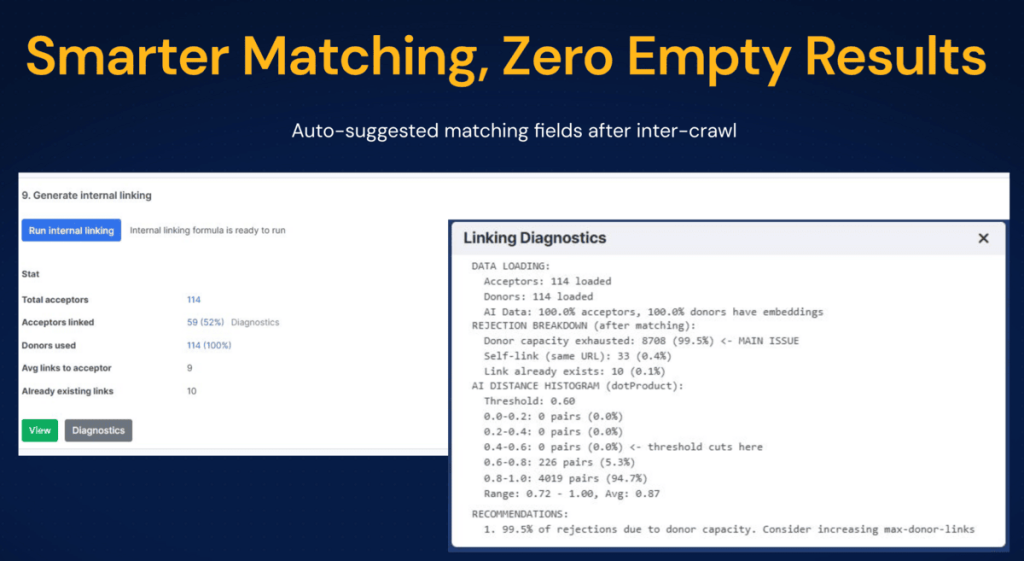
We also improved the matching engine with auto-suggested fields after inter-crawl comparison and a new Linking Diagnostics panel. The panel gives a full breakdown of the matching run: how many acceptors and donors were loaded, what percentage have embeddings, how many links were rejected and why (donor capacity exhausted, self-links, already-existing links), and the AI distance histogram showing the quality of semantic matches. If the tool can’t link all your acceptors, Diagnostics tells you exactly where the bottleneck is and what to change.
Plans for 2026
Search is entering a new era. Organic discovery now happens across Google, ChatGPT, Perplexity, Claude, and other AI surfaces – and each of them has different criteria for what content it finds, uses, and surfaces. JetOctopus is building the platform that gives SEO teams the tools to compete in all of them.
Content & Page Intelligence
Our biggest focus for 2026 is making content fully discoverable across every search surface – traditional and AI. This means three new capabilities:
- Fan-Out Queries Analysis at scale – uncover missing keyword clusters and search intent gaps across your entire site, not just page by page
- AI-Driven Page Optimizer – fine-tune pages for the exact queries AI tools are searching on behalf of users, with updated AI recommendations based on the latest search behavior
- Advanced Content Efficiency Analysis – understand what content is actually driving results, where you’re losing to competitors, and where the highest-impact opportunities are
AI Search Visibility & Automation
The AI bot layer of the platform will get significantly more powerful in 2026. Expanded reports will give deeper insight into how different AI tools interact with your site – not just visit counts, but content usage, crawl depth, and conversion from AI crawl to AI-generated citation. The AI Internal Linker will also continue evolving, with enhanced automation to reduce the manual steps required to implement linking recommendations at scale.
Customer Experience
We’re also continuing to invest in the quality of support and overall platform performance. Faster load times, better onboarding, and more proactive guidance from our team of SEO experts – this remains a core part of how JetOctopus operates.
Ready to see how these updates work for your site specifically? Book a free demo and we’ll walk you through the platform, show you the features most relevant to your project, and help you find quick wins right away.
- Category:
- Product Update

About Stanislav Dashevskyi
Stan is a long-time JetOctopus user and currently is the Head of Customer Success (SEO) of JetOctopus. SEO analyst since 2013, SEO tutor and Tech SEO enthusiast. You can find Stan on LinkedIn.