Over 90% of webpages earn zero organic traffic, while the top five results capture nearly 70% of all clicks. In a search‑driven economy, that gap is a competitive moat.
If your site isn’t optimized, you’re effectively invisible at the exact moment demand is highest. And while paid advertising can buy visibility, it can’t replace the trust, credibility and compounding growth that come from sustained organic performance.
Today’s challenge is that SEO is no longer about keywords and metadata. It’s about building a durable, technically sound foundation that search engines and increasingly, AI-powered tools can crawl, index and trust.
The good news: every challenge is solvable with the right framework and a clear approach to prioritizing what actually moves the needle.
In this article, you’ll learn why SEO is an important growth channel, the technical forces that determine whether your site gets seen and how it translates into real, measurable business growth.
TL;DR
- SEO is the process of making your website easy for search engines and AI agents to find, understand and rank, driving qualified traffic without paying for every click.
- The components of effective SEO need to work in sync: content creation, on-page optimization, technical performance, keyword intelligence, user experience, off-page authority and local search signals where relevant.
- The cost difference between SEO and paid ads: paid traffic stops the moment you stop spending; SEO builds assets that keep generating returns long after the initial work is done.
- Keyword intent determines whether traffic converts. Informational queries attract researchers; transactional ones attract buyers.
- Technical issues, like slow load times, crawlability problems, JavaScript indexing failures and AI bot blockers are silent ranking killers.
- The importance of SEO in business is reflected in visibility, traffic, trust and revenue. Track metrics like conversion rates from organic, customer acquisition cost and customer lifetime value.
- SEO is an ongoing program that gets more efficient over time and the businesses that treat it that way are the ones that end up owning their category in search.
What Is SEO
SEO (Search Engine Optimization) is the process of shaping and optimizing a website so search engines can easily understand, index and rank its content. It’s a structured, ongoing process that enhances a company’s organic visibility across Google’s results pages, driving qualified traffic without relying on paid media.
The Components of Effective SEO
High‑value content creation
Your website should strategically craft assets that address real buyer questions, demonstrate authority and move prospects through the decision journey. A detailed guide with original data, expert quotes and actionable frameworks outranks a 600-word post that restates what every other site already says.
On‑page optimization
All web pages require precise alignment of content, metadata, headings and internal linking to match exactly what your target audience is searching for, so every page earns its ranking.
For instance, a product page targeting “project management software for remote teams” that leads with that exact use case in its H1, breaks down relevant features under clear subheadings and links to a supporting comparison guide will consistently outrank a generic page titled “Our Product” with a vague meta description and no internal structure.
Keyword intelligence
Match the specific language your audience uses at each stage of their search; for instance, “how does CRM software work” attracts researchers while “best CRM for small teams” signals buying intent.
Additionally, be as specific as possible, as “marketing software for small nonprofits” beats “marketing software” due to less competition and higher intent.
User experience
Search engines track how visitors interact with a page, feeding directly into how they evaluate content quality: how long they stay, how far they scroll and whether they click deeper. Visitors who find what they need quickly stick around; those who don’t bounce and Google reads both signals.
Off‑page authority building
Build a portfolio of high-quality inbound links from credible, relevant sources that signal domain authority to search engines and accelerate competitive ranking gains. A Forbes citation or university backlink signals credibility that no amount of on-page work can replicate.
Technical performance
You should avoid structural barriers, like crawlability issues, page speed, Core Web Vitals and schema markup. These prevent search engines from properly indexing and ranking your site. A page loading in 1.2 seconds will consistently outrank an identical one loading in 4.8.
At scale, that diagnostic work requires infrastructure built for it and that’s where JetOctopus can help.
With a cloud-based crawler that processes up to 250 pages per second, it provides unlimited integration with log file and Google Search Console data. Every crawl simulates search engine bot behavior, exposing all technical SEO issues.
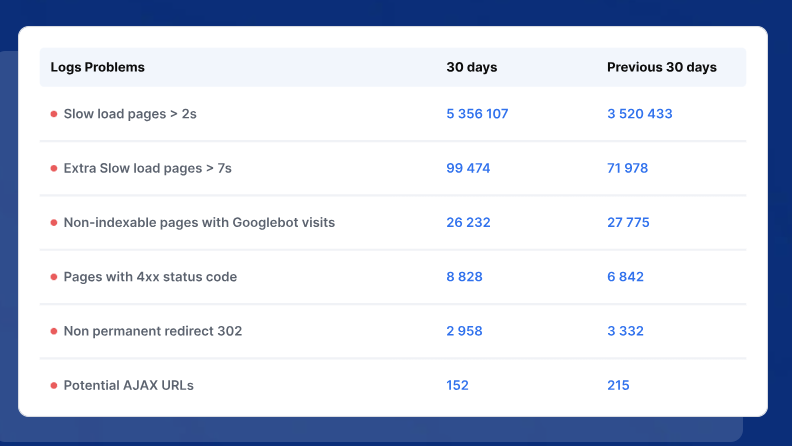
For JavaScript-heavy environments, JetOctopus unifies Field Data from real user interactions with Lab Data from controlled Lighthouse simulations into a single Core Web Vitals workflow. Connect your API key, launch a crawl in minutes and get precise CWV diagnostics across your full indexable inventory or any custom page set.
Local search signals (when relevant)
If your business serves a specific geographic area, local SEO operates as its own ranking system, driven by proximity, consistency and reputation signals. Consistent NAP (Name, Address, Phone Number) details and strong Google Business reviews decide who shows up when someone searches “dentist open Sunday.”
Together, all these elements help search engines evaluate a site’s relevance, expertise and trustworthiness.
While algorithms are complex and constantly evolving, the core principle stays the same: align your content with user intent and present it in a format search engines can interpret. That means understanding what your audience is searching for and delivering it through pages that load fast, are structured cleanly and demonstrate clear authority.
But why should you care about it?
SEO Is The Most Cost-Efficient Marketing Strategy
Globally, 46% of people begin product searches on Google, while 70% of shoppers find a new brand via Google Shopping and increasingly, AI agents are doing that same searching on behalf of users, pulling answers directly from SERPs to fuel their responses. The implication is that a weak or inconsistent SEO strategy leaves a substantial share of potential customers on the table.
In competitive markets, failing to optimize for search means sending off your potential customers to competitors who show up first and look more credible.
SEO Vs Paid Advertising
Most marketing spend operates on a simple, unforgiving equation: the moment you stop paying, the traffic stops coming. Paid ads produce immediate visibility, which is valuable for launches or time-sensitive campaigns, but they build no lasting equity. Cut the budget and the pipeline disappears overnight.
SEO operates on a fundamentally different model. The initial investment covers foundational work: site audits, competitive analysis, keyword intelligence and core on-page optimisation. Results follow a measured but multiplied timeline. Early results from SEO typically appear within 3 to 6 months, with more substantial gains emerging between 6 and 12 months as domain authority builds.
That’s the core distinction. Paid advertising is a rented visibility; SEO builds owned digital assets. High-performing organic pages attract a steady flow of motivated visitors, convert into inbound leads and revenue and grow more valuable with every incremental improvement, long after the initial investment is made.
Why Is SEO Important – The Impact on Your Business
When it comes to how can SEO benefit your business, it starts with visibility and traffic, credibility and ends with revenue performance.
Increased Visibility – Be the Brand that Shows Up First
SEO improves your brand’s visibility as long as your content is placed high in search results, where buyers actively evaluate solutions.
Optimized content that aligns with user queries pushes your business above competitors and into high‑value positions such as featured snippets. As your authority grows through quality content and backlinks, branded searches increase, which is the key indicator of rising trust and market recognition. Consistently appearing at the top of SERPs strengthens credibility, drives qualified traffic and establishes your brand as the default choice in its category.
A DTC sleepwear brand proves the scale of growth achievable, even in a saturated, highly competitive market, when a company commits to a disciplined, SEO‑first strategy. This brand aligned product offerings with search intent and optimized high-impact pages, turning its products into serious revenue drivers.
After just one quarter, the impact was decisive: 6,008 new keyword rankings, a 103% YoY increase in organic revenue, and organic share of total revenue expanding from 36% to 54%.
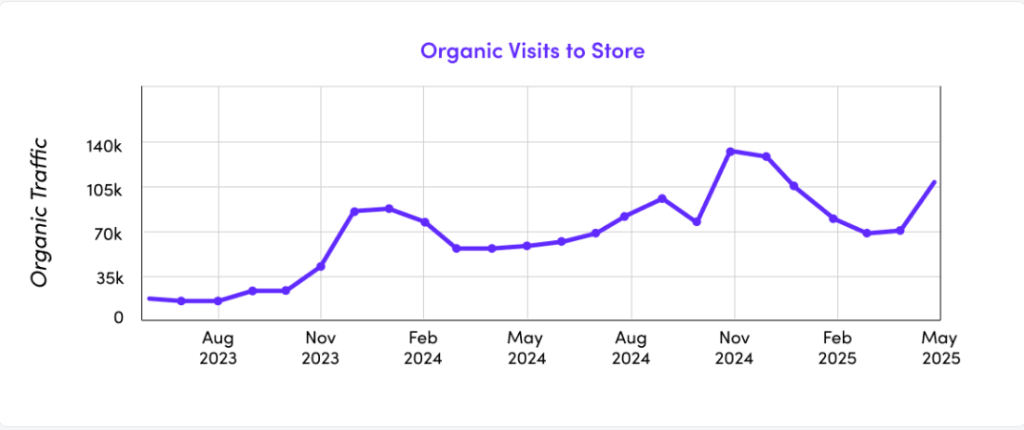
Source: Digital Commerce Partners
However, to sustain your visibility, you need to know exactly what’s driving it, where it’s slipping and what to prioritize next. Google Search Console gives you an overview, but JetOctopus takes things further.
With its GSC Insight Extractor, you can track impressions, clicks, CTR and rankings broken down by device and country, then act on what you find.
A dedicated dynamics section surfaces which pages are growing or declining across every key metric, so high-priority opportunities never stay hidden.
Keyword intelligence is equally comprehensive: monitor new, lost and zero-click keywords alongside winners and losers, with the same granularity applied to pages. Query-length analysis maps how search intent shifts across short and long-tail terms, so you know what you rank for and what’s driving clicks.
Turn High Rankings Into a Traffic Stream
Higher visibility directly translates into traffic: the top organic result on Google is roughly 10x more likely to earn a click than the result in the tenth position and Featured Snippets can push click‑through rates even higher by placing your content above every other listing. For company teams, this is a scalable acquisition channel that evolves in time.
And since 2023, AI search with assistants like ChatGPT, Anthropic and Perplexity, has changed “old-school” SEO.
SEO now also means:
- Structuring content so AI can lift and attribute key facts.
- Building signals that make your site a “go‑to source” (authoritative sections, well‑cited data, clear citations).
For organizations operating across AI-influenced search landscapes, JetOctopus’s AI Dashboard tracks AI bot visits and referral traffic from AI chat platforms and Google’s AI mode. This allows you to pinpoint which content earns attention across both traditional search engines and emerging AI systems and where optimization will drive the greatest impact.
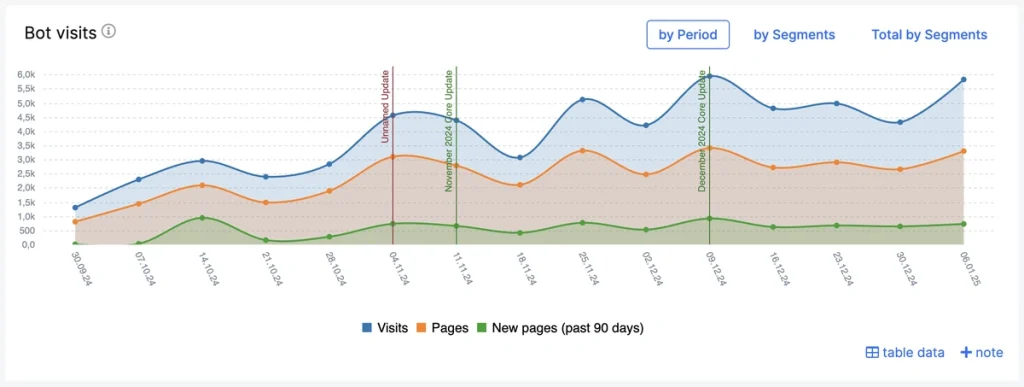
When your pages rank in the top positions for high‑intent queries, you’re meeting users at the exact moment they’re searching for a solution, product or answer, driving traffic that converts at a higher rate.
Here’s how a B2B company turned search visibility into $5.9M in revenue over just 17 months across both traditional search and AI-driven ecosystems.
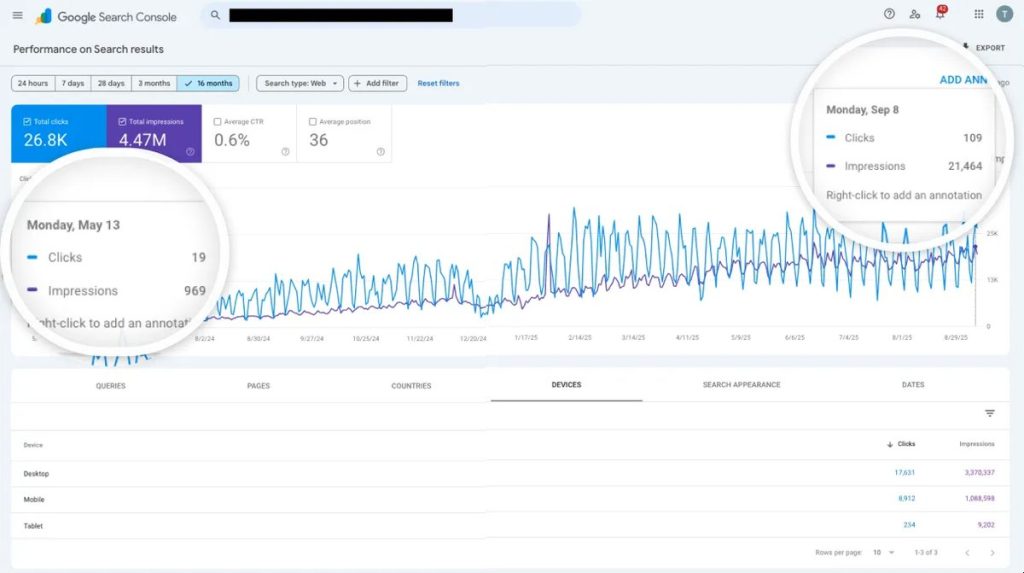
Source: Rankmax
This company combined early AI optimization, strategic content development, and topical authority expansion. The results showed up fast: organic traffic surged from 4,973 to 26,313 users (a 429% increase), with growth accelerating every quarter as authority built on itself.
Elevate Credibility and Authority
SEO boosts brand trust by making your brand consistently visible, credible and validated across the search ecosystem. When your site appears prominently in organic results, especially for high‑intent queries, users instinctively view it as more authoritative. That perception is the outcome of the signals search engines reward: relevance, expertise and technical integrity.
Authority is earned through quality. In practice, that means publishing content that demonstrates expertise, earning backlinks from reputable domains and maintaining a secure, high‑performance technical foundation. These elements align with Google’s E‑E‑A‑T principles, which heavily influence how both users and algorithms evaluate reliability.
For instance, Shopify’s TikTok statistics resource gained over 2,000 backlinks and 1,165 Referring Domains:
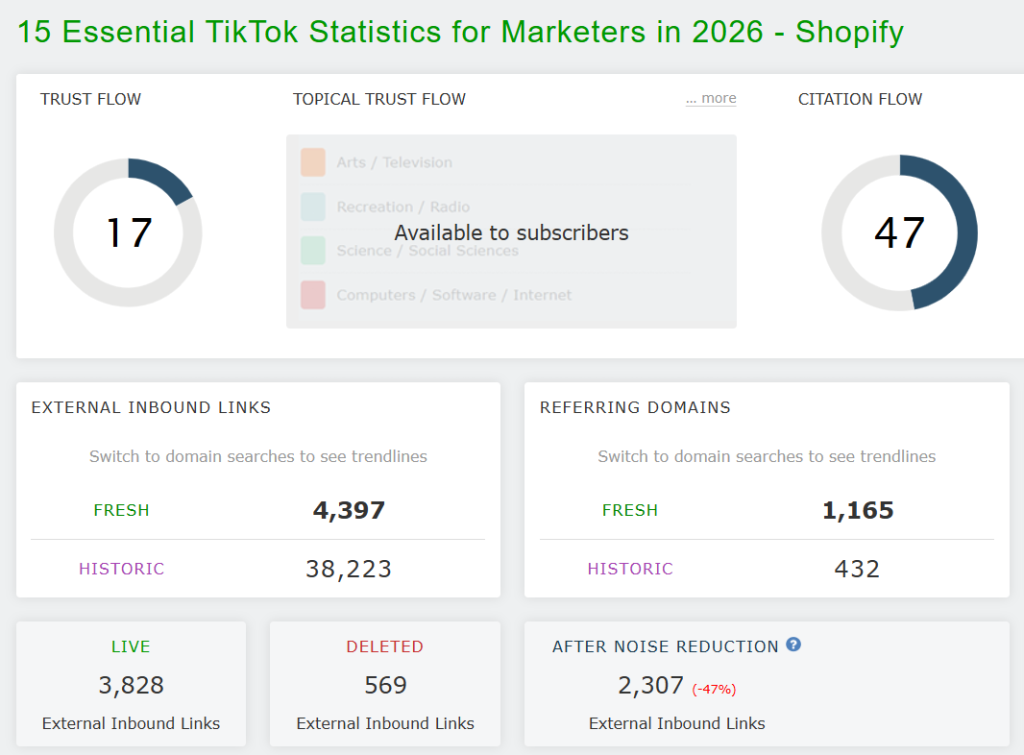
That kind of link equity signals to both search engines and potential buyers that your content is worth referencing. Backlinks from credible domains act as third-party endorsements, leading to a trust profile that’s difficult for competitors to replicate quickly.
Get Higher Returns Over Time
When visitors are already searching for your product or solution, this naturally lifts conversion rates. Ranking across multiple commercial keywords expands your presence throughout the buying journey, increasing the number of touchpoints that lead to a sale.
ROI improves because SEO lowers customer acquisition costs over time. Organic clicks don’t require ongoing budget and the assets behind them: content, backlinks and technical enhancements continue to appreciate as your site gets more authority.
Here’s how the numbers bear this out in practice. Since implementing JetOctopus, OMcollective has delivered measurable SEO and operational gains across its client portfolio, specifically for Puratos across 60+ global websites.
- +103% Growth in Impressions – by correlating Googlebot crawl behavior with Google Search Console data, OMcollective exposed indexation gaps and crawl inefficiencies, lifting visibility across every targeted page.
- +38% Growth in Active Users – automated alerts enabled the team to resolve technical issues (broken pages, slow load times) before they impacted users, directly improving retention and engagement.
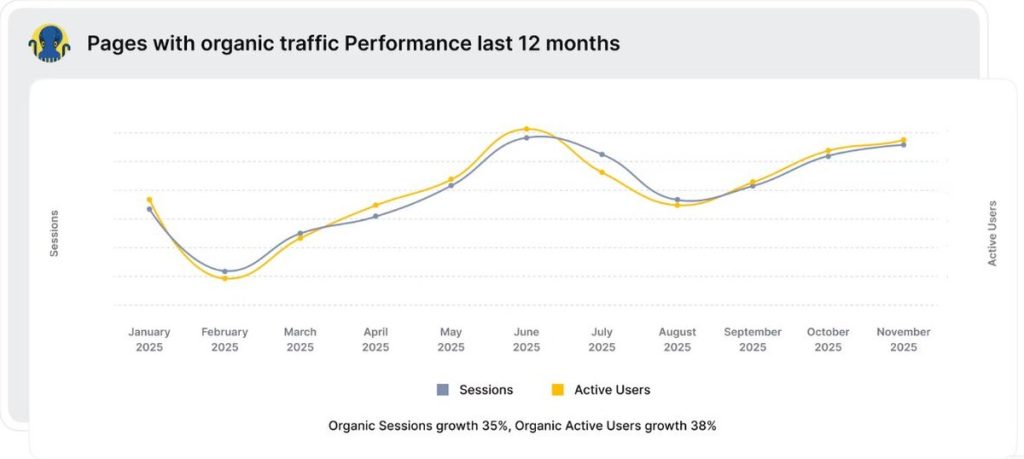
Industry benchmarks reinforce the impact: SEO leads can convert at dramatically higher rates than outbound efforts, underscoring why ranking for high‑intent queries consistently delivers stronger long‑term return.
Specifically, here are some metrics you can track:
| Metric | What to Track | Beginner Benchmark | When It Drops |
|---|---|---|---|
| Organic traffic and keyword rankings | Total organic sessions, rankings for your target keywords CTR from Google Search Console – broken down by page and device | Flat or slow movement in the first 3 months. Consistent growth from month 4 onward (even if month-over-month signals are modest, it shows the program is working). | Rule out a Google core update by checking JetOctopus. It will reveal if rankings fell on specific pages, cannibalization, thin content or recent on-page changes. If traffic dropped but rankings held, the problem is CTR: review your meta titles and descriptions for pages losing clicks. |
| Leads, sales and conversion rates from organic | Form submissions, calls, trials and purchases coming from organic search. Segment by landing page to see which content actually converts. | Organic conversion rates vary widely by industry. 2 to 4% is a reasonable baseline for B2B. E-commerce typically sits at around 1 to 3%. If you’re well below that, the traffic may not match buying intent. | Check whether the pages driving traffic are informational rather than transactional. Ranking well for “what is CRM software” will never convert like “best CRM for small teams.” If intent is right but conversions are still falling, audit the page experience: load time, CTA clarity and form friction are the usual culprits. |
| Customer Acquisition Cost (CAC) | Divide your total SEO investment: agency fees, content production, tooling by the number of customers acquired through organic in the same period. | Organic CAC will likely exceed paid CAC in the early stages. As content matures and begins ranking without additional spend, the cost to acquire each customer through organic gradually declines. | Rising CAC usually means one of three things: your content ranks but doesn’t convert, your close rate on organic leads has dropped or your investment increased without a matching rise in customers. Audit which pages are generating leads versus which are generating traffic only. If high-traffic pages produce no leads, they’re targeting the wrong intent (either re-optimize them for commercial queries or accept them as top-of-funnel only and build conversion paths downstream). |
| Customer Lifetime Value (CLV) | Average revenue per customer multiplied by average customer lifespan, segmented by acquisition channel. Organic leads should show higher CLV than paid if your content is attracting the right audience. | If your organic CLV is lower than paid, your content is pulling in the wrong audience: people researching, not buying, or buyers who churn faster because expectations weren’t set correctly. | Review which keywords are driving new customers and whether those keywords signal genuine purchase intent or just curiosity. Content that overpromises to earn a click and underdelivers after purchase will always show up as declining CLV before it shows up anywhere else. |
This measurement approach gives you a precise view of SEO’s financial impact and long‑term scalability.
Conclusion: SEO Is How You Own Your Visibility and Convert It Into Revenue
SEO is an ongoing tactic that’s important for your online success as it determines whether your business is discoverable when customers are actively looking for solutions. Businesses that keep investing in SEO increase their chances of ranking at the moments that actually drive revenue, spend less to get customers over time, and build a position that’s really hard for competitors to beat.
Start with what’s broken, fix the foundation and build from there. The ceiling on what organic search can deliver is higher than most teams realize, but only for sites that give search engines a clear reason to trust them.
That’s where JetOctopus fits into the picture. Whether you’re diagnosing crawl inefficiencies, monitoring visibility shifts in real time or validating that your pages are being indexed the way you intend, it gives you the diagnostic clarity to act on what actually matters and stop guessing.
Get the fundamentals right, measure what moves and organic growth follows.