Organic search remains massive, driving 53% of all website traffic. Yet the way people discover information has fractured. You’ve probably felt it yourself: you Google less, ask ChatGPT more, trust Reddit for recommendations and you use Claude when you want fast synthesis. Traditional search feels saturated with content seemingly written more for crawlers and less for customers.
So is SEO still worth the investment?
The short answer is yes. But SEO is not worth doing for everyone and definitely not in the way most agencies still try to sell it. By the end of this article, you’ll know exactly which camp you’re in, backed by data, real‑world performance signals and the realities of how search is evolving.
TL;DR
- SEO is worth the investment for most businesses, but only when the economics, timeline and execution quality are understood.
- The ROI case for SEO is structural: no per-click cost, compounding returns over time and a long-term CPA.
- Most businesses see positive ROI within 7–8 months, with 200–500% returns by the second year.
- Technical SEO health is the multiplier most teams underestimate.
- Crawlability issues, indexation gaps and unresolved technical debt silently suppress rankings and erode ROI before anyone notices.
- SEO delivers the strongest returns for B2B SaaS, professional services, local businesses, e-commerce and high-margin industries.
- The hidden cost stack is what most budget conversations miss and underestimating any one of them is the most common reason SEO programs fail to deliver.
The Real ROI of SEO: What the Data Actually Says
Most companies struggle with linking organic traffic directly to closed deals. That’s why they question whether paying for SEO is worth it and wonder how to justify the budget.
Truth is, you can always link traffic to closed deals or revenue as long as you know how to use the right tooling. Proper GA4 configuration and CRM integration, along with other SEO tools, make organic-to-revenue tracking precise and boardroom-ready.
Once attribution is solved, the ROI case for SEO tends to outperform every alternative channel when measured over a meaningful time horizon.
Every channel can acquire customers. The real question is what each customer costs and whether that cost rises or falls over time. Here’s how that plays out.
SEO vs. Paid Search vs. Social Ads — Median CPA
One of the most common concerns that comes up in nearly every SEO investment conversation within companies is “Why choose SEO over paid search, social or other channels?”
The short answer is: paid traffic stops the moment the budget does, while SEO keeps working. Every optimized page, every earned ranking, every structured content asset keeps generating pipeline without ongoing spend. That cumulative effect translates directly into acquisition economics.
Cost per acquisition varies sharply by channel, but the hierarchy is consistent:
- SEO delivers the lowest long‑term CPA (Cost per Acquisition)
- paid search sits mid‑range
- social ads trend higher
However, both paid search and social ads costs can push higher in premium B2B and niche consumer categories.
SEO carries no per‑click cost and once rankings mature, companies see 40–60% lower CPA than paid search, driven by organic traffic and content investments that continue to return value long after creation.
| Channel | CPA Range | Relative Cost | Key characteristic |
|---|---|---|---|
| SEO (Organic search) | 40–60% lower than paid search | Lowest | No cost per click; content grows over time |
| Paid search (Google/Bing) | $23–$54 median($53–$70 in competitive verticals) | Mid | Most predictable engine for high-intent demand |
| Display/Shopping (Google network) | $20–$70+ display$38–$49 shopping | Mid | Wide spread; shopping is more predictable than display |
| Meta ads (Facebook/Instagram) | $18–$40 | Mid-high | Volatile; highly audience-and creative-dependent |
| LinkedIn ads (B2B social) | $100–$125 | High | Precision B2B targeting justifies premium; niche audiences |
| TikTok ads (Short form social) | $260–$750+ | Extreme | Dynamic industry swings; high variance by vertical |
So while paid and social channels trade budget for visibility, SEO converts that same budget into a permanent, appreciating asset.
Beneficial Growth Lives in Long Tail Keywords
Another question that comes up often is: Our competitors are already ahead, can we catch up with them?
In SEO, early doesn’t mean permanent. Rankings shift with content strategy, technical execution and Google algorithm updates. And the most durable path to closing that gap is systematically owning the long tail they’ve overlooked.
94.74% of keywords have monthly search volumes of 10 or fewer. But these micro‑queries collectively drive a disproportionate share of qualified traffic.
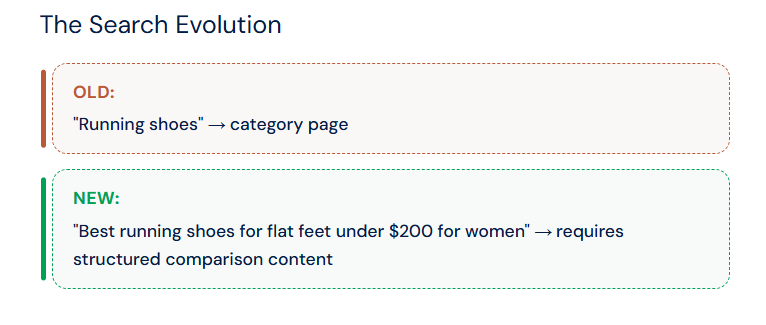
Enterprise datasets show that while head terms dominate visibility, real revenue comes from the hundreds of hyper‑specific phrases each page naturally accumulates, often with zero reported volume. These long‑tail queries (“best X for Y in [city]”) carry sharper intent, lower competition and materially higher conversion rates.
One real example: Northeast Medical Group achieved 84.4% of their total site traffic from a single article that also ranks for an outstanding 34.9K keywords, by abandoning broad health topics and shifting to hyper-specific long-tail queries.
They realized ranking for generic terms like “blood sugar” was unrealistic, so they targeted long tail keywords and questions, like “what is the normal range for blood sugar” and “normal blood sugar levels.” The queries had lower competition, higher intent and matched exactly what patients were already asking.
The Battleground for AI Visibility
This long-tail advantage is becoming even more relevant as AI search evolves. AI agents now generate fan-out queries, taking a single user prompt, inferring the sub-intents behind it and expanding it into several related searches running in parallel.
A query like “best project management software for remote engineering teams” might silently branch into sub-queries like:
- “does it integrate with GitHub and Jira?”
- “what is the per-seat cost at 50 users?”
- “is it SOC 2 Type II certified?”
The agent then re-ranks candidate pages by topical focus and trust signals, synthesizing a final answer that cites only the most relevant supporting pages, often showing a wider, more diverse set of results than classic search.
When SEO Starts Paying Off
Across recent 2025–2026 analyses, businesses see the first results from SEO within 6–12 months, with most enterprise programs registering ROI around the 7–8‑month mark.
Independent ROI studies show 80–85% of organizations see positive returns in that timeframe, with many teams reporting a median 200–500% ROI by months 12–24 once rankings settle and organic traffic becomes more predictable.
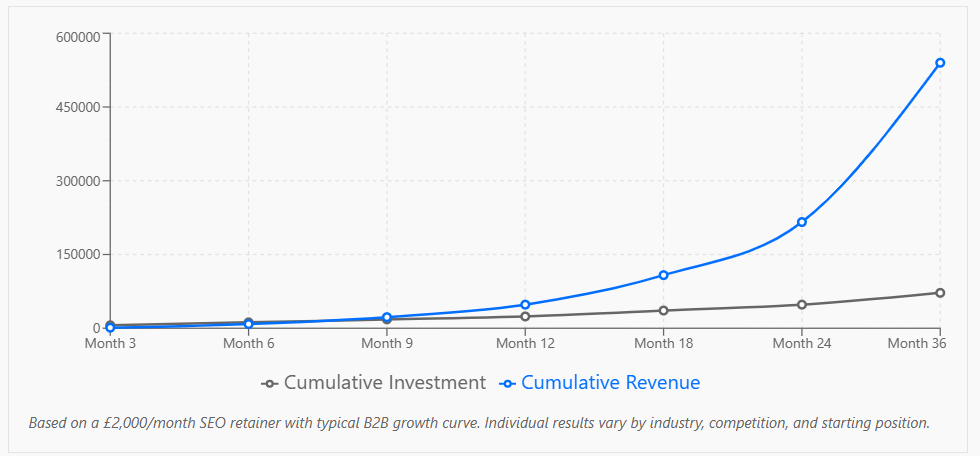
But execution velocity matters: focused B2B SaaS and local service programs can achieve ROI in 4–6 months, while high‑competition or long‑sales‑cycle sectors, like legal, higher education or enterprise technology, typically require 12–16 months to turn profitable.
So the strategic takeaway is to plan for a 6–12‑month breakeven horizon, with year‑two ROI accelerating sharply as organic visibility grows and marginal acquisition costs drop toward zero.
How Technical SEO Health Determines SEO ROI
Ranking potential means nothing if Googlebot can’t crawl, render and index your pages correctly. Crawlability and indexation issues affect between 30–60% of website pages at any given time, silently suppressing the rankings you’re investing in to build.
For enterprise SEO teams, sustainable returns come down to one thing: tooling that shows you exactly what search engines see. JetOctopus runs cloud-based crawls at up to 250 pages per second, storing full crawl data across up to 10 simultaneous crawls, surfacing status codes, redirect chains, JavaScript rendering, page depth and sitemap coverage across 100+ filters and 20+ reports.
Detect crawl issues with log files
JetOctopus also integrates your server log files to show exactly how Googlebot behaves across your architecture. You can compare crawled pages against high-value pages, identify internal linking gaps and pinpoint if crawl budget is being wasted on low-priority pages, non-canonical duplicates or tech URLs.
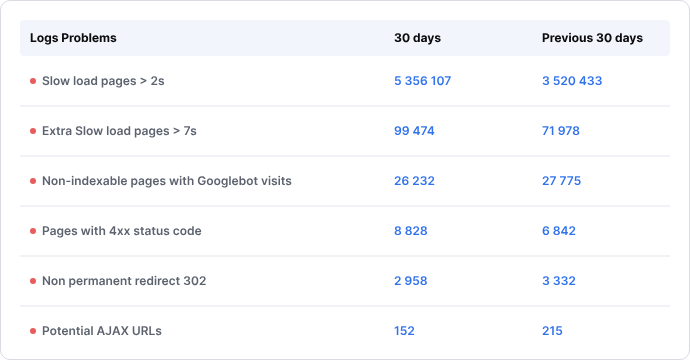
Fixing crawl budget waste is one of the highest-leverage technical moves available to enterprise SEOs and log analysis is the only way to do it with real precision because every page Googlebot skips is a page that never reaches a user.
The same logic extends to AI crawlers. Bots like GPTBot and ClaudeBot move more slowly than Googlebot, but they’re indexing pages, so they can pull them into the AI answers read by millions. That means every low-value page they crawl is a missed opportunity to get your most useful content in front of that audience, which makes crawl budget management just as critical for AI bots.
For instance, OMcollective used JetOctopus to shift from reactive to proactive SEO, uncovering a critical anomaly: Ahrefs Bot was crawling Puratos’ sites at a higher rate than Googlebot itself.
A single robots.txt update fixed it. The results:
- +103% growth in impressions
- +25% growth in clicks
- +38% more active users
Turn link equity into performance
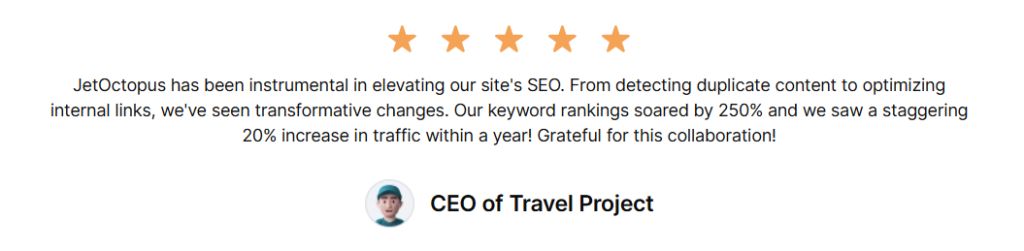
Most audits stop at link counts. JetOctopus maps donor and acceptor pages using GSC, log data and technical metrics, so equity decisions are grounded in real performance data. In one travel industry project, fixing broken sitemaps and underlinking delivered:
- 787% growth in internal links
- 800% growth in traffic potential
- 250% surge in keyword rankings
Its AI-powered internal linker automates this at scale, identifying underperforming pages and high-authority pages that aren’t passing equity, then showing contextually relevant opportunities based on actual content and performance data.
Core Web Vitals at the page-type level
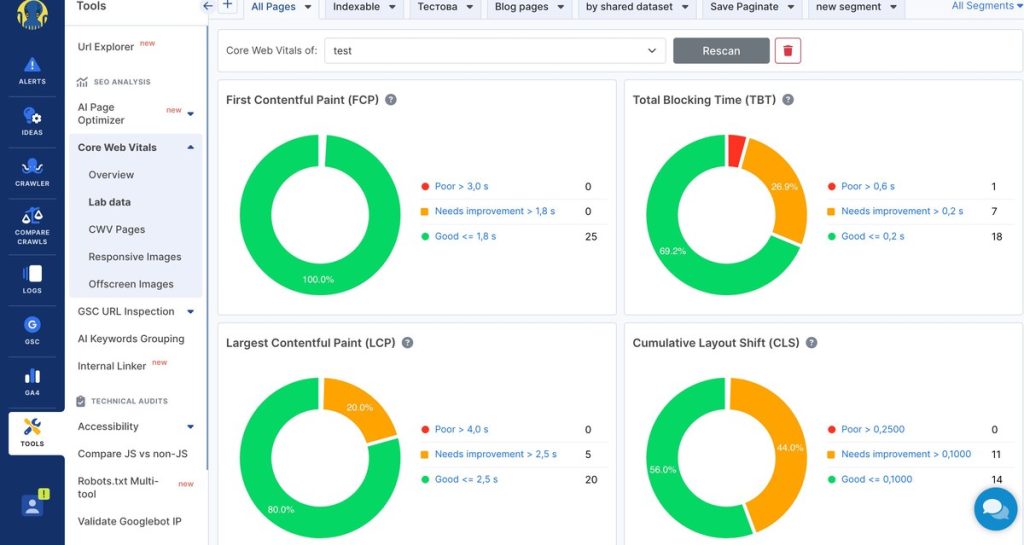
Bulk CWV analysis via Google’s PageSpeed API, overlaid with CrUX field data from GSC, lets you segment failing pages by folder, template or category and address systemic issues.
For multilingual and multi-location SEO architectures, hreflang-aware audits catch broken alternate tags and 404-pointing targets before they cascade across markets.
SEO ROI scales with technical execution quality. The teams consistently outperforming benchmarks run cleaner, more crawlable, more efficiently structured sites and the right infrastructure is what makes that possible.
SEO Is Worth It For These 5 Business Types
SEO delivers the strongest long-term ROI for organizations that depend on high-intent, research-driven buyers, especially when paying for every click is no longer sustainable.
Based on 2025–2026 performance data, the following business types see the most meaningful returns from sustained organic investment:
1. B2B SaaS & IT Services
Prospects actively search for solutions, which makes SEO a primary demand-capture channel. These sectors often achieve around 700%+ ROI over three years with breakeven in 7–10 months.
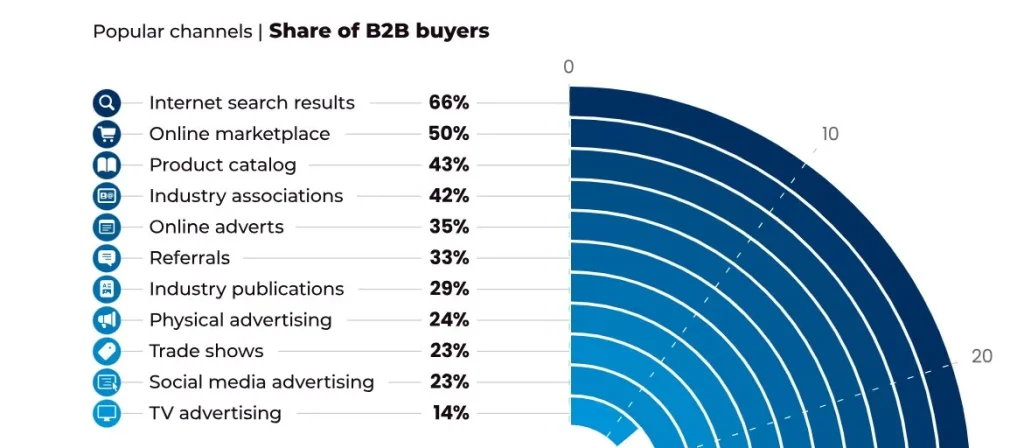
The mechanics here are precise: B2B SaaS buyers run an average of 12+ searches before contacting a vendor and organic rankings dominate the research phase of that journey.
The highest content wins are bottom-of-funnel comparison and alternative pages (“X vs Y”, “best [category] software”), which capture buyers already in evaluation mode and convert at 2–4x the rate of informational content.
2. Professional Services
Law, accounting, consulting, architecture and similar fields benefit from high-intent searches. SEO drives premium leads at a far lower cost than paid search, where CPCs in legal alone routinely exceed $50–$200 per click.
The strategic edge in professional services is E-E-A-T as a competitive moat. Google’s quality raters apply heightened scrutiny to YMYL (Your Money or Your Life) content, which means firms with verifiable credentials, named authors and genuine expertise baked into their content architecture rank at a structural advantage over generic agency-produced content. This is one of the few niches where brand authority directly translates to ranking ability.
3. Local & Service-Based Businesses
Medical, home services, legal and personal-care providers see fast ROI, often 5–10 months, because local visibility directly converts into booked appointments.
The local SEO stack in 2025–2026 is more technical than most practitioners realize. Google Business Profile (GBP) is now a ranking system of its own; review velocity, response rate, photo freshness and service attribute completeness all function as direct ranking signals in the Local Pack.
Businesses that treat GBP as a set-and-forget directory are leaving top-three positions on the table.
4. E-commerce & DTC
Category pages and product-led content deliver about 300% ROI over time, though breakeven may take 12–16 months in competitive markets.
The architecture decisions made at launch define the ceiling. The most impactful advantage for e-commerce SEO is faceted navigation and crawl budget management. Large catalog sites generating thousands of parameterized URLs from filters (color, size, brand) are routinely cannibalizing their own rankings and wasting Googlebot crawl on zero-value pages.
A well-implemented noindex strategy on facets can produce double-digit ranking improvements within a single crawl cycle.
5. High-CPA / High-Margin Industries
Finance, insurance, legal, medical devices and higher education see exceptional returns: a 12–16-month payback period is easily justified when a single converted lead is worth $10K–$500K in lifetime value.
The core strategic logic is simple: when your paid CPA is $600–$1,000 per lead (as it is in insurance and financial services), organic rankings that deliver the same lead for $40–$80 in allocated content and technical costs produce 10–30x cost efficiency within 18–24 months.
The numbers basically say that avoiding SEO is an expensive decision.
When Investing in SEO Isn’t A Wise Decision
SEO isn’t the right investment for every organization and in some cases, it’s the wrong move entirely. The following scenarios consistently underperform in 2025–2026 ROI analyses:
Hyper-niche B2B with an extremely small TAM (Total Addressable Market)
If your total addressable market is 200 companies, search volume isn’t a meaningful channel. Monthly search volume for your core terms is likely in the single or double digits.
Direct outreach, ABM and intent-data platforms (G2, Bombora, 6sense) will outperform SEO on every metric that matters, so it’s better to invest there.
Trend-driven or viral-dependent products
SEO timelines are measured in months; trend cycles are measured in weeks. If your product’s relevance is tied to a cultural moment, algorithm shift or seasonal spike, you need social, influencer and creator-led distribution. An organic infrastructure will arrive after the wave has passed.
Teams unwilling to invest in content or technical quality
This is the most common failure mode and the most avoidable. SEO done cheaply doesn’t produce mediocre results but rather negative results. And this will reflect into thin-content penalties, crawl waste and damaged domain authority that takes years to rehabilitate.
If leadership won’t fund strong content production, a capable technical team and iterative CRO alongside SEO, the channel won’t deliver ROI.
The Hidden SEO Costs Nobody Talks About
Most SEO budget conversations stop at the agency retainer or the freelancer rate. That’s the visible line item. What rarely makes it into the proposal or the boardroom discussion is the full cost stack: the people, the content output required to compete, the tools and the technical debt that quietly grows in the background.
Before committing to an SEO investment, decision-makers need a realistic picture of what execution actually costs across three dimensions: talent, content production and technical infrastructure.
SEO Talent Costs
The first decision is whether to hire a freelancer, engage an agency or build in-house. Each model carries a different cost structure, capability ceiling and management overhead.
Cost range for SEO Specialists
| Model | Typical monthly cost | Big companies, like e-commerce |
|---|---|---|
| Big companies, like e-commerce | $500–$3,500 | Limited‑scope, SMBs or project‑based work. |
| Agency | $1,000–4,000 | Mid-size companies |
| In‑house SEO | ~$4,000-5,000 | Big companies, like ecommerce |
Content Production Costs
Talent gets the strategy right. Content is what executes it at scale and it’s where budget expectations most often collide with reality. A competitive SEO program typically requires four to eight pieces of optimized content per month at a minimum, which adds up faster than most teams anticipate.
Cost range for SEO writers
| Model | Approx. cost per article |
|---|---|
| Freelance SEO writer | $100–$600 |
| Agency‑managed article | $500–$2,000 |
| AI‑assisted (human‑edited) | $50–$200 per article |
Technical SEO Debt: The Silent Budget Drain
Legacy CMS platforms, like aging WordPress installs, monolithic e-commerce builds, enterprise systems with fragmented URL structures, don’t just create technical SEO problems. They create compounding technical SEO debt that consumes a disproportionate share of every sprint cycle.
Migrating a large site off a legacy CMS can cost $5,000–$150,000+ in development resources. Cleaning up a decade of redirect chains, duplicate content and bloated crawl paths routinely takes 6–12 months of continuous technical work before rankings respond. Every month that debt sits unaddressed is a month of crawl budget wasted, link equity diluted and indexation suppressed.
The calculation most organizations skip: what is the cost of NOT fixing technical debt? For a site generating $2M/year in organic revenue, even a 15% ranking suppression from technical issues represents $300,000 in annual lost revenue, outweighing the cost of fixing the problem.
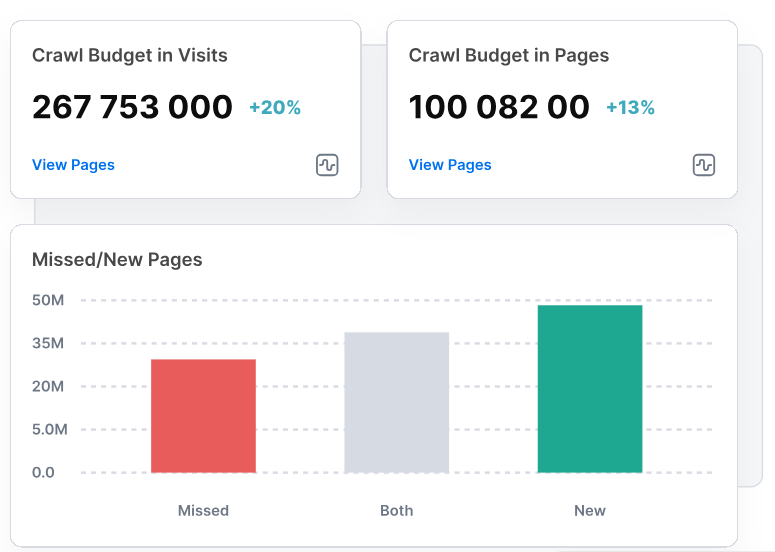
JetOctopus makes that debt visible before it becomes a revenue problem, showing exactly where crawl budget is being wasted, which pages are leaking link equity and how many indexable pages are being silently suppressed, so teams can prioritize fixes by financial impact.
Conclusion: SEO Value Shows Up When the Foundations Are Solid
For businesses with the right profile and the right timeline, organic search delivers lower long-term CPA than any other digital channel, grows in ways paid media structurally cannot and builds an acquisition asset that appreciates over time.
But the conditions matter as much as the channel. SEO doesn’t rescue businesses with short runways and doesn’t produce returns when technical infrastructure is broken. Broken infrastructure is more common than most teams realize: crawl waste, indexation gaps and unresolved technical debt silently suppress rankings long before anyone notices the ROI isn’t materializing.
Platforms like JetOctopus exist to help precisely for these issues, showing you exactly what search engines see, where crawl budget is being wasted and which structural problems are holding your rankings down. Fixing those issues is a direct ROI lever.
SEO is an asset that only appreciates if it’s maintained. The teams abandoning it are making a capital allocation decision on incomplete data and paying for it with a competitor’s year-four advantage.