It started with a Slack message.
Our colleague Stan sent a screenshot with a single line: “Look, I think I found fan-outs in GSC.” The first reaction was skeptical: we hear about the AI revolution every day. But the data looked different. It wasn’t a few random long-tail keywords. It was a pattern, repeating across hundreds of enterprise sites, hiding in plain sight.
We spent two weeks querying terabytes of GSC data to find out what was really happening. What we found wasn’t a small uptick. It was an explosion: a 161% growth in long-tail queries that almost no SEO tool could see, driven almost entirely by AI agents silently reading the web on behalf of their users. This is what query fan-out looks like in the wild. And this is what to do about it.
Key Takeaways
- The Gradient Effect is real: 10-word queries grew 161% in 2025, while 3-word queries grew only 14%. The longer the query, the more likely a machine wrote it.
- “List” is the most powerful trigger: Queries asking for a list generate an average of 49 sub-queries – 14x the baseline. Your “Best of” and comparison pages are the highest-value targets for agentic traffic.
- The CTR signal: If you see high impressions and near-zero clicks (around 2.26% CTR) for long-tail queries, you’re not being ignored – you’re being read by an agent. Those are citations, not dead ends.
- Deep product pages beat category pages: AI agents fan out specifically to hunt for structured, opinionated content: reviews, specs, pros/cons. If your product pages lack this depth, you’re invisible to the fan-out.
- You need two tools to see any of this: Log analysis (to find which agents are hitting your site) combined with GSC API access (to bypass the 1,000-row UI limit and expose the zero-click impressions). Standard keyword tools cannot see 95% of this traffic – it has 0 monthly search volume.
What Is Query Fan-Out?
Query fan-out is the search query asked by an AI agent as a result of decomposing a single user prompt into multiple parallel sub-queries. The AI agent retrieves information for each query fan-out one and then synthesizes all of them into a single, coherent response.
A simple example: a user asks “What are the most durable running shoes for flat feet in 2025?” To the user, it’s one question. To the AI agent, it’s at least ten: queries about materials and durability, podiatry consensus on overpronation, brand reputation in the running community, price ranges, comparison between top models, user reviews for each and so on. Each sub-query may retrieve a different page from your site or from a competitor’s.
This matters enormously for SEOs and marketers because it means your content is no longer just “ranking.” It is being evaluated as a source inside a machine-generated reasoning chain. The agent decides whether your page deserves to be cited, quoted or silently used to build part of an answer without a single human click.
How AI Agents Use Fan-Out: RAG Under the Hood
To understand why fan-out happens, you need to understand the retrieval architecture that powers modern AI agents: Retrieval-Augmented Generation (RAG) and more specifically, its agentic variant.
Large language models like the ones behind ChatGPT, Claude and Perplexity have a knowledge cutoff. Their training data doesn’t include yesterday’s product launches, latest reviews or current pricing. To answer questions accurately and without hallucinating they pull current information from the web at query time. That retrieval process is RAG.
In standard RAG, a query is embedded as a vector and the closest matching documents are retrieved. In Agentic RAG, the model goes further. It actively plans its retrieval strategy. It identifies what sub-topics it needs to cover in order to answer well, generates targeted sub-queries for each and runs them in parallel. This prevents the model from anchoring to a single source and producing a narrow or biased answer.
This architecture is grounded in documented technical frameworks. Google’s “Thematic Search” patent (US11663201B2), for example, describes an approach where the search system expands a query into multiple “themes” to triangulate the most complete and accurate answer. Rather than optimizing for a single head term, the system fans out to cover all the conceptual territory of the original prompt.
The implications for how you think about content strategy are significant. Keyword research assumes a one-to-one relationship between a question and a retrieval event. Fan-out makes that relationship one-to-many. Your pages don’t just need to rank for one query – they need to be the best possible answer to a sub-query that a user never actually typed.
Not All AI Agents Fan Out Equally
One of the most practically important things to understand is that ChatGPT, Claude and Perplexity don’t behave the same way. Their fan-out strategies differ and those differences have direct implications for which pages on your site get read.
Analysis of over 160,000 AI interactions reveals a clear spectrum:
| Platform | Fan-Out Strategy | Avg. Queries per Prompt | Implication for SEO |
|---|---|---|---|
| ChatGPT Search | Conservative | ~2.17 | Cost-aware. Tends to hit your higher-level category or “Best of” pages unless the prompt is highly specific. |
| Perplexity | Direct | ~1 | Precision-focused. One targeted query, laser-focused. Favors highly specific, authoritative content. |
| Google AI Mode | Aggressive | 9–10.7 | Exhaustively comprehensive. More likely to reach deep product pages, specs and long-tail content. |
The strategic read: if you want to appear in ChatGPT answers, your category pages and top-level “best of” content need to be strong. If you want to appear in Perplexity answers, you need pages that are laser-authoritative on a specific topic. Google’s AI Mode, because of its aggressive fan-out, is the system most likely to surface your deep product pages, your shipping policies, your technical spec sheets.
The common mistake is to optimize for only one of these. In practice, a mature agentic SEO strategy needs to account for all three retrieval styles, which means both strong category-level content and deep, structured product-level pages.
A practical starting point: if you produce product comparison pages, prioritize making them friendly to Google’s aggressive fan-out first: the system is most likely to crawl deep into your site and find them. Then ensure your top-level “Best of” and category pages are clean and authoritative enough for ChatGPT’s more selective retrieval.
What Triggers More Fan-Out (and What Suppresses)
Not all prompts generate fan-out equally. Specific linguistic patterns act as triggers that push agents into what can be called “Exploration Mode”, dramatically increasing the number of sub-queries generated. Understanding these triggers is the bridge between theory and content strategy.
The “List” Trigger: 49x Fan-Out
The single most powerful trigger is the word “List.” When a user asks for a list, the agent infers that a single source is insufficient to answer the question well. It must cast a wide net.
- “List” queries generate an average of 49.01 sub-queries — approximately 14 times the baseline.
- “Top” queries generate around 8.4 sub-queries.
- “vs” or comparison queries generate around 5.7 sub-queries.
The implication: your “Best running shoes for flat feet” page, your “Top 10 project management tools” article and your category comparison pages are under far more scrutiny from agents than your homepage or about page. They are being retrieved, cross-referenced and evaluated as part of a multi-source synthesis.
Short, Ambiguous Prompts: 3x More Activity
Counterintuitively, shorter prompts often trigger more search activity than longer ones. Prompts under 50 characters generate 3x more sub-queries than medium-length prompts. And the reasonfor than is ambiguity. If a user types “marketing,” the agent has no idea whether they mean software, strategy, job listings or a university course. It must fan out broadly to cover all possible interpretations. The shorter and more ambiguous the prompt – the more exploratory the retrieval has to be. By contrast, a long, specific prompt like “enterprise B2B marketing strategies for SaaS startups” constrains the search space considerably — the agent knows exactly what it needs to retrieve and can do so efficiently with fewer queries.
Definitional Queries: Low Fan-Out, Low Opportunity
Queries starting with “What is” generate the least fan-out, 1.96 sub-queries on average. The model frequently relies on its internal training data for definitions and doesn’t need to go looking. This has a pointed implication: your glossary pages and basic definitional content are the least likely to be retrieved by an AI agent in active search mode. They still have value for human users who land on them via traditional search, but if you’re prioritizing content for agentic retrieval, your comparison pages, product reviews and “Best of” articles deserve far more investment.
The GSC Evidence: What Fan-Out Looks Like in Your Data
All of this is theory until you see it in real data. JetOctopus analyzed aggregated Google Search Console data across hundreds of enterprise properties processing terabytes of historical records going back over 16 months. This is exactly what Stan had spotted in that screenshot: a pattern too consistent to be noise. What we found confirmed the fan-out hypothesis.
The Gradient Effect
In 2025, the search query growth was not uniform. It scaled in direct proportion to query length, a pattern we call the Gradient Effect.
| Word Count | Growth Rate (2025 vs Baseline) | Monthly Volume Increase |
|---|---|---|
| 3 words | +14.3% | +1.5M |
| 5 words | +30.9% | +448K |
| 7 words | +70.0% | +63K |
| 9 words | +129.5% | +13K |
| 10 words | +161.3% | +8K |
Short queries grew modestly. Long queries exploded. The 10-word queries growing at 161% while 3-word queries grow at 14% is not a human behavioral pattern – people haven’t suddenly started typing longer and longer searches. Those are machines generating sub-queries and those sub-queries tend to be long, specific and highly contextual.
The Inflection Point
The data shows a sharp inflection between August and October 2025:
- August 2025: 7+ word queries hit 307,717 impressions, 0.64% of total search volume.
- October 2025 (peak): 7+ word queries hit 412,838 impressions, 0.92% of total search volume. That’s a 34% jump in just two months and roughly triples their share compared to pre-2025 levels.
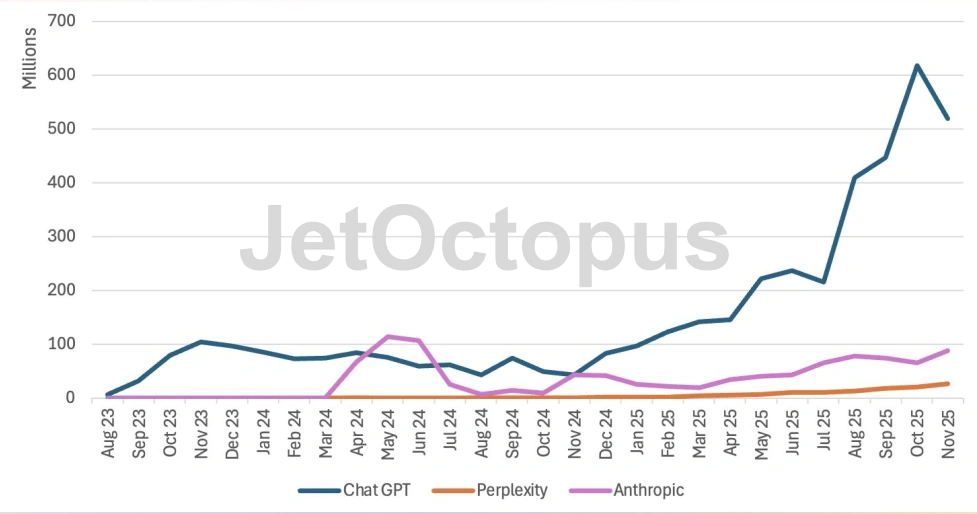
This timing correlates directly with two events: the rollout of ChatGPT Search to free users and the aggressive expansion of Google’s AI features. The machines started searching en masse and the long-tail exploded.
The Phantom Impression Phenomenon
The most important thing the data revealed is that in October 2025, while impression volumes for 10-word queries spiked 161%, CTR collapsed to 2.26%. In 2023, these same long-tail queries carried click-through rates of 8–11%. So since impressions multiplied, the clicks disappeared. This is the Phantom Impression phenomenon and it’s the clearest fingerprint of agentic search:
- High impressions: The AI agent sees your page in the SERP or retrieves it via API.
- Zero clicks: The agent reads your content, extracts what it needs and synthesizes it into its response. The human user never visits your site.
- The result: A massive spike in impressions in GSC with near-zero traffic.
If you’re currently filtering these queries out of your reports because they don’t drive traffic, you’re making a strategic error. They drive citations and citations are the new brand currency in agentic search. Being quoted or referenced by an AI agent, even without a click, is how your brand builds authority in an AI-era.
What Agents Are Actually Looking For
Analysis of query-type trends shows a staggering surge in product review intent:
- June 2025: ~239 queries related to product reviews and analysis across the dataset.
- September 2025: 40,001 queries on the same topic.
That’s a 16,000% increase in three months. Again, those were not humans suddenly becoming more interested in product reviews – the AI agents started to systematically harvest review content to build comparison tables and “Best of” responses for their users.
The content types agents crave most are:
- Reviews with clear verdicts and structured reasoning
- Pros/Cons breakdowns that let the agent extract structured opinion quickly
- Technical specifications (exact measurements, compatibility details, material data)
- Comparisons between competing products or services
- Opinionated analysis that takes a position, not just a summary
If your product pages are thin, by featuring only a product name, a photo and a price, you are functionally invisible to query fan-outs. The agent has nothing to extract, nothing to cite, nothing to use. The pages that get retrieved are the ones with depth, structure and opinion.
How to Detect and Capture Fan-Out: A 3-Step Audit
Understanding fan-out conceptually is one thing. Finding it in your own data and acting on it is another. Here’s a practical methodology, the framework we use at JetOctopus uses internally and with enterprise clients.
Step 1: Log Analysis
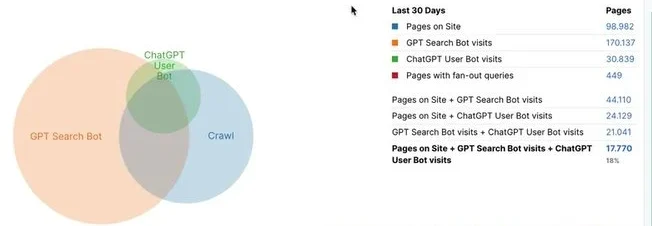
Traditional analytics tools don’t show you AI agent activity at all – you need server-level log analysis. In JetOctopus Log Analyzer, filter your log data for Search and User AI bots to identify retrieval requests. Your goal here is to identify a specific category of page: product pages or content pages that are receiving agent hits in the logs but show zero organic impressions in GSC. We call these “Zombie” pages – pages the machines are visiting, but Google isn’t ranking. Zombie pages are pages with AI agent bot hits in your logs but zero GSC impressions. The agent is trying to read them; Google isn’t surfacing them. Every Zombie page is a citation you’re losing.
Zombie pages are the most important discovery in the audit. An AI agent is trying to read them – the fan-out is attempting to retrieve them, but Google isn’t ranking them, likely because of technical quality issues, crawl budget problems or poor internal linking. You’re losing citations and brand awareness you could be earning.
Step 2: Fan-Out Opportunity Matrix
The Google Search Console UI is capped at 1,000 rows. That limit hides almost all of the fan-out signal. You need to connect to the GSC API directly – JetOctopus handles this connection and removes the row cap entirely.
Once connected, apply the following filters:
- Query length: More than 7 words
- Impressions: Fewer than 20–50 (your threshold will vary by site size)
- Clicks: 0
- Date range: Last 3 months
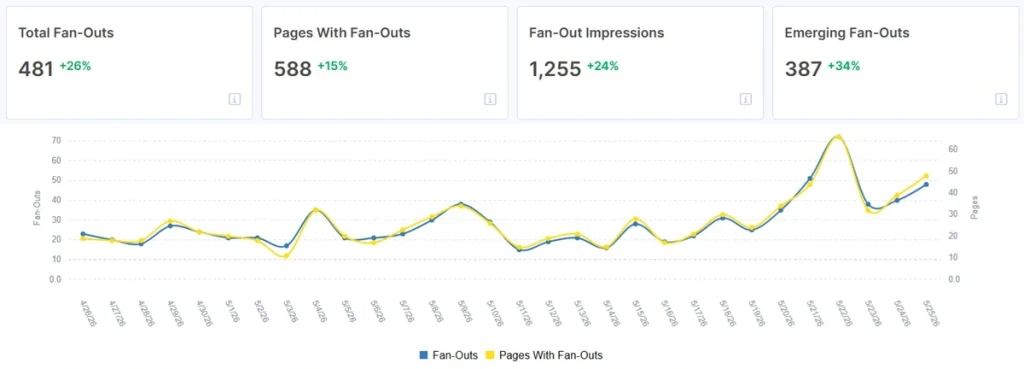
The result is your Fan-Out Opportunity Matrix: the exact long-tail questions that AI agents are asking your site. These are real sub-queries generated during fan-out events. They have near-zero monthly search volume in traditional keyword tools, which is why they’re invisible to standard research. But they represent the actual surface area where agents are trying to find information on your topic. Work through this matrix to identify clusters of unanswered questions. These gaps are your content brief for the next quarter.
GSC shows only a part of fan-out that lands in Google’s index, and it can’t tell you which prompt a sub-query came from. To see that side, you can use a GEO tool like AIclicks, which runs the prompts you care about through AI platforms and logs the fan-out queries each one generates. Cross-referencing those with your GSC matrix shows which prompts are pulling your pages into the reasoning chain and which ones are skipping you.
Step 3: Technical Accessibility Audit
Once you know which pages agents are trying to reach, you need to verify those pages are technically accessible. An agent that can’t read your page simply moves on to the next source. Run a strict technical audit against the URL clusters identified in Steps 1 and 2:
Page weight: Is the HTML payload larger than 2MB? Heavy pages slow agent retrieval and increase the likelihood the agent will abandon the request or fall back to a simpler source.
JavaScript rendering: Is the core content (reviews, specs, comparison tables) hidden behind a “Load More” button or rendered entirely in JavaScript? Many agents read the initial DOM and don’t execute JavaScript interactions. If your content requires a click to appear, agents may never see it.
Internal linking depth: Are these deep product and review pages orphaned? If a page is more than 5 clicks away from your homepage, many crawlers will deprioritize it or never reach it at all.
The fix for internal linking issues is structural: use JetOctopus to map your full internal link graph, identify pages deeper than 5 clicks and build deliberate linking paths from high-authority category pages down to deep product content. The goal is to surface your most structured, opinionated pages to agents that are following your link graph during retrieval.
The New KPI: Technical Accessibility
The era of ranking for high-volume keywords as the primary measure of SEO success is giving way to something new. When 95% of the queries driving your brand’s AI citations carry zero monthly search volume in any keyword tool, MSV becomes an incomplete metric. The question that should keep technical SEOs up at night is no longer “Does this page rank for a keyword with 10,000 searches a month?” It’s “Can an AI agent crawl, index and extract a fact from any of our product pages in under 200 milliseconds?”
Technical Accessibility is the degree to which every page on your site is fast, readable, deeply linked and structurally rich enough for an agent to use. This is a shift that actually plays to the strengths of technical SEO. The fundamentals: clean crawlability, lean page weight, strong internal linking, structured and accessible content. All those are not new, by what’s new is the audience that rewards them. It’s no longer just Googlebot. It’s ChatGPT, Claude, Perplexity and every other AI agent that is, right now, systematically reading the web to build answers for millions of users. The 161% growth in long-tail queries is not a trend to watch. It’s already here. The machines are searching. The question is whether you’re letting them in.
Summary
Query fan-out is the mechanism by which AI agents transform a single user prompt into dozens of parallel sub-queries, retrieving content from across the web to build a synthesized answer. It is already reshaping what “search traffic” means, creating a new category of high-impression, zero-click visibility that standard analytics tools are structurally unable to see.
The data is clear: long-tail queries are growing at 161% year-over-year. CTRs for those queries have collapsed to 2.26%. Product review content surged 16,000% in AI agent queries in a single quarter. And the majority of this activity is invisible to any tool that relies on monthly search volume.
To capture fan-out traffic, you need three things: log analysis to identify which agents are hitting your site and which pages they can’t reach; GSC API access to surface the real sub-queries being asked; and a technical accessibility audit to make sure every page worth citing is actually readable, fast and reachable.
That’s the new work for SEOs in the AI-search era.