
SEO for fashion ecommerce runs into a problem that other verticals get to ignore. Filters are the best thing on a fashion category page for a shopper and the most expensive thing on it for a crawler, and the two facts do not cancel out. Worldwide fashion ecommerce generated US$1.33 trillion in revenue in 2025 on an online share of 35 to 40 per cent, according to ECDB, so the catalogs involved are large and the filter sets on them are generous.
Here is the part most advice on this topic gets backwards. Fashion does not expose more filter dimensions than other verticals. It exposes fewer. What makes fashion different is what sits behind each dimension, and that distinction changes which fix actually works.
TL;DR
- Fashion carries fewer facet dimensions than electronics, not more. A dress category runs about 10 to 12 dimensions while a laptop category runs 23 to 40. The problem is not how many filters exist.
- The multiplication comes from high-cardinality, multi-select values. One retailer’s dress category offers 80+ brands, around 25 sizes and 15 colours, and letting shoppers tick several at once turns three dimensions into tens of millions of possible URLs.
- Google documents the harm plainly: crawlers access a very large number of faceted URLs before working out the URLs are useless, which leaves less time for new, useful ones.
- Robots.txt is Google’s documented first choice for facet URLs. It describes canonical and nofollow as generally less effective in the long term.
- A cleanup holds until the next collection drops. New colours, new size runs and new patterns re-multiply across every dimension already in the filter UI, which is why this is a seasonal check rather than a project.
Why Fashion Catalogs Multiply Filter Combinations Faster Than Almost Any Other Vertical
Start by killing a comfortable myth. The usual framing says fashion stacks six to eight filter dimensions while a vertical like electronics gets by on two or three. Count the live pages and the opposite turns out to be true.
Newegg’s laptops category enumerates more than 40 filter dimensions, from CPU code name to WiFi generation. Currys lists 23. Against that, Zalando’s women’s dresses offers 12 once you expand the full filter panel and Next runs about 10. Electronics wins the dimension count comfortably.
So why does fashion generate the worse URL problem? Because dimensions are a count and values are a multiplier. A laptop filter asks you to pick one processor family from a short list of mostly single-select spec values. A dress filter hands you 80 or more brands, roughly 25 sizes spanning numeric 4 to 40 alongside XXS to XXL, 15 colours and a separate size-type dimension for curve, petite, tall and maternity. Those are long lists, and the UI lets a shopper tick several boxes in one dimension at once.
Work the arithmetic on just three of Next’s dimensions. One pick each from 80 brands, 25 sizes and 15 colours is 30,000 combinations. Allow any combination of those 15 colours to be selected together, which the filter UI does, and the colour dimension alone contributes 32,767 states. Multiply that out and three dimensions have produced over 65 million addressable URLs before length, sleeve, material, pattern, occasion, price or sort order join in.
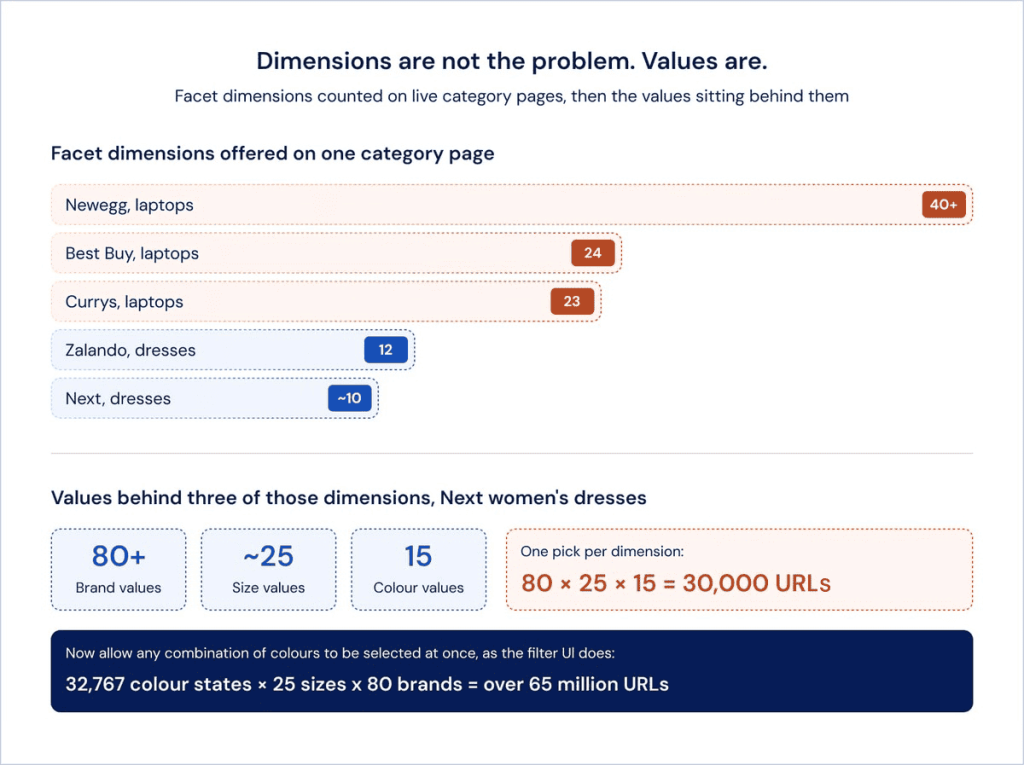
Dimension counts read from the live category pages named above. The multiplications are arithmetic on those counts rather than measured URL totals.
Electronics avoids this because spec filters are mostly single-select and low-cardinality. You rarely want four processors at once. In fashion, ticking three colours and two sizes is ordinary shopping behaviour, and every one of those states is a URL unless something stops it.
What Unlimited Filter Combinations Actually Cost a Fashion Catalog
The arithmetic above is abstract until it starts spending something. Two costs land first, and both are measurable before any ranking moves.
Crawl Budget Drained by Low-Value Combinations
Googlebot cannot tell a valuable filter URL from a worthless one without fetching it, and Google says so in its own guidance on managing faceted navigation. Because the URLs look novel, the documentation notes that “the crawlers will typically access a very large number of faceted navigation URLs before the crawlers’ processes determine the URLs are in fact useless.”
The consequence is stated just as directly in the same document: “if crawling is spent on useless URLs, the crawlers have less time to spend on new, useful URLs.” On a fashion catalog that means a three-way filter nobody searches for competes with this week’s new arrivals for the same finite attention. Google’s separate crawl budget guidance for large sites puts “differently sorted versions of the same page” on the list of URLs worth blocking outright, and it is worth reading beside a full crawl budget optimization playbook since facet sprawl is one case of a broader problem.
Seeing which patterns are actually consuming the budget takes log data rather than a sample of pages. Googlebot’s requests grouped by URL pattern tell you whether your filters are taking five per cent of the crawl or fifty.
See Where Crawl Budget Is Wasted
Index Bloat and Duplicate Content at Fashion Scale
Filter combinations frequently return the same products in a different order, or very nearly the same set. A colour filter inside a category and the same colour reached from a different entry point can resolve to near-identical product grids under two URLs, and sort variants duplicate the set exactly.
At the scale the arithmetic above describes, that stops being a handful of duplicates and becomes thousands of near-identical pages competing for the few queries the category genuinely answers. The canonical, noindex and robots.txt mechanics for resolving it are worth a document of their own, and we wrote one: how to audit, prioritize and fix faceted navigation issues covers the implementation in detail, so this article stays on why fashion feels it harder than other verticals.
Link Equity Spread Across URLs That Cannot Use It
The third cost is the quietest one. Every facet control in a sidebar is an internal link, so a category exposing 15 colours and 25 sizes is linking out to dozens of filter states from the page you actually want to rank. Link equity dilution follows: the authority that should concentrate on the category and its collection pages spreads across thin content states instead, most of them size and color variants of a product set that already lives on one URL.
That matters more in fashion than in a vertical with short filter lists, because the number of outbound facet links scales with the cardinality of the values rather than with the number of dimensions. The same multiplication that produces the URLs produces the links to them.
Which Filters Deserve to Rank, and Which Should Not Exist as URLs at All
Not every filter is equally worth indexing, and the dividing line is search demand rather than technical tidiness. A single attribute with standalone demand behind it, such as red dresses or leather boots, earns an indexable URL. A four-attribute combination with a sort order on top almost never does. The table below is how that usually resolves on a fashion catalog.
| Filter Type | Example | Search Demand | Recommended Handling |
|---|---|---|---|
| Category plus colour | “red dresses” | Real and verifiable in keyword tools | Indexable with a self-referencing canonical, linked from the parent category |
| Category plus material or style | “leather boots”, “midi dresses” | Often real, worth checking per term | Indexable once demand is confirmed in Search Console, otherwise treat as below |
| Size on its own | “size 8” | None as a standalone intent | Keep out of the index. Nobody searches a size without a garment |
| Sort and view order | ?sort=newest | None | Disallow in robots.txt. Google names differently sorted versions of a page as blockable |
| Three or more attributes | “red dresses size 8 under $50 newest” | None | Disallow in robots.txt, or move the control to a URL fragment, which Google says has no crawl impact |
| Combinations returning nothing | a filter state with zero products | None | Return a 404, which Google documents as the correct response for an empty filter combination |
One nuance in that last column is worth stating precisely, because the two Google documents involved do not say the same thing. The faceted navigation guidance recommends robots.txt and does not mention noindex at all, describing canonical and nofollow instead as “generally less effective in the long term than the previously mentioned methods.” Google’s ecommerce pagination documentation does mention noindex alongside robots.txt for filtered and sorted variations. The practical reading is that noindex keeps a URL out of the index while robots.txt keeps it out of the crawl, and on a fashion catalog the crawl is usually the scarcer resource.
Deciding any of this from a guess is the expensive way to do it. What matters is which filter URLs are indexed right now, which is a question with a factual answer rather than an opinion.
Auditing Facet Sprawl Before It Snowballs
Fashion ecommerce SEO rewards a recurring check here more than a thorough one-off. A catalog that looked manageable at 2,000 products can be unmanageable at 20,000, because the facet count does not grow with the product count. It grows with the product of the attribute values, and adding one new colour across an existing size and brand matrix adds thousands of states at once.
That makes this a recurring check rather than a one-time fix, and it makes the source of the numbers matter. Checking a handful of category pages by hand tells you what those pages do. It cannot tell you how many facet URLs exist across the catalog, which of them Googlebot is actually spending visits on or whether last quarter’s robots.txt rule is still matching the URL patterns your platform generates today.
Three questions are worth answering on a schedule, and all three need crawl and log data to answer honestly:
- How many facet URLs exist in the crawl, grouped by the parameter pattern that produced them
- What share of Googlebot requests those patterns receive, taken from log file analysis rather than estimated
- Which facet URLs are indexed, compared against the short list the demand test says should be
Facets and AI Crawlers
Do AI crawlers face the same maze? They face it with less patience. GPTBot, ClaudeBot, PerplexityBot and the rest arrive at the same combinatorial structure Googlebot does, and a bloated facet layer can absorb their activity on URLs that answer nothing, exactly as it does for Google.
One finding makes this sharper for fashion specifically. Joint research by Vercel and MERJ found that none of the major AI crawlers currently render JavaScript, across a dataset where GPTBot, Claude, AppleBot and PerplexityBot together accounted for nearly 1.3 billion fetches in a month. The study notes these crawlers do fetch JavaScript files without executing them, so they cannot read client-side rendered content. If your product grid or your filter-derived copy only exists after a script runs, those crawlers see the shell.
What can be said without overclaiming is modest and useful: tracking which bots reach which URL patterns is possible from server logs, and on a catalog with a large facet layer it tells you whether AI crawlers are reaching product pages at all or exhausting themselves on filter states. Nobody should promise AI visibility from a facet cleanup, and nobody needs to.
Why This Problem Comes Back Every Season
Fashion catalogs do not accumulate facet sprawl once and then hold steady. Every collection launch, restock and discontinued line resets the combinatorics, because new attribute values arrive and old ones rarely leave.
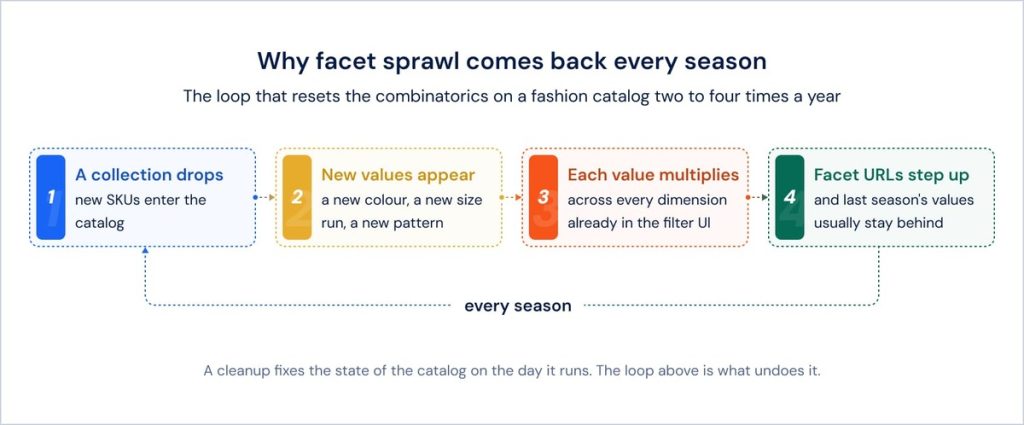
The loop runs two to four times a year on most fashion calendars, and faster on a fast-fashion cadence.
A new season brings colours that did not exist in the filter UI last quarter, a size run extended into curve or petite and a pattern or two that nobody had to model before. Each new value multiplies across every dimension already present, so the catalog that was tidied in February is generating fresh combinations by March. Last season’s values usually stay in place as well, since discontinued lines keep their attributes long after the stock has gone.
So the goal worth setting is not a clean audit. It is a crawl timed to the collection calendar, which turns a cleanup you did once into a number you watch. That is what sustainable SEO for fashion ecommerce looks like in practice: the same three measurements, taken after every major launch, compared against the launch before.
See the Complete Picture. Stop Auditing Samples.
FAQ
Does faceted navigation hurt crawl budget on a mid-sized fashion catalog, or only very large ones?
Size of catalog matters less than size of the attribute matrix. A 3,000 product catalog with 15 colours, 25 sizes and multi-select filters can generate more crawlable states than a 50,000 product catalog with three single-select filters. The useful test is the share of Googlebot requests going to filter patterns, which you can read from logs at any catalog size.
Does JavaScript-rendered filtering solve the crawl budget problem, or just hide it from a crawl report?
It depends entirely on whether the filter produces a URL. Google states that a filtering mechanism based on URL fragments “will have no impact on crawling (positive or negative)”, so a fragment-based filter genuinely removes the crawl cost. A JavaScript filter that still pushes a unique query string into the address bar creates the same crawlable URLs as a server-rendered one, and only hides them from a crawler configured not to render.
Do out-of-stock filter combinations need to return a 404, or can they stay live?
Separate the two cases, because Google documents them differently. For a filter combination that returns no results, the faceted navigation guidance says to return a 404. For an individual product that is out of stock, Google’s advice runs the other way: its guidance on pausing a business says “it’s better to still allow that page, and mark it out of stock,” so people can see what is going on. An empty filter state and a temporarily unavailable dress are not the same object.
Can Google Search Console’s URL Parameters tool replace on-site indexation fixes?
That tool no longer exists. Google deprecated the URL Parameters tool in a Search Central post on 28 March 2022 and switched it off the following month, explaining that only around one per cent of the parameter configurations in it were useful for crawling. Parameter handling now has to happen on your side, through robots.txt, canonical tags, internal linking and the URL structure itself.
Will fixing faceted navigation make the indexed page count drop in Search Console, and is that a bad sign?
The count should drop, and a drop is the expected result rather than a warning. You are removing URLs that were never going to rank from a report that counts URLs. What matters is whether impressions and clicks hold or grow while the count falls, which is the shape of a successful cleanup. A count that falls alongside clicks on pages you meant to keep is the signal worth investigating, and it is the one measurement in SEO for fashion ecommerce that separates a successful facet cleanup from a damaging one.