
Ecommerce schema SEO usually gets handled as an implementation job. You add Product markup, run one sample product through the Rich Results Test, see a green tick and close the ticket. Six months later a competitor’s listing carries a price, a star rating and a stock status, and yours is a plain blue link.
The markup is almost certainly still there. What went missing is eligibility, and that is a separate thing. Valid structured data tells Google what a page contains, and Google then decides whether the page earns a rich result based on its own quality guidelines, the completeness of the data and how well the result fits the query.
So this guide treats rich snippets as something you diagnose across a whole catalog rather than something you install once. For the wider context on how product pages are built for search, start with our guide to ecommerce product pages SEO, then come back here for the audit. The reports used in the examples come from an SEO tool built specifically for ecommerce.
TL;DR
- Valid markup makes a page eligible for a rich result and nothing more. Google weighs completeness, guideline compliance and query relevance before it shows one.
- FAQ rich results stopped appearing in Google Search on 7 May 2026, after a three year pullback. FAQPage schema is safe to keep and it will not earn a visible snippet.
- Review stars are not banned on product pages. Google’s self-serving restriction names LocalBusiness and Organization markup. On products the disqualifiers are reviews that are not genuine and ratings pulled in from other websites.
- A structured data manual action costs a page its rich result eligibility and does not change how that page ranks in web search.
- The Rich Results Test checks one URL per run. In a catalog of 200,000 products the gaps sit in the URLs nobody checks: variants, out of stock items and deep filtered category pages.
What Rich Snippets Actually Require
A rich snippet needs five things to be true at the same time, and only three of them are about code. The markup has to be in a format Google reads, it has to be reachable, it has to carry every required property, it has to satisfy the quality guidelines and the enhancement itself has to look like a good fit for the query. Fail any one of the five and the page renders as an ordinary blue link, with nothing broken anywhere in your stack.
Three of those conditions are the ones teams already know. Product schema has to be written in a format Google reads, which means JSON-LD, Microdata or RDFa, with JSON-LD recommended. The markup has to be crawlable, and Google is blunt about it: do not block your structured data pages to Googlebot using robots.txt, noindex or any other access control method. Missing required properties make an item ineligible, which is exactly how variant URLs drop out.
The other two are the ones that cost ecommerce sites their snippets, because no validator reports on them. Quality guidelines rule out marking up content that is not visible to readers of the page, and marking up irrelevant or misleading content. Relevance is decided by Google at the moment of the query, and its product documentation states plainly that search result enhancements are shown at the discretion of each experience and may change over time.
“A structured data manual action means that a page loses eligibility for appearance as a rich result; it doesn’t affect how the page ranks in Google web search.”
Since four of the five conditions are invisible to a single URL validator, the useful question changes shape. Rather than asking whether your schema is valid, ask which pages in your catalog fail which condition. That is a data problem, and it needs data at catalog scale to answer.
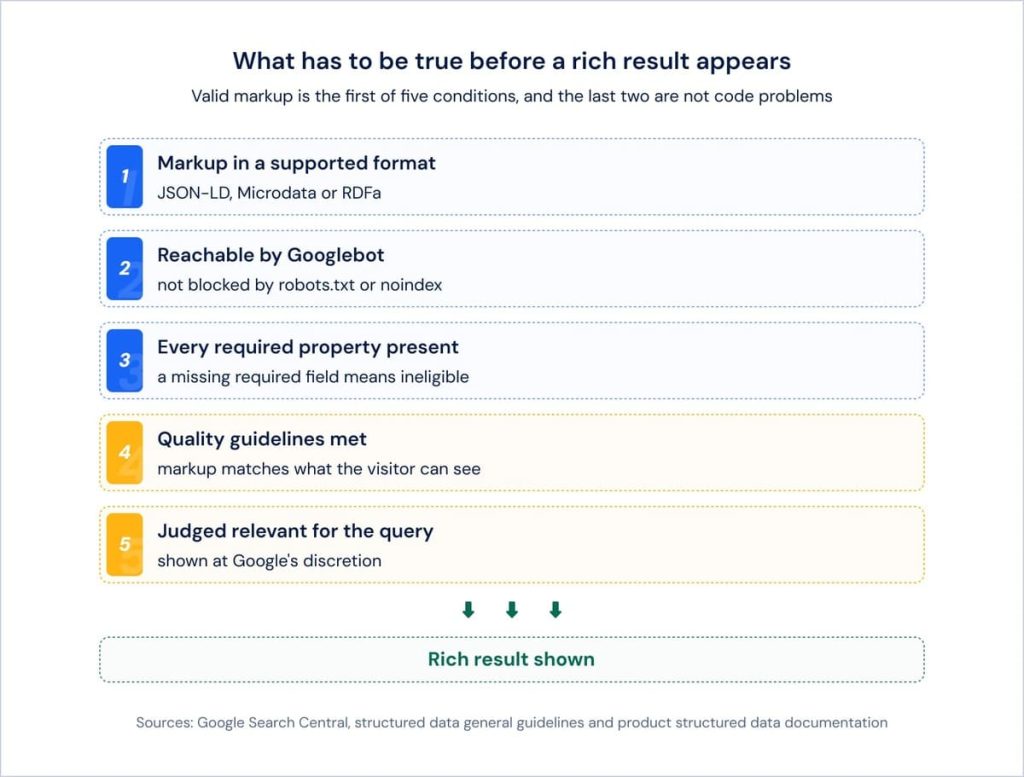
Valid markup gets you through step one of five. Steps four and five are judgment calls that no validator can check for you.
Which pages fail which condition is a question only your own catalog can answer. A crawl of it takes minutes, and the trial gives you seven days of full access without a credit card.
The Schema Types That Move the Needle for Ecommerce
One distinction decides which properties you actually need. Google runs two separate product experiences. Product snippets cover pages where a shopper cannot buy directly, such as an editorial product review. Merchant listing experiences cover pages where they can buy, and they accept far more detail, including apparel sizing, shipping cost and return policy. Adding the required merchant listing properties also makes a page eligible for product snippets, so if you sell on the page, build for merchant listings.
The table below covers the schema types for ecommerce SEO that still earn something in the SERP, plus the one that no longer does.
| Schema Type | What It Earns in Search | The Typical Gap |
|---|---|---|
| Product | Title, image, price and availability in the listing | Complete on best sellers, thin or absent on variant and out of stock URLs |
| Offer | Price, currency and stock status shown directly in the SERP | Written once from a template and never refreshed when price or stock moves |
| AggregateRating and Review | Star rating and review count beside the listing | Ratings imported from marketplaces or suppliers, or review text that is not visible on the page |
| BreadcrumbList | A readable trail in place of the raw URL | Missing on deep category and filtered pages, or built from a different hierarchy than the visible breadcrumb |
| ProductGroup with isVariantOf | Helps Google understand which products are variations of one parent | Every colour published as a standalone Product with no parent relationship declared |
| FAQPage | No visible rich result since May 2026. Content structure only | Still being built and maintained by teams waiting for a snippet that will not arrive |
That last row deserves a paragraph, because sprint time is still going into it. Google restricted FAQ rich results to well-known, authoritative government and health websites in August 2023, removed them from Search entirely on 7 May 2026, then dropped the FAQ search appearance, the rich result report and Rich Results Test support the following month. Google’s own notice says FAQ structured data can stay in place, so there is no cleanup emergency and no ranking risk either way. Keep FAQPage if it structures your content well, and stop counting it as a visibility play.
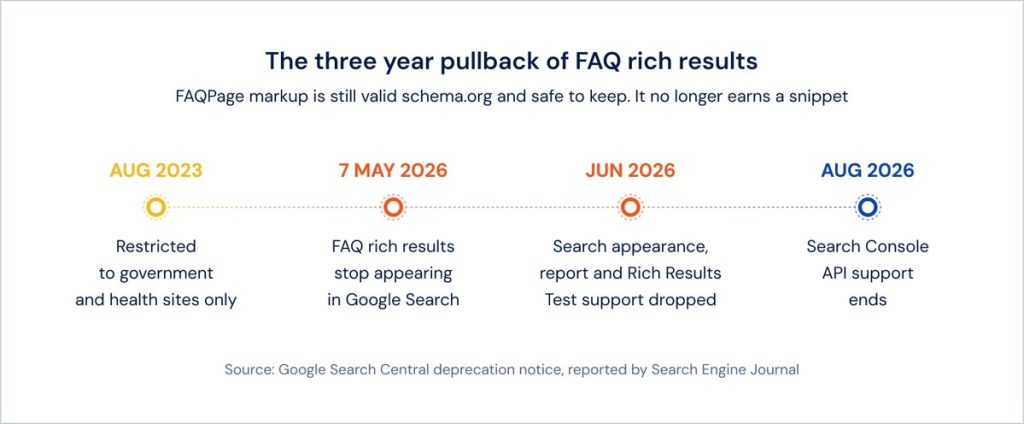
Three years of narrowing, ending in full removal. The markup stays valid schema.org throughout.
Where Ecommerce Schema Actually Breaks
The failures below are the ones that appear specifically when markup meets a catalog of hundreds of thousands of URLs, several page templates and a theme that gets updated without anyone telling the SEO team. Generic advice about remembering to add schema does not describe any of them.
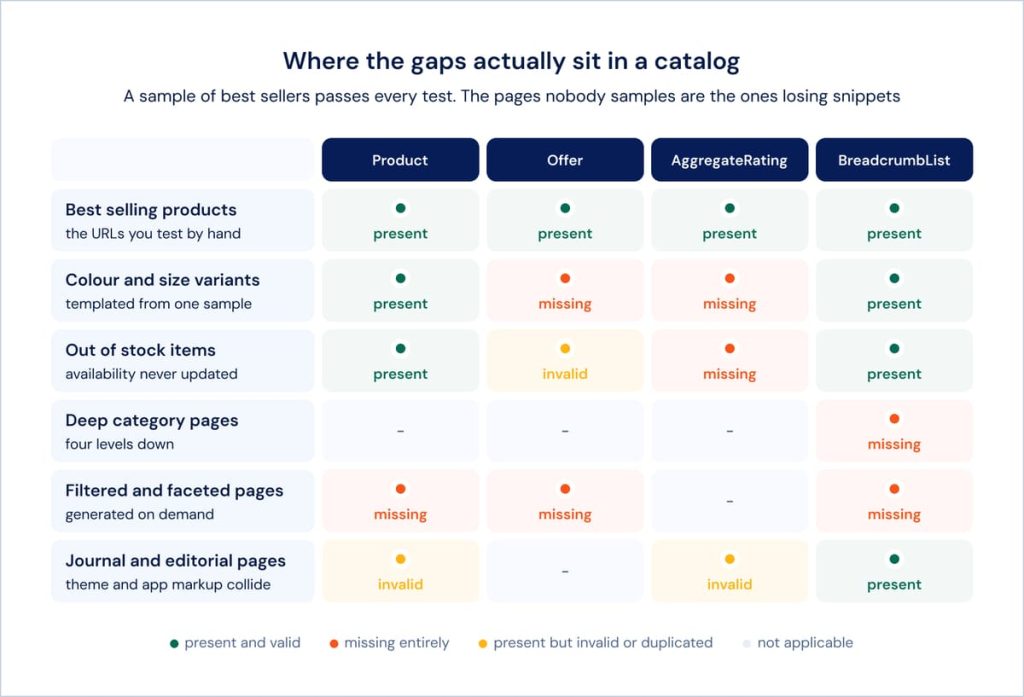
A worked example of the same catalog seen by page type. The top row is what a manual sample tests.
Missing Fields on Variants and Out of Stock Products
Schema gets built once, tested on one good sample product, then trusted everywhere. That sample is nearly always a best seller: in stock, fully populated, priced, reviewed and sitting two clicks from the homepage. It passes every check you run on it.
Variants are where the template shows its seams. A size or colour variant often inherits the Product schema and loses the Offer block, because the price lives behind a selector the renderer never resolves. Out of stock items fail differently and worse. Availability stays at InStock long after the warehouse disagrees, which puts the markup at odds with the visible page, and a mismatch like that is a quality guideline problem rather than a syntax error.
Neither failure surfaces as an error anywhere. The validator sees perfectly valid JSON-LD that happens to say something untrue.
Review Schema That Crosses Into Self-Serving
One rule gets repeated wrong constantly: plenty of teams believe Google banned review stars on a brand’s own product pages. It did not. The self-serving restriction in Google’s documentation is specific about which types it covers. If the entity being reviewed controls the reviews about itself, pages using LocalBusiness or any other type of Organization structured data are ineligible for the star review feature. Product pages do not appear in that sentence.
What does disqualify a product page is the content of the reviews. Google’s review snippet guidelines rule out reviews that are not based on genuine experience, reviews written in exchange for a benefit without a clear and prominent disclosure, and ratings aggregated from other websites. The common ecommerce version of this failure is importing supplier or marketplace ratings into AggregateRating so a new product looks established. The markup validates cleanly. The eligibility is gone.
Conflicting Schema From Themes and Apps
On a platform build, structured data rarely has one author. The theme ships Product markup. A reviews app injects its own AggregateRating. A rich snippets plugin adds a third block for good measure, and an SEO app writes a BreadcrumbList that disagrees with the visible breadcrumb. Each piece works in isolation. Together they hand Google two prices and two ratings for the same product and leave it to guess which to believe.
Catching that means reading structured data off every URL rather than a handful. JetOctopus is a cloud-based technical SEO platform built for large websites, e-commerce catalogs and the agencies that manage them, and its Structured Data Extraction report lists the schema types found across a crawl with a count for each. A second AggregateRating sitting on 40,000 product URLs shows up as a number instead of a hunch, and any extracted field can be pushed into a data table and read page by page.
Auditing Your Ecommerce Schema at Catalog Scale, Not Page by Page
The Google Rich Results Test and the Schema Markup Validator each check one URL per run. For debugging a single template that is exactly what you want. For finding every gap across a catalog the arithmetic defeats you: at roughly two minutes per URL, 200,000 products works out to about 6,600 hours of checking, and the catalog keeps changing while you work through it.
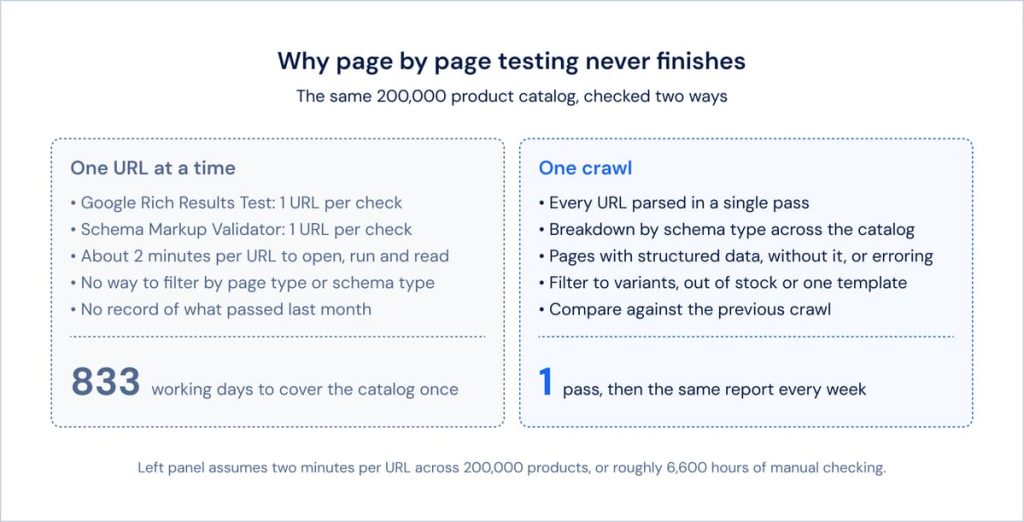
The same catalog, checked two ways. The left panel is the reason most schema audits are never finished.
A structured data audit at catalog level answers a different set of questions, and these are the ones that map onto lost snippets:
- Which pages carry structured data, which carry none and which return errors
- Which schema types exist across the site, and in what volume
- Which templates drop a required property, found by comparing page groups rather than single URLs
- Which schema types appear more than once on the same URL
- What changed since the previous crawl
In JetOctopus that work starts in the Extraction section, under Structured Data Extraction, which breaks a finished crawl down by schema type. Tick the fields you care about into a data table, then open Data Tables and Pages. From there the whole catalog becomes filterable: every URL carrying Product but no Offer, or every out of stock URL still declaring InStock. Segments make those views repeatable per template, and crawl comparison answers the question that matters after a fix, which is whether the fix survived the last release.
Read that alongside the Enhancements report in Search Console, because the two answer different questions. Your crawl shows what the markup says on every URL you asked it to fetch. The Search Console Enhancements report shows what Google managed to parse and validate, broken out by rich result type, which makes it the closest thing to a second opinion. It only covers URLs Google has crawled and it lags behind your deploys, so treat a disagreement between the two as a lead rather than an error.
Not every gap deserves a sprint, and the ordering gets obvious once you can see the volume behind each one. Fix a missing Offer block on in stock products first, because that is price and availability on pages that can convert today. Correct availability on out of stock URLs next, since a wrong value is a guideline problem rather than an omission. Duplicated AggregateRating follows, because a contradiction costs you the star rating everywhere it appears. Breadcrumbs on filtered pages come last: the gap is real and those pages rarely deserve a snippet anyway.
Find Every Schema Gap. Two Limits Worth Stating Plainly

Rich Snippets and AI Search
Does structured data help you show up in AI Overviews? Google’s answer is more direct than most of the advice written around it. The documentation on AI features states that there are no additional requirements to appear in AI Overviews or AI Mode, and that there is no special schema.org structured data you need to add.
“You don’t need to create new machine readable files, AI text files, or markup to appear in these features. There’s also no special schema.org structured data that you need to add.”
Google Search Central, AI features and your website
Take that at face value, because the useful instruction comes right after it. In the same guidance Google asks you to make sure your structured data matches the visible text on the page, and to keep Merchant Center information current. What gets rewarded, then, is markup that agrees with the page rather than more markup, and agreement is exactly the condition that breaks on out of stock items and stale prices.
For shopping surfaces specifically, Merchant Center carries more weight than markup. The product data you submit through a feed is what Google leans on across Shopping and its AI shopping experiences, and the same guidance asks you to keep that information current alongside what sits on the page. A price that is right in the feed and wrong in your JSON-LD is a contradiction you have published twice.
There is a second reason to care, and it has nothing to do with ranking. AI crawlers do not render JavaScript. Research by Vercel and MERJ found that none of the major AI crawlers currently render JavaScript, across a month of data in which GPTBot, Claude, AppleBot and PerplexityBot together accounted for nearly 1.3 billion fetches. Any markup that depends on a client side script is invisible to them no matter what Googlebot manages to see, and server rendered JSON-LD is the difference between a machine reading your price and a machine reading an empty container. We looked at structured data as part of AI crawlability in more depth separately.
Where the honest uncertainty sits: nobody outside Google can quantify how much weight structured data carries inside AI Overviews, and any article handing you a percentage is guessing. What can be said is that accurate, server rendered markup costs nothing extra and removes a whole category of misunderstanding.
FAQ
Does removing FAQ schema hurt rankings, now that it does not produce a rich result?
No. Google’s deprecation notice says FAQ structured data can stay in place, and unused structured data does not harm search performance. Removing it will not cost you rankings either, so treat it as housekeeping rather than an SEO decision.
Can a page have Product and Offer schema and still not show a rich result?
Yes, and it happens constantly. Valid markup only makes the page eligible. Google also checks that required properties are present, that the marked up content is visible to visitors and that the enhancement suits the query, and it states that these enhancements appear at its own discretion.
Do schema markup errors get a page penalized, or just make it ineligible for rich results?
It makes the page ineligible, in almost every case. Google is explicit that a structured data manual action means a page loses eligibility for appearance as a rich result and does not affect how that page ranks in web search. Deliberately misleading markup can trigger that manual action, while a missing property simply drops the enhancement.
How often does ecommerce schema need to be re-audited?
Tie the schedule to change rather than to the calendar. Any theme update, app install, template release, feed change or seasonal catalog expansion can open a gap. A monthly crawl with an alert on structured data volume catches drift on most sites, and weekly makes sense if you deploy often.
Is there a real ranking boost from schema, or only a visibility and CTR boost?
Google has consistently framed structured data as a way to make a page eligible for enhanced presentation rather than as a ranking signal, and it repeats that no special markup is needed for its AI features. The measurable gain is presentation and click through, which beside four plain blue links is worth having on its own.
Keeping Your Schema Gap-Free as the Catalog Grows
An audit is a photograph. Every new product, every new variant, every theme update and every app install is another chance for a gap to open, and the gap never announces itself. You lose a rich result quietly, then notice a quarter later when somebody compares SERP screenshots in a meeting.
Most advice on how to improve ecommerce SEO with schema.org structured data stops at the implementation ticket. The part that keeps paying out is the monitoring that comes after it.
So the work worth building is the recurring kind. Crawl the catalog on a schedule, keep the structured data breakdown as a saved view, segment it by template so a regression points at a specific part of the build, and put an alert on the count of URLs carrying Product without Offer. When that number moves, something shipped.
That is what ecommerce schema SEO looks like once implementation is behind you. It becomes a number you watch rather than a checklist you finish, and the catalog will keep growing either way. The only real question is whether you find the next rich snippet gap yourself or read about it in a competitor’s listing.