You built a page for every store, every pickup point and every city you deliver to. Six months later half of them are not in the index, the other half rank for each other’s queries, and nobody on the team can explain which page Google actually decided to show. That is the most common failure mode in local SEO for eCommerce, and it has nothing to do with a penalty. It is what happens when a site gives Google two hundred pages that say almost the same thing.
TL;DR
- Google does not penalize duplicate content. It clusters near-identical pages, picks one canonical and suppresses the rest, which is exactly what makes templated store pages disappear.
- The line that does carry a policy risk is doorway abuse: pages built to rank for similar queries, differing only by the city name.
- Local intent queries still belong to the local pack. AI Overviews appeared on only 15% of local intent queries in a 2025 Whitespark study, against 93% for the local pack.
- The title tag on your store page is the fourth strongest local organic ranking factor in the 2026 Whitespark survey, so a templated title repeated across fifty pages is self-inflicted damage.
- Crawl budget is the wrong alarm for a hundred location pages. Google’s own thresholds start at a million URLs, and crawling is not a ranking factor.
- Fixing cannibalization comes down to three choices per cluster: consolidate, differentiate or canonicalize. Picking the wrong one costs you more than doing nothing.
What Is Local SEO for eCommerce (and Why Scale Changes Everything)
Local SEO for eCommerce is the work of making a retail brand visible for queries tied to a place, across every store, warehouse and pickup point it runs. The goal is the same as for a single shop: appear in the local pack, own the branded and category queries in each city, convert a nearby searcher into a visit or a pickup order.
The mechanics change completely once there is more than one location. A single cafe optimizes one Google Business Profile and one page. A retail chain optimizes forty profiles, forty pages and a store locator that links to all of them, and it does that inside a catalog that already contains hundreds of thousands of product and category URLs.
That scale cuts both ways. Every extra location is another chance to appear in a local pack in another city, and multi-location brands do capture that: SOCi analyzed roughly 350,000 locations across 2,751 brands and found they appeared in the local three-pack 35.9% of the time. At the same time every extra location is another page that has to justify its existence, and the fastest way to produce forty pages is to write one and swap the city name.
For brands running the same playbook across several countries, this sits next to the other scale problem, which is language and region targeting. Our guide to international SEO covers that side.
Why eCommerce Brands Need Local SEO
Physical retail did not lose to eCommerce, it merged with it. Forrester forecasts that stores will still account for 71% of US retail sales in 2030, while digitally influenced sales, meaning purchases researched online and completed in a store, are forecast to reach 70% of total US retail sales by 2027. Your store page sits exactly where those two numbers meet.
Four benefits are specific to eCommerce rather than generic local business advice.
Purchase intent arrives already formed. Someone searching for a product plus a city has finished comparing. BrightLocal’s 2026 consumer research found that 72% of consumers look at three or fewer businesses before deciding, and 75% make that decision in under thirty minutes. There is no long consideration phase to nurture.
The local pack is extra real estate, not a substitute. A chain with a verified profile and a relevant store page can occupy the map pack and an organic position for the same query. A pure eCommerce competitor without locations can only take the organic slot.
Pickup is a conversion lever, not a logistics detail. Adobe measured that 17.1% of online orders used curbside pickup during the 2025 holiday season among retailers offering it, and Digital Commerce 360 found retailers offering curbside pickup converted at 4.1% against a 2.9% average for the Top 1000. Local pages are where that option becomes discoverable.
Marketplaces cannot follow you here. A marketplace listing can beat you on price and on domain strength, and it still cannot tell a shopper that the item is on a shelf eight minutes away.
Local Keyword Research for Multi-Location Catalogs
Keyword research for a chain is not a bigger version of keyword research for one shop. For one shop the output is a list of phrases. For a chain the output is a map: every query assigned to exactly one page that is allowed to compete for it. Skip the assignment step and you have built the cannibalization problem into the strategy before a single page is written.
Types of Local Queries eCommerce Sites Target
Local demand for a retail chain breaks into four patterns, and each one wants a different page type:
- Proximity queries, such as “running shoes near me”, where the searcher wants a map result and a distance
- City plus category queries, such as “electronics store manchester”, which sit between a local pack and a normal organic result
- Availability queries, such as “is the ps5 in stock near me”, which reward pages that expose real stock data
- Fulfilment queries, such as “same day delivery brooklyn” or “click and collect glasgow”, which belong to a service page rather than a store page
The fourth group is the one most chains ignore, and it is also the group where a store locator alone cannot answer the question.
Where Keyword Overlap Starts: Mapping Queries to the Right Page
Take one query: “furniture store austin”. On a typical chain site at least three pages are eligible for it. The store locator filtered to Austin. The individual page for the Austin Lamar Boulevard store. The category page for furniture with a city modifier in the title. All three are technically relevant, all three are internally linked, and none of them was told which one is supposed to win.
Google resolves that ambiguity for you, and it rarely resolves it the way you would. The result is the pattern every multi-location SEO recognizes: a query where your impressions are healthy, your clicks are not, and the URL receiving them changes from week to week.
Catching it early means reading query and page data together rather than separately. Our GSC integration keeps more than sixteen months of history and merges properties, which is what makes a rotating URL visible as a pattern instead of as noise.
Structuring Store and Location Pages Without Duplicate Content
Location page architecture is the technical heart of this article. Everything else, from schema to citations, either reinforces a clear structure or decorates a broken one.
What Makes a Location Page Actually Unique
A location page earns its place when a shopper could not get the same answer from any other page on the site. In practice that means real, page-level differences rather than a swapped place name:
- Opening hours, including holiday exceptions and the difference between store hours and pickup hours
- Stock signals for that location, even at the category level. Only 64.9% of Top 1000 retailers show in-store stock status, so this is still a differentiator
- Reviews written about that specific store, not aggregated brand reviews
- Photographs of that building, its entrance and its parking
- Local context a template cannot produce: which bus stops nearby, where to park, which services that branch offers and the neighbouring branches do not
Three of those five come from operations rather than from marketing, which is why location pages usually fail. Nobody owns the content.
Store Locator vs Individual Location Pages: Who Should Rank for What
The locator and the individual pages serve different intents and should be built to compete for different queries.
| Page type | Intent it should own | What it must contain | What it should not do |
|---|---|---|---|
| Store locator hub | Brand plus generic discovery: “brand stores near me”, “brand locations” | Map, search by postcode, complete list of locations, links to every location page | Rank for individual city queries |
| City or region hub | City level browsing where a chain has several branches: “brand stores in chicago” | All branches in that city, differences between them, city level delivery information | Duplicate the content of its child pages |
| Individual location page | Branch level queries: “brand lamar boulevard”, “brand austin opening hours” | Address, hours, stock, local reviews, photos, contact, directions | Carry generic brand boilerplate as its main content |
The rule that keeps this stable is simple. A parent page links down and summarizes. A child page holds the detail and does not repeat the parent. When a city hub reproduces the address blocks of all six branches it contains, it becomes a better match for branch queries than the branch pages themselves, and the cluster starts eating itself.
Why Templated Location Pages Are a Cannibalization Trap
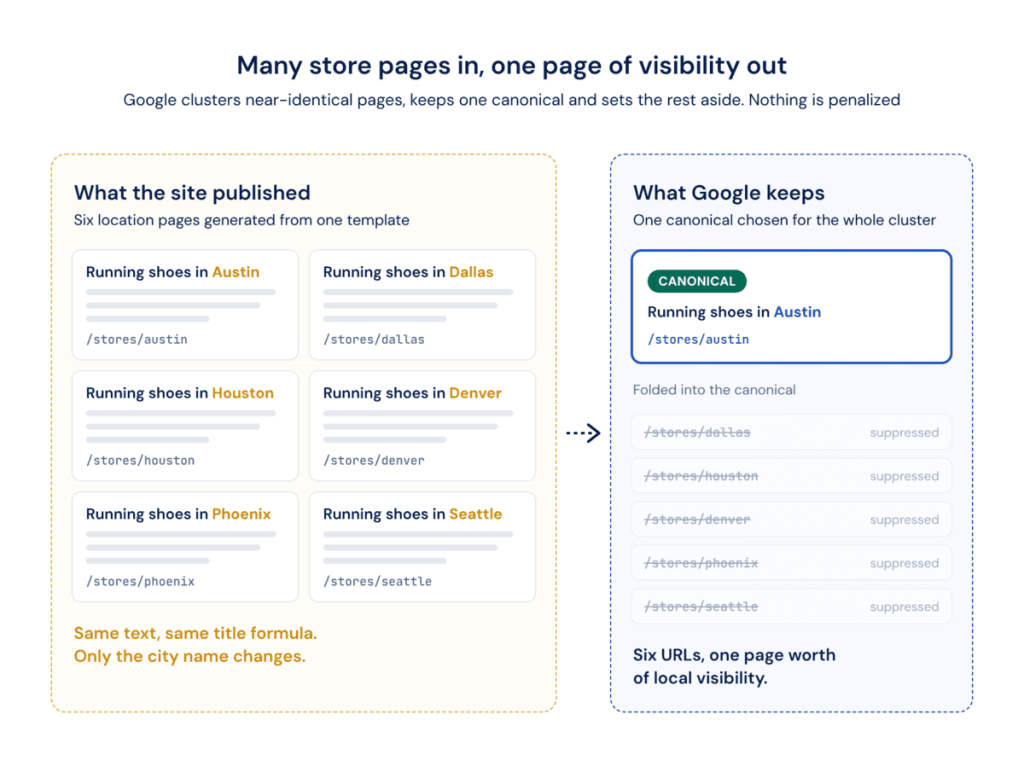
Here is the mechanism, in Google’s own words. Google clusters pages whose primary content is the same or very similar, chooses the one it considers most complete and useful, and marks it as canonical. Your own rel=canonical is, in Google’s phrasing, “a hint, not a rule”.
So a chain with sixty templated store pages does not receive sixty pages worth of visibility. It receives one page worth, plus fifty nine URLs Google decided were the same thing. Nothing was penalized. The pages were simply read as one page and treated accordingly.
Worth saying clearly, because the industry keeps repeating the opposite: Google states that “some duplicate content on a site is normal and it’s not a violation of Google’s spam policies”. There is no duplicate content penalty.
There is, however, a policy line nearby, and templated location pages can cross it. Google’s spam policies define doorway abuse as pages “created to rank for specific, similar search queries”, and list “generating pages to funnel visitors into the actual usable or relevant portion of a site” as an example. Forty pages that differ only by city name, all funnelling into the same checkout, are describable in exactly that language. The distinction matters: duplication gets consolidated, doorways get actioned.
This is the same structural problem that faceted navigation creates on a product catalog, arriving through a different door.
Templated pages are easy to spot in bulk and almost impossible to spot by eye. A crawl that groups pages by content similarity shows you the whole cluster at once.
Google Business Profile for Multi-Location eCommerce
The profile is where local SEO for eCommerce stops being a website problem. Google treats the profile as the record of the business and the store page as its supporting evidence, and at chain scale the profiles fall out of sync long before the pages do.
Setting Up and Verifying Profiles per Location or Pickup Point
Every location that a customer can physically visit during stated hours gets one profile, and only one. Google’s representation guidelines are explicit: do not create more than one page for each location, in one account or across several. Departments inside a store can have their own profile, which is how “Walmart Vision Center” style listings exist, but the store itself gets a single record.
Pickup points and dark stores are the grey area. A locker with no staff and no opening hours is not a business location. A counter inside a partner store, staffed during set hours, usually is. Delivery-only brands register as service area businesses and hide the street address while keeping the service radius.
Once you pass ten locations, stop doing this by hand. Google supports bulk upload and bulk verification at that threshold, and business groups let you share management without sharing a login.
Google claims that customers are 2.7 times more likely to consider a business reputable and 70% more likely to visit when the profile is complete. Those numbers come from Google’s own help documentation with no study or sample attached, so treat them as directional rather than as evidence.
NAP Consistency Across Dozens (or Hundreds) of Listings
Name, address and phone consistency is dull and it is also the single most common source of chain-wide local damage, because drift is invisible from the inside. It arrives through ordinary operations: a branch changes its phone system and tells the switchboard but not marketing, a regional manager claims a profile to fix hours and creates a duplicate, a franchise partner lists the location on three directories with three different suite numbers, a store moves two doors down and the old address survives in a dozen citations.
The fix is procedural rather than technical. One source of truth for location data, ideally the same feed that powers the store pages, the profiles and the schema. Anything that writes location data outside that feed will eventually contradict it.
On-Page Signals: Schema, Titles and Internal Linking
Three on-page signals decide whether a location page reads as a distinct entity or as the fortieth copy of the same page. All three are template-level decisions, which means they are cheap to fix and expensive to leave alone.
LocalBusiness Schema Markup
Each location page should carry LocalBusiness structured data with the properties that make the location machine readable: name, address, geo coordinates, telephone, openingHoursSpecification, priceRange and a url pointing at that page rather than at the homepage.
Google asks for the most specific subtype available, so a shoe retailer marks up ShoeStore rather than LocalBusiness, and a chain with departments follows the “{store name} {department name}” convention. On the brand side, the Organization markup should use the OnlineStore subtype, with the location pages carrying the LocalBusiness layer underneath it.
Two failure modes recur at scale. The first is a single set of coordinates copied to every location, which happens when the template pulls from a brand-level field. The second is opening hours hardcoded into the markup while the visible page pulls live hours from an API, so the structured data and the page disagree. Both survive for months because neither breaks anything visibly.
Unique Title Tags and Meta Descriptions per Location
If you change one thing after reading this article, change the titles. In Whitespark’s 2026 Local Search Ranking Factors survey of 47 local search practitioners, keywords in the landing page title tag ranked as the fourth strongest factor for local organic results, with headings eighth. The title of the store page is not a formality, it is a top-five signal.
A title formula that only injects the city produces near-identical titles across the estate and gives Google one more reason to treat the pages as one. Build the formula from fields that actually vary: the neighbourhood or street rather than the city where a chain has several branches in one city, the store format where formats differ, the services that branch offers.
Meta descriptions do not rank, and they still decide the click. A description naming the specific street, the pickup window and the parking situation will outperform the same sentence with a placeholder in it.
Internal Linking Between Store and Category Pages
Internal linking is where multi-location sites either distribute authority or bury it. The usual pattern puts every location page one click from the footer, gives them all identical anchor text and links them to nothing except the locator, which leaves forty pages with the same signal and no topical connection to the catalog.
Three principles hold up at scale. Link location pages to the categories that matter in that market rather than to the full category tree. Use anchors that carry the place name instead of a repeated “our store”. Let city hubs pass links down to branches without duplicating their content, so the hierarchy is visible in the link graph as well as in the URL structure.
On an estate of a few hundred pages this is manageable by hand. On a catalog of hundreds of thousands, it is not, which is the problem our AI Internal Linker exists to solve: it uses crawl, log and Search Console data to match donor pages with the pages that need discovery, rather than linking by popularity.
How to Find and Fix Store Page Cannibalization
Diagnosis before treatment. Most location page cannibalization is fixed badly because the team jumps to canonical tags before establishing which pages actually compete, for which queries, and why.
Diagnosing Overlap With Search Console Data
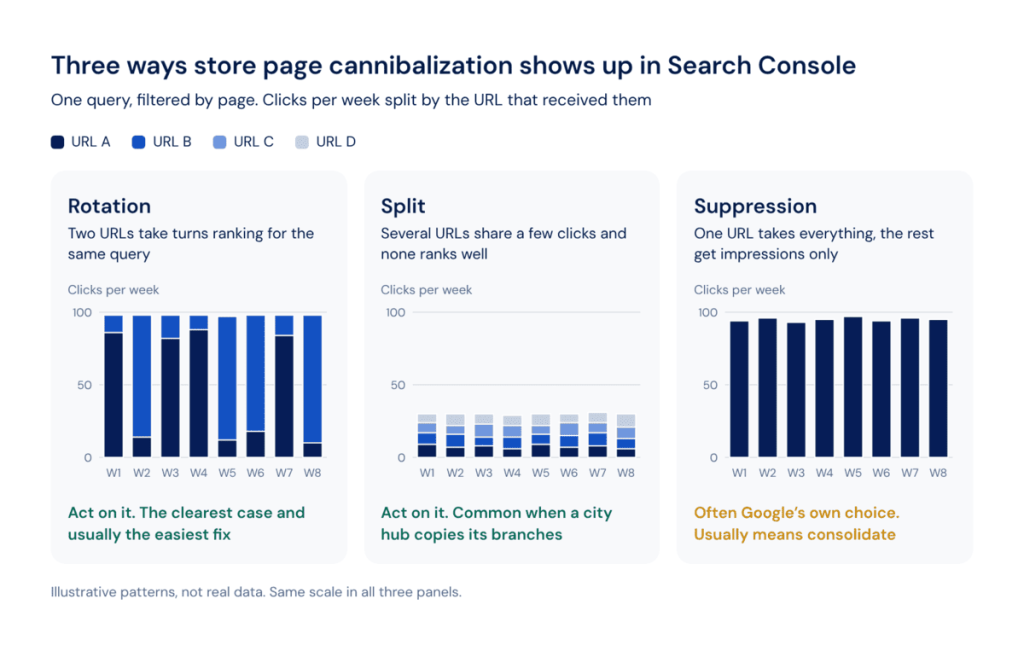
The signature of cannibalization in Search Console is not a ranking drop. It is instability. Filter to a single query, add the page dimension, and look for a query where two or more URLs collect impressions in the same period and the click share moves between them week over week.
Three patterns are worth separating:
- Rotation: two URLs alternate as the ranking page for one query. This is the clearest case and usually the easiest to fix.
- Split: several URLs each hold a handful of impressions for the same query and none of them ranks well. Common on city hubs that duplicate branch content.
- Suppression: one URL takes everything and the rest sit with impressions in the hundreds and no clicks. Often this is Google having already picked a canonical for you.
Rotation and split are worth acting on. Suppression may be Google making a reasonable decision about pages that genuinely say the same thing, in which case the honest answer is consolidation.
Auditing Templates for Near-Duplicate Content
Search Console tells you which pages compete. It does not tell you why. That answer comes from the crawl, and specifically from comparing pages of the same type against each other rather than reading them one at a time.
What to look for across the location template: duplicate and near-duplicate title tags, duplicate H1s, text to HTML ratio below the level where a page carries any unique prose, body content similarity between pages of the same type, and word count clustering tightly around one value, which is the tell that every page came out of the same generator.
A travel marketplace we worked with ran exactly this audit across 300,000 pages and found 100,000 fully duplicated HTML pages plus another 117,000 with non-unique content, which they reduced to 40,000. The full case study has the numbers.
Checking Crawl and Indexation Patterns via Log Analysis
Logs answer the question neither Search Console nor the crawl can: what did Googlebot actually do with these pages.
First, an honest correction to a claim this industry repeats. A few hundred location pages do not create a crawl budget problem. Google’s own guidance puts the thresholds at a million or more unique pages with content changing weekly, or ten thousand or more pages changing daily, and Google states plainly in its crawl myths documentation that crawling is not a ranking factor. If somebody tells you fifty store pages are eating your crawl budget, they are selling something.
What logs do show for a location cluster is more useful than a budget figure. Which location pages Googlebot has stopped requesting, which is the fingerprint of pages already consolidated into a canonical. Whether the bot reaches new branch pages at all or only ever crawls the locator. Whether location URLs return a different status code to a bot than to a browser, which happens more often than teams expect on geo-redirecting sites.
Crawl budget does become the real constraint when location pages multiply against a large catalog, for example when every city hub can be filtered by category and the combinations run into six figures. That is a genuine crawl budget optimization problem, and it is a different problem from having two hundred store pages.
Log analysis shows which of your location pages Googlebot still visits.

Fix Playbook: Consolidate, Differentiate or Canonicalize
Every cannibalizing cluster resolves into one of three decisions, and the right one depends on whether the pages deserve to exist separately.
| Decision | When it applies | How to execute | What you gain |
|---|---|---|---|
| Consolidate | The pages have no genuine difference and no separate audience, for example three near-identical city pages for one metro area | Merge into one page, 301 the others, rewrite internal links to the survivor | One page with the combined signals instead of three weak ones |
| Differentiate | The locations are genuinely distinct and the pages simply were not written that way | Add hours, stock, local reviews, photos and local context; rewrite titles and H1s from varying fields | Pages that earn separate rankings because they answer separate questions |
| Canonicalize | The duplication is structural rather than editorial, for example a printable version or a filtered locator view of the same branch | Point rel=canonical at the primary URL and keep internal links consistent with it | Consolidated signals without deleting a URL users still need |
Two cautions. Canonicalizing pages that should have been differentiated is the most common mistake, because it is the quickest, and it permanently gives up the local visibility those locations could have had. And a canonical is a hint, so if the target page is weaker than the page pointing at it, Google may ignore you. Our complete guide to canonical tags covers the implementation detail, and our earlier article on diagnosing and fixing cannibalization covers the general case this article narrows to locations.
Reviews and Reputation Across Locations
Reviews sit between ranking and conversion, and at chain scale they are also an operations problem, because a hundred locations produce a hundred separate reputations.
The 2026 BrightLocal Local Consumer Review Survey sets out what shoppers actually require. Recency is the strictest condition: 74% look for reviews written in the last three months, and 32% want something from the last two weeks. Volume has a floor: 47% will not use a business with fewer than twenty reviews. Responses matter more than most brands assume, with 80% saying they are likely to use a business that responds to all reviews, and half saying a templated reply puts them off.
That last finding is awkward for chains, because a templated reply is exactly what a hundred locations produce. It is also where most brands lose: SOCi’s 2026 index puts the average Google review response rate for multi-location brands at 46.9%, meaning more than half of all reviews go unanswered.
On the ranking side, Whitespark’s 2026 survey places high numerical ratings sixth, review quantity with text ninth and review recency eleventh among local pack factors. A location with forty reviews from two years ago is weaker than a location with fifteen from this quarter.
Local Link Building and Citations for eCommerce
A local link profile is built on relevance to a place rather than on domain strength. A link from a regional newspaper with modest authority does more for one branch than a national link does for all of them, because it carries the geographic association the branch needs.
Citations come first, and they are maintenance rather than acquisition. Core directories, industry directories for your vertical and the data aggregators that feed them should carry identical NAP data pointing at the individual location page rather than at the homepage. Consistency is the whole point: a citation that disagrees with your profile is worse than no citation.
Local links follow from things the business already does. Sponsorships of local sports clubs and events. Partnerships with nearby businesses that produce a genuine page rather than a link list. Local press when a branch opens, refits or runs something newsworthy. Chamber of commerce and business association memberships. Community involvement that results in coverage.
The scale advantage is real here. A chain with forty branches has forty local news markets, forty sets of community organizations and forty opening stories, which is forty times the surface area a single-location competitor works with. Very few chains use it, because link building sits with a central team that thinks nationally.
Measuring Local SEO Performance at Scale
Aggregate metrics hide local problems by design. A chain can lose visibility in eight cities and still report flat organic traffic, because the other thirty two cover the gap. Measurement at chain scale has to be per location before it is anything else.
KPIs to Track per Location
Per location, four numbers tell you almost everything:
- Local pack position for the two or three queries that matter in that market
- Profile actions, meaning calls, direction requests and website clicks, which is where discovery converts
- Organic sessions and revenue attributed to that location page
- Indexation status of the location page, which is the early warning for consolidation
The fourth one is the one nobody watches. A location page falling out of the index is usually the first visible sign that Google has folded it into a cluster, and it shows up weeks before the traffic does.
Catching Cannibalization Early in GSC
Cannibalization is cheap to fix early and expensive to fix late, because a page that has been suppressed for two quarters has also lost its internal links, its freshness and whatever external signals it once had.
The monitoring routine is straightforward when the site is small. Group location URLs into a segment. Once a month, pull queries where more than one URL in that segment takes impressions. Sort by the variance in which URL ranks. Investigate the top of that list.
It stops being straightforward somewhere around the point where a person has to do it for forty pages, twelve queries each, every month. That is the job to automate, together with alerts on indexation drops so that a page leaving the index becomes a notification rather than a discovery.
Our automated alerts handle the second half of that.
Checking Search Console location by location stops scaling past a handful of stores.
Common Local SEO Mistakes eCommerce Brands Make
Most chain-wide local problems come from the same short list, roughly in order of how much damage they cause:
- Templated location pages. One page written, the city name swapped, forty times. This is mistake number one and it produces every other symptom in this list.
- NAP drift. Operations changes a phone number or an address and the citations, profiles and schema do not follow.
- Duplicate profiles. A regional manager claims a location that already had a profile, and two records compete for the same store.
- Thin location pages. An address, a map embed and nothing a shopper could not get from the locator.
- Missing or copy-pasted schema. No LocalBusiness markup, or identical coordinates across every location.
- City hubs that duplicate their branches. The parent page absorbs the queries the child pages were built for.
- Reviews left unanswered. Half of all reviews on multi-location brands get no reply.
- No per location measurement. Aggregate reporting hides the cities that are losing.
- Location pages orphaned from the catalog. Linked from the footer and the locator, connected to nothing that sells anything.
If you want to work through this systematically rather than issue by issue, our eCommerce SEO solution covers the platform side, and the eCommerce SEO audit checklist is a ready-made framework for auditing the whole site rather than only the problems listed here.
Final Thoughts
Scale is the advantage. A brand with forty locations can appear in forty local packs, own forty sets of city queries and convert a shopper who wants the product today rather than on Thursday. None of that is available to a marketplace competitor, however strong its domain is.
What turns the advantage into a liability is treating forty locations as one page repeated forty times. Google reads those pages exactly as they were written, clusters them, keeps one and quietly sets the rest aside. Nothing gets penalized and nothing gets reported. The pages simply stop earning.
An agency running 60 local sites for Puratos on a single platform grew impressions by 103% and organic sessions by 35%, and the reason that worked is unglamorous: they could see all sixty at once rather than auditing them one at a time. That is what local SEO for eCommerce comes down to at chain scale. Write pages that deserve to be separate, then watch the whole estate in one place so you find out before Google decides for you.
FAQ
Does an eCommerce brand with no physical stores need local SEO?
Sometimes, and less often than agencies suggest. Without a location a customer can visit, you cannot hold a standard Google Business Profile or appear in the local pack. If you deliver within defined areas you can register as a service area business, and city or delivery area pages can rank organically when they carry genuinely local information such as delivery windows, coverage and local pricing. If they carry only a city name, skip them.
How many location pages before cannibalization risk becomes real?
The count matters less than the similarity. Ten pages built from the same template with only the city swapped will cannibalize each other, while two hundred pages with real hours, stock, reviews and local context usually will not. Risk rises sharply once you add a second page type covering the same places, for example city hubs on top of branch pages, because that is when two pages become eligible for one query.
Do subdomains or subdirectories for city pages affect cannibalization?
Not directly. Cannibalization is driven by content similarity and query overlap rather than by URL structure, so identical pages compete whichever way they are hosted. Subdirectories are still the better default for most chains, because they keep the location pages inside the main site’s signals and make internal linking between stores and categories simpler.
Can location pages share the same product description if only the city name changes?
Product descriptions shared across locations are fine, since the product is the same everywhere. The problem is when the product description is the only substantial content on the page. Keep shared product copy, then add what differs by location: stock, hours, local reviews, photos and collection options. The unique material should be what a shopper reads first.
Does every warehouse or pickup point need its own Google Business Profile?
No. Google’s guidelines expect a profile for locations that customers can visit during stated hours with staff present. A fulfilment warehouse closed to the public should not have one, an unstaffed locker generally should not, and a staffed collection counter usually qualifies. Creating profiles for locations that fail these conditions risks suspension and produces duplicates that compete with your real stores.
How long does it take for rankings to recover after fixing store page cannibalization?
Expect weeks rather than days. The pages have to be recrawled, the cluster reassessed and the canonical choice revisited, and consolidation decisions that have been in place for months take longer to unwind than recent ones. Differentiation fixes usually show movement faster than redirect-based consolidation, because no signal transfer has to settle first. Either way, recovery in local SEO for eCommerce is measured per location rather than in aggregate, so track the affected cities one by one instead of watching the total.