
SEO for marketplaces is not single-store ecommerce SEO at a larger scale. It is a different discipline, and the reason is structural. Marketplaces now carry the majority of online retail: Euromonitor reports that online marketplaces achieved 62% of global retail e-commerce sales in 2024, reaching USD 2.4 trillion. That scale comes with a constraint no single brand faces.
Every listing on your platform has to win twice. It has to surface in your own internal search, which you control, and it has to rank in Google, which you do not. Those are two relevance systems with different inputs, and a listing can top one while being invisible in the other. The reports in this guide run on an SEO platform built for ecommerce and marketplace catalogs.
TL;DR
- Marketplace SEO is a separate discipline rather than a bigger version of store SEO. You optimize buyer-facing pages directly and can only influence the listing content vendors supply.
- The review-schema risk inverts on a marketplace. On a single product page, reviews are not disqualified for belonging to the brand. On a marketplace, star ratings pooled across several sellers of the same product are exactly the aggregation Google’s guidelines rule out.
- Duplicate listings are the defining architecture problem. A JetOctopus audit of one travel marketplace found nearly 100,000 pages with full HTML duplication, with only a third of the site indexable before the work started.
- Vendor publishing creates a change rate no single catalog sees, so crawl priority has to be decided deliberately rather than left to the platform.
- The maturity goal is moving technical checks into vendor onboarding, so a broken listing never reaches the live catalog at all.
What Makes Marketplace SEO a Different Discipline
A marketplace is a dual-sided platform, and that shape decides everything about how its SEO works. The defining feature is that you do not write your own catalog. A single brand controls every title, every description, every image and every attribute on its product pages. A marketplace controls the template, the taxonomy and the rules, then receives its actual content from thousands of vendors with varying skill and varying incentives.
That splits the work in two. Buyer-facing SEO is the familiar part: category and browse pages, internal linking, crawl priority, schema, performance. Seller-facing SEO is the part with no equivalent in a single store, and it is mostly governance rather than code. How vendors title a listing, which category they choose, whether they fill the attributes, what they upload as images: all of it is input you shape through onboarding, validation and templates instead of writing yourself.
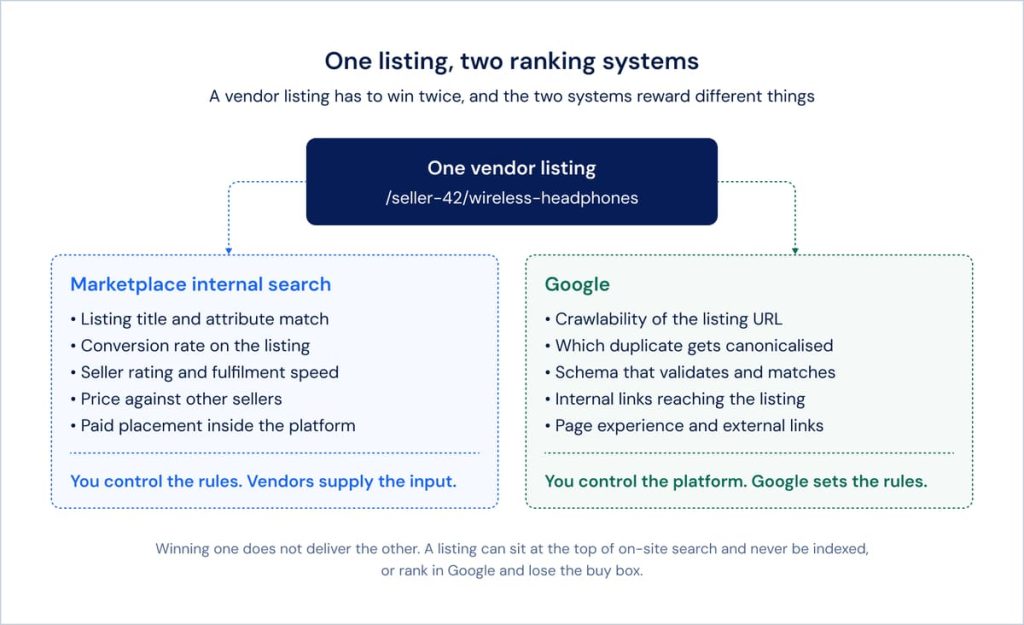
Typical signals on each side. A listing can lead internal search and never be indexed, which is why the two systems need separate work.
The table below sets out where the two models actually diverge.
| Factor | Single Ecommerce Store | Marketplace |
|---|---|---|
| Who controls listing content | The brand, completely | Vendors, within rules the platform sets and enforces |
| Source of internal ranking | Usually a simple catalog sort | A proprietary search algorithm with commercial inputs |
| Typical duplicate scale | Variants and parameter URLs of one catalog | The same physical product listed by many sellers, plus variants and parameters |
| Who owns SEO quality | One team with end-to-end control | A platform team that can only set standards, plus thousands of vendors who meet them unevenly |
| Rate of catalog change | Release cycles and seasonal updates | Continuous, with listings created and deleted daily |
Should You Invest in Marketplace SEO Right Now
Not every marketplace should. Two questions decide it, and both have honest negative answers.
First, is there non-branded search demand for what your vendors actually sell? A platform whose growth runs on paid acquisition and app installs may have a catalog nobody is searching for in those words. If the demand sits entirely on your brand name, organic work will move it slowly and the budget probably belongs elsewhere for now.
Second, is the catalog big enough for organic to matter? A few hundred listings across thin categories rarely produces pages that can compete with established retailers, and the fix is more inventory rather than more technical SEO.
When both answers point the right way, the next step is a baseline rather than a backlog. The useful question before committing a quarter of engineering time is whether the problem is fifty pages or the whole catalog, and that is answerable only from a full crawl. Teams that skip the baseline tend to fix what they happened to look at.
The Architecture Problem: Categories, Listings and Duplicate Content at Vendor Scale
This is the technical backbone of marketplace SEO, and it is structurally different from a single catalog’s duplicate content issue rather than simply larger. On one store, duplication comes from your own variants and parameters. On a marketplace, it comes from the business model working as designed.
When Multiple Vendors List the Same Product
The same physical product gets listed by several sellers, each with a near-identical title, a description copied from the manufacturer and the same specification table. Every one of those listings lives on your domain, so Google sees one site publishing the same product page seven times.
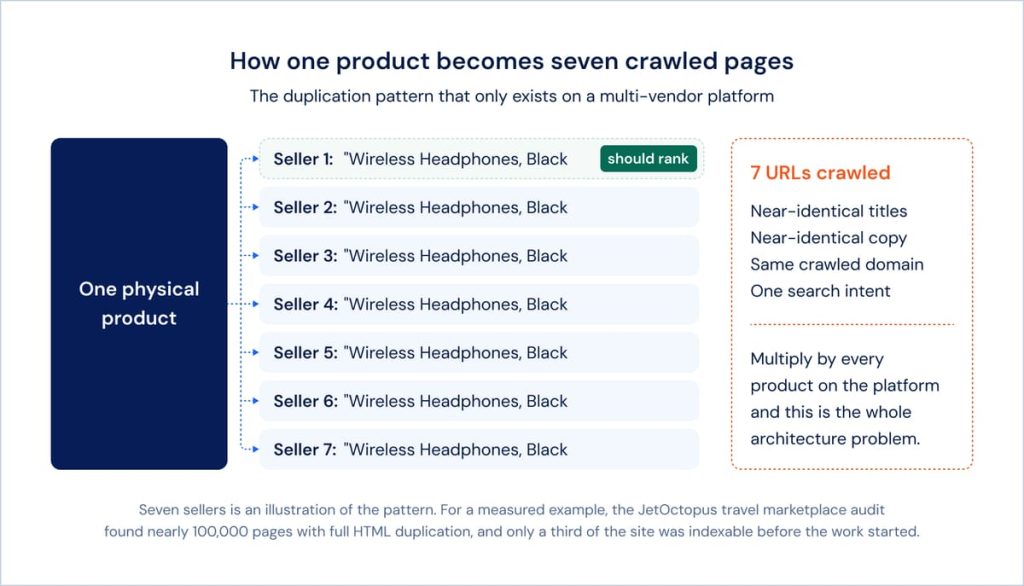
The pattern that only exists on a multi-vendor platform. One intent, one product, several crawled pages.
The scale this reaches is not theoretical. A travel marketplace audit that found nearly 100,000 duplicate pages is one of our own: the first crawl turned up over a million pages of which only a third were indexable, and nearly 100,000 of them were full HTML duplicates, identical in both text and code. After the cleanup, the number of indexable pages with traffic potential rose by 800%, pages with non-unique content fell from 117,000 to 40,000 and pages with critical technical issues dropped by 83%.
The strategy choice is consolidate or separate, and the deciding question is whether the seller is part of what the buyer is choosing. For a commodity product where buyers compare price and delivery, consolidate: one canonical product page carrying every offer, with sellers as offers on that page rather than as separate pages. For a product where the seller is the differentiator, such as a used item in a specific condition or a handmade piece, keep the listings separate and give each one genuinely distinct content, because they are genuinely distinct products.
Category Pages Versus Individual Listings: Which Should Rank
Category and browse pages usually deserve to be the ranking target, and marketplaces often get this backwards by optimising listings that cannot win. A category page accumulates internal links from navigation, holds external links, survives inventory turnover and matches the broad commercial intent behind most searches. An individual listing has one seller’s copy, a short life and almost no links.
So route accordingly. Treat browse pages as the ranking surface for category-level queries and let listings rank for specific product or model queries where the intent is precise. Internal linking should reflect that: strong, stable links into browse pages and links from browse pages down to listings that are current rather than to whatever was in stock when the template was written.
Finding the duplicates across sellers takes a view of the whole catalog, since the pattern is invisible inside any one vendor’s inventory and only appears when every seller offering the same item is compared on the same crawled domain.
Crawl Budget and Indexation When Thousands of Vendors Publish Daily
Vendor publishing produces a change rate a single brand never generates. New listings, price edits, stock updates and deletions arrive continuously, and each one is a reason for a crawler to come back. Add faceted navigation on top, where filter and sort parameters multiply across the catalog, and the crawlable surface grows faster than the useful one. Canonicalisation is the lever that decides which of the resulting near-duplicates Google keeps.
Google’s crawl budget guidance for large sites is direct about the consequence of leaving this alone, and it recommends consolidating duplicate content “to focus crawling on unique content rather than unique URLs”. It also rules out the shortcut most teams reach for first: “Don’t use noindex, as Google will still request, but then drop the page when it sees a noindex meta tag or header.” The request is spent either way.
Deletion is the marketplace-specific trap. When a vendor removes a listing, the links to it often survive in templates and sitemaps, so crawlers keep requesting pages that no longer exist. How a multi-vertical marketplace group scaled Googlebot visits by 350% is our own case with SMG Swiss Marketplace Group, whose classifieds site sees users create and delete thousands of ads daily. Working from crawl and log data together, the team optimised crawl budget and recorded a 350% increase in Googlebot visits alongside a 700% rise in SERP impressions. One of the specific actions they describe is removing internal links that pointed at deleted user ads, which had been left behind in the HTML and the sitemap.
The practical priority list for a marketplace is short. Keep browse pages and live listings crawlable, consolidate duplicates onto one canonical offer page, block parameter variants in robots.txt, and make deletion remove the links as well as the page.
See Where Crawl Budget Is Wasted
How Schema, Images and Mobile Break Differently at Marketplace Scale
These three exist in any ecommerce SEO checklist. On a marketplace each one fails in a way the single-catalog version does not, because the platform does not control what vendors upload.
Schema and the Review-Aggregation Risk That Is Unique to Marketplaces
Start with a correction that matters, because the rule gets repeated wrong in both directions. On a single-brand product page, reviews are not disqualified merely for being the brand’s own. Google’s review snippet guidelines aim the self-serving restriction at specific types: “If the entity that’s being reviewed controls the reviews about itself, their pages that use LocalBusiness or any other type of Organization structured data are ineligible for star review feature.”
A marketplace hits the opposite risk. The same guidelines rule out ratings aggregated from other sources and reviews that are not based on genuine experience, and pooling star ratings across every seller offering one product is aggregation by design. A buyer reading four stars on a listing may be reading the average of six sellers with different handling, different condition grading and different delivery records.
The defensible setup separates the two things being rated, and the schema types already distinguish them. Product schema describes the item, Organization schema describes the business, and a seller is an organisation rather than an attribute of the product. Product-level ratings belong to the product and should be sourced from verified purchases of that product on your platform. Seller-level ratings belong to the seller and should be marked up as such. Mixing them into one AggregateRating on a listing page is the pattern worth auditing first.
Image Consistency Across Thousands of Vendor Uploads
A single brand shoots its catalog to a specification. A marketplace receives whatever the vendor had on their phone. The result is a catalog where image quality, aspect ratio, background, file weight and alt text vary listing by listing, and where a meaningful share of listings have no usable image data at all.
Treat it as moderation rather than markup. The levers that work at this scale are upload validation that rejects an image below a minimum size, generated alt text derived from structured listing attributes when a vendor leaves the field empty, server-side compression applied on ingest rather than requested of sellers, and a quality score surfaced to vendors so the incentive sits with the person uploading.
Mobile Performance Weighed Down by Every Seller’s Own Scripts
Listing pages on marketplaces often carry third-party scripts the platform never chose: chat widgets, promo banners, tracking pixels and seller-tool embeds, each adding render-blocking weight. The platform owns the Core Web Vitals score and the vendors own several of the inputs to it.
That makes this a governance question before an engineering one. Decide what sellers may embed, serve the permitted integrations through your own tag layer instead of raw script tags, and measure the result against the documented threshold: Google’s guidance on Interaction to Next Paint puts good responsiveness at 200 milliseconds or below at the 75th percentile, with anything above 500 milliseconds classed as poor.
| Technical Area | Problem on One Catalog | Problem at Marketplace Scale |
|---|---|---|
| Schema | Missing or invalid properties on product pages | Star ratings pooled across sellers, which is the aggregation Google’s guidelines rule out |
| Images | Forgotten alt text and unoptimised files | Thousands of vendor uploads at inconsistent quality, with no central way to reshoot them |
| Mobile | Your own scripts and templates to optimise | Render-blocking third-party scripts added by sellers, which the platform did not choose |
| Duplicates | Variant and parameter URLs of one catalog | The same product published by many sellers, each on your own domain |
Off-Page Signals: Why Link Building and UGC Work Differently for Marketplaces
Marketplaces start with an advantage most single stores never get. User-generated content arrives continuously and for free: reviews, questions and answers, seller stories, buying activity. Structured well it is a renewable source of unique, linkable content on pages that would otherwise be a product grid. Left as noise it is thin content at scale.
The link building picture inverts too. Nobody links to one seller’s listing, so outreach aimed at listings fails by design. What does earn links is platform-level work: category buying guides, data reports built from your own transaction patterns, vendor spotlights and seasonal trend pieces. Those assets live on browse pages and editorial pages, which is also where the internal link equity should be concentrating.
Internal distribution matters as much as external acquisition here, and for a reason specific to marketplaces. Hundreds of new listings appear between crawls, and a listing with no internal links pointing at it is orphaned until something changes. Those listings do not get crawled, do not get indexed and do not sell, and nobody notices because they were never in a report.
Marketplace SEO and AI Search (GEO)
Generative engine optimisation, or GEO, is the label the industry has settled on for this work, and marketplaces carry a double exposure to it. An AI Overview or a shopping agent can answer a category-level question outright, summarising the comparison a browse page exists to provide and sending no click to any listing. At the same time, AI crawlers have to reach and parse thousands of vendor pages before they can cite any of them.
Two things are documented and worth building on. Google’s guidance on AI features states that there is no special schema.org structured data required to appear in AI Overviews or AI Mode, and asks instead that your structured data match the visible text on the page and that Merchant Center information stay current.
Beyond that, honesty is the right posture. Nobody outside the vendors can quantify how AI answer engines weight marketplace content, and anyone selling you a guaranteed AI visibility uplift is guessing. What you can do is measure coverage: which AI crawlers arrive, how deep they get and whether they stop at category pages or reach listings. On a site of this size that distinction matters more than on a small catalog, because the bot activity is spread across far more URLs.
See Which AI Bots Reach Your Listings
FAQ
Does marketplace SEO mean optimising for Google, or for the marketplace’s own internal search?
Both, as separate projects. Internal search decides which listing a buyer who is already on your platform sees, and you set those rules yourself. Google decides whether anyone arrives in the first place, and its inputs are crawlability, consolidation, schema, internal links and page experience. Optimising one does not deliver the other, which is why a listing can lead your on-site results and never appear in search.
How is technical SEO for a marketplace different from technical SEO for a single online store?
Three differences do most of the work. You do not author the listing content, so quality has to be enforced through onboarding and validation rather than editing. Duplication is structural, because several sellers legitimately list the same product on your domain. And the catalog changes continuously rather than on a release cycle, which makes crawl priority a standing decision instead of a one-time configuration.
Can individual vendor listings realistically outrank category pages?
For precise product or model queries, yes, and that is the right outcome. For category-level commercial queries it is unlikely and not worth chasing, because the category page holds the internal links, the external links and the broader intent match. Route listings at specific queries and browse pages at category queries rather than making them compete.
Does more vendor-generated content always help marketplace SEO, or can it hurt?
It helps when it is unique and structured, and it hurts when it is duplicated or empty. Genuine reviews and answered questions add content no competitor has. Listings with manufacturer copy pasted by six sellers add crawlable pages with nothing new on them. The deciding factor is uniqueness per URL rather than volume.
How often should a marketplace’s technical SEO be re-audited as new vendors join?
Tie the cadence to the rate of change rather than to the calendar. A platform onboarding vendors weekly and publishing listings daily needs a crawl at least monthly, with alerts on orphan counts and duplicate clusters between crawls. The better answer is to stop relying on the audit cycle at all, which is what the next section describes.
What Marketplace SEO Maturity Actually Looks Like
Most of this guide describes problems you find after they are live. The arc worth planning against is the one where that stops being true.
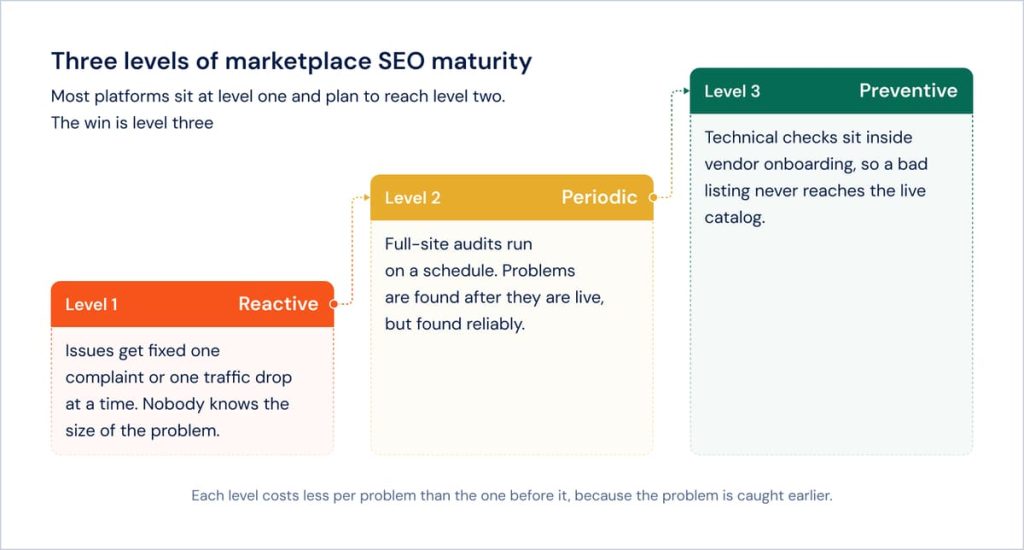
Each level catches the problem earlier than the one before it, which is why each costs less per problem.
Level one is reactive, and almost every platform starts here. Something breaks, a vendor complains or traffic dips, and the issue gets fixed in isolation. Nobody knows how many other listings have the same defect, because nobody has counted.
Level two is periodic. A full crawl runs on a schedule, problems get found reliably and fixes go out in batches. This is a real improvement and it is where most marketplaces with a dedicated SEO function sit. The limitation is timing: everything is still discovered after it is published and indexed.
Level three moves the check upstream into vendor onboarding, so a listing with a duplicate title, a missing image or an invalid attribute set gets rejected or corrected before it is ever published. The same validation that protects your catalog quality protects your crawl budget, and it scales with vendor count instead of against it.
Getting there is less about ambition than about knowing the current state. No marketplace SEO guide can tell you which of the three levels you are on. Effective ecommerce marketplace SEO starts with a baseline of what the catalog actually looks like today, measured across every URL rather than sampled from the pages someone thought to check, and that baseline is where SEO for marketplaces stops being a reading exercise and starts being a plan.