The tools your agency pays for every month should earn their seat at the table. The problem is most SEO stacks grow by accident; one subscription added for a pitch, another inherited from a previous team lead, a third because a client asked about backlinks once.
The inevitable situation looks like this: bloated tooling costs, overlapping features and team members defaulting to whatever they already know rather than whatever actually fits the job.
Here’s the reality check most agency owners eventually arrive at: technical SEO, content, local and reporting workflows don’t all need the same tools. A stack optimized for one discipline is often wrong for another.
This guide is organized around that logic of essential technical SEO tools for agencies, grouped by what each tool genuinely does best, so you can build intentionally instead of by default.
Our List of Top Essential Technical SEO Tools for Agencies
Best for Technical SEO
| Tool | Free Trial | Notes |
|---|---|---|
| JetOctopus | ✅ | Enterprise-level log file analysis + crawling in one platform; AI-powered insights emphasize crawl and indexation issues automatically |
| Botify | ✅ | Crawl intelligence for large sites |
| Lumar | ✅ | Strong for governance and scheduled audits |
| Screaming Frog | Free plan | Desktop-based, suitable for technical audits |
| Oncrawl | ✅ | Combines crawl + log data; strong for structured data and core web vitals |
Best for Backlink Intelligence
| Tool | Free Trial | Notes |
| Ahrefs | Free plan | Best-in-class backlink index |
| Majestic | ❌ | Unique Trust Flow and Citation Flow metrics |
Best for Content-led SEO
| Tool | Free Trial | Notes |
| Surfer SEO | ❌ | Best for on-page optimization |
| Rankability | ✅ | Strong for editorial SEO workflows |
Best for Competitive Research & Full Stack
| Tool | Free Trial | Notes |
| Semrush | ✅ | Covers SEO, PPC, content and social in one login |
| Mangools | ✅ | Best UI in its class; limited for complex multi-client workflows |
| Moz | ✅ | Trusted DA metric; strongest for local SEO clients |
| SE Ranking | ✅ | Solid agency features at affordable prices |
Best for Measurement & Reporting
| Tool | Free Trial | Notes |
| SEOTesting | ✅ | GSC-native A/B testing for SEO changes |
| SEOGets | Free plan | Rank change alerts and automated reporting direct from Search Console |
| Whatagraph | ✅ | Multi-source marketing intelligence |
Best for Data Infrastructure
| Tool | Free Trial | Notes |
| WebCEO | ✅ | Full platform white-labeling on your custom domain |
| DataForSEO | Sandbox | API-first SEO data layer; built for custom pipelines and automations |
Best Tools for Technical SEO
1. JetOctopus
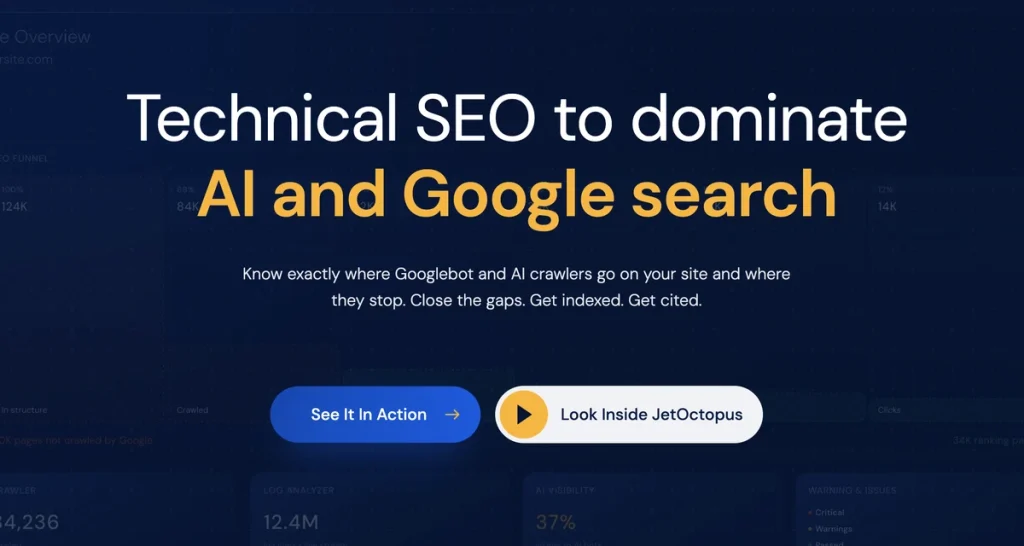
JetOctopus is a cloud-based technical SEO platform that unifies crawl data, log-file analysis, Google Search Console and GA4 into one environment.
It’s built for agencies auditing large, complex sites: ecommerce catalogs, enterprise architectures, JavaScript-heavy properties, where standard rank trackers and content tools simply don’t have the diagnostic depth required.
(Yes, JetOctopus is our platform, so take this with whatever grain of salt you’d like. That said, we’ll be straight with you about where it excels and where it has limits.)
With unlimited projects, users and domains, your whole team and clients can work from the same live data. You can even set alerts per client and go beyond merely presenting a report; you can hand them over a fix already mapped.
And as AI search raises the stakes, JetOctopus tracks exactly what AI bots reach, what JavaScript hides from them and where your clients risk being invisible in AI-generated answers.
For instance, one of our latest additions, the AI SEO Recommender, links together and interprets crawl data, logs and GSC, ultimately delivering a ranked, plain-English action list. It flags issues like indexable pages Googlebot never visits or URLs cannibalizing each other’s rankings, which gives you a clear, prioritized roadmap you can use to demonstrate value and drive faster wins for your clients.
And that’s only a fraction of what JetOctopus can do; below is the complete set of functionalities that help you spot any technical SEO problem.
Key Features
- Ultra-fast and large-scale crawling (up to 1M pages/day): cloud-based with scheduled crawl options; no local machine bottleneck
- Log file analysis: see exactly how Googlebot and AI bots (GPTBot, ClaudeBot, PerplexityBot, etc) interact with client sites
- GSC + GA4 integration: connects technical issues directly to search performance and traffic outcomes
- AI-powered Internal Linker: cross-references crawl, logs and GSC to surface underlinked pages and suggest contextually relevant links via API or CSV
- AI SEO Recommender: Claude-powered analyst that queries your actual crawl, log and GSC data to surface site-specific issues
- AI Bots Dashboard: tracks AI bot behavior, blocked pages and crawl efficiency vs. Googlebot
- Query Fan-Out Detection: maps AI-generated query patterns to product pages for GEO optimization
- Real-time Alerts: monitors log, crawl, GSC and Core Web Vitals data continuously, flagging on-page changes and anomalies the moment they happen
- MCP Integration: connects Claude, ChatGPT and other AI assistants directly to live JetOctopus data, so queries are answered from real crawl and Search Console results
- Core Web Vitals analysis: bulk LCP, INP and CLS testing across large URL sets via Google’s PageSpeed API, with CrUX field data overlaid for real-user context
For large sites: Handles billions of log lines and crawled pages without performance degradation. Scheduled crawls keep data fresh without manual intervention and cloud architecture means enterprise-scale audits don’t paralyze your workflow.
For multi-client workflows: Preset segmentation, alert systems and visualized reporting templates make it practical to run ongoing technical monitoring across an entire client portfolio.
For reporting: Preset charts surface prioritized SEO opportunities with impact framing, so agencies can package findings for client conversations without hours of manual interpretation.
| PROS | CONS |
| Unifies crawl + logs + GSC + GA4 in one platform (the cross-source analysis is the genuine differentiator) | Specialized scope: no keyword research, content optimization or backlink analysis |
| AI Recommender draws from your actual site data | Requires pairing with broader SEO tools (like Ahrefs or Semrush) for full-stack agency workflows |
| AI bot monitoring is a forward-looking capability most technical SEO tools don’t have | Steeper onboarding for teams new to log-file analysis |
| Internal linking automation via API | |
| Multi-client management with alerts makes proactive client communication scalable |
Based on G2 Reviews
Aside from the steep learning curve for non‑technical users, JetOctopus customers consistently highlight its fast crawling speeds and deep insights, making it a strong tool for technical SEO analysis.
Pricing
Usage-based pricing scaled by crawl volume and log lines processed.
2. Botify
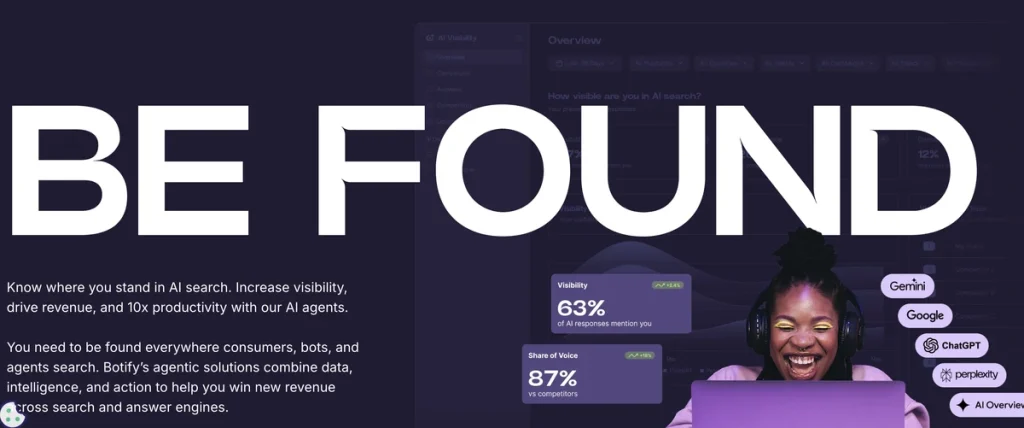
Botify connects crawl data, server logs and Search Console signals into a unified view, so you can tie crawl budget waste, indexation gaps and internal linking problems directly to traffic and revenue impact.
Its automation engine and prioritized recommendations enable lean SEO teams to execute faster and reduce dependency on developer resources. The platform also delivers shareable reporting and simplified cross‑team collaboration, making it easier for agencies to communicate insights clearly to clients.
Key features
- Unified crawl, log file and GSC analysis
- ActionBoard for impact-prioritized SEO and dev task management
- RealKeywords for real-time searcher behavior and trending query detection
- Missed clicks reporting tied to title tag and structured data opportunities
- Shareable reporting built for client and stakeholder communication
| PROS | CONS |
| Handles sites with millions of URLs without degrading in accuracy or speed | Not built for backlink research or broad competitive intelligence |
| Connects technical findings to business outcomes, not just issue counts | Overkill for agencies without enterprise-scale clients |
| Reduces developer dependency through automated prioritization | Pricing and onboarding complexity suit only large teams |
Based on G2 Reviews
Botify is praised for its ease of use and strong technical SEO insights. However, users note that its extensive features can be difficult to master and that the price feels high relative to its value.
Pricing
Custom pricing only.
3. Lumar
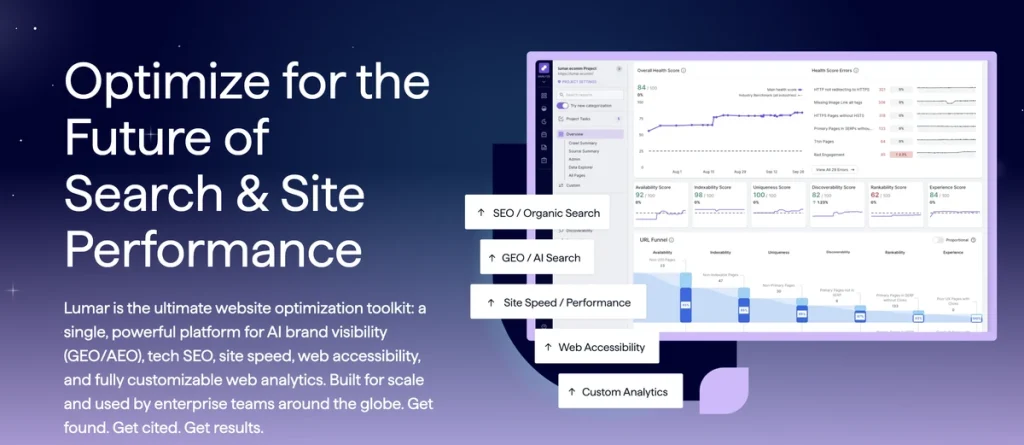
Lumar is a website intelligence platform built for agencies that need repeatable, scalable technical SEO workflows across large and complex client sites. Where general-purpose tools surface issues, Lumar structures them, connecting crawl findings to analytics and search data so teams can prioritize by business impact.
Lumar Monitor gives agencies a single dashboard across multiple domains, with customizable alerts that flag regressions before they drain organic traffic.
Key features
- High-speed crawler built for enterprise-scale and high-URL sites
- Lumar Monitor for multi-domain oversight with customizable alerting
- Technical SEO QA automation to reduce manual audit overhead
- GEO/AEO tools for AI search optimization
- Custom extractions and integrations with analytics and GSC
| PROS | CONS |
| Continuous monitoring catches regressions between audits (not just point-in-time snapshots) | No backlink analysis, keyword research or content tools |
| Multi-client dashboard saves significant time across large agency portfolios | Premium pricing justified only at enterprise client scale |
| Strong collaboration features for communicating findings to developers and stakeholders | Steeper learning curve for teams new to technical-first platforms |
Pricing
Custom pricing.
4. Screaming Frog
As a standard desktop crawler, Screaming Frog SEO Spider imposes no URL limits or cloud throttling. You can crawl sites ranging from 10,000 pages to multi‑million‑page architectures, making it a reliable tool for technical SEO analysis.
Where cloud tools miss nuance, Screaming Frog goes deep: redirect chains, canonical conflicts, hreflang errors, orphaned pages, schema issues and crawl depth problems all displayed in a single pass. Connect it to GSC, GA4 and Ahrefs APIs and you move from audit to prioritized action without switching platforms.
Key features
- Unlimited crawling on paid version
- JavaScript rendering to crawl as Googlebot does
- Custom extraction via XPath, regex and CSS selectors
- XML sitemap generation from live crawl data
- API integrations with GSC, GA4, PageSpeed Insights and Ahrefs
| PROS | CONS |
| Fast crawl speeds available | Primarily runs on a local machine (not in the cloud), making it a major limitation when working with very large sites |
| High technical depth: catches critical issues | No scheduled monitoring, rank tracking or keyword research |
| Flat pricing ($245/year), which is a great value for unlimited enterprise crawling | Steep learning curve without prior technical SEO experience |
Pricing
Free version (500 URL limit). Paid: $245/year. Volume discounts from 20+ licenses.
5. Oncrawl
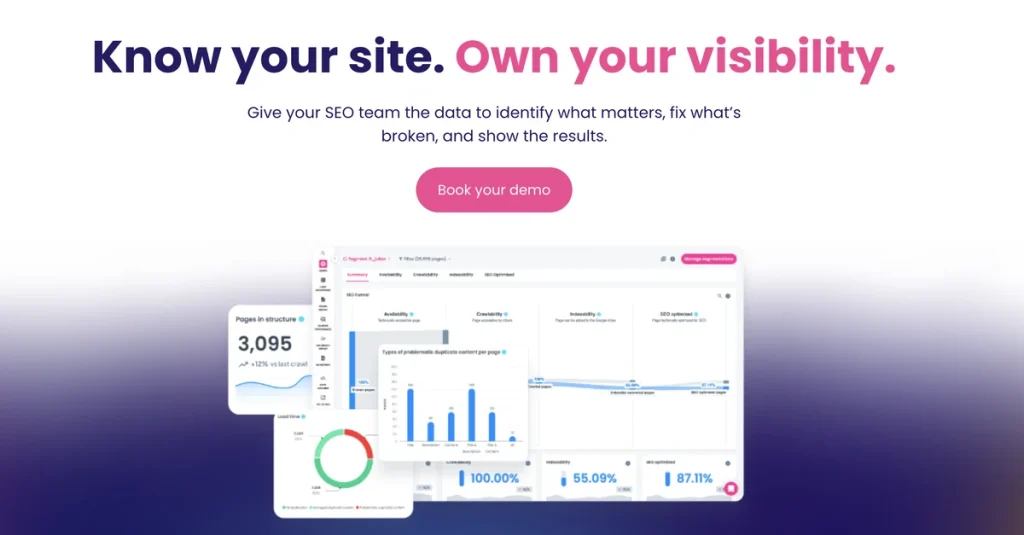
Oncrawl is a technical SEO platform that unifies crawl data, log file analysis and performance metrics into a single environment. This gives agencies a complete picture of how search engines (and AI bots) actually interact with client sites.
Designed for large, complex websites and heavy data loads, Oncrawl is a strong fit for agencies working with enterprise, e‑commerce or media clients, especially those that prioritize technical and operational SEO over keyword research and content planning.
Key Features
- SEO Log Analyzer: cross-references crawl behavior, KPIs, and performance data to surface crawl budget waste and indexation gaps
- AI Bot Monitoring: tracks visits from OpenAI, Claude, Perplexity, and Mistral for AI search visibility
- JS rendering, Web Vitals & data scraping: deep technical auditing at high speed
- Oncrawl Lenses: specialized analytical views, including AI-powered Content Lens
- Scheduled crawls, alerts & automation: enables ongoing programs
- Oncrawl Query Language: custom filtering and segmentation for large, complex site architectures
| PROS | CONS |
| Suitable for enterprise-scale and big data volumes | Doesn’t include a keyword research or content ideation tool |
| Connects technical issues to business ROI | Steeper learning curve for less technical teams |
| AI bot monitoring | |
| Client-ready reporting for non-technical team members |
Pricing
Custom/enterprise pricing that scales by data volume and crawl frequency.
Best SEO Tools for Competitive Research & Full-Stack
1. Semrush
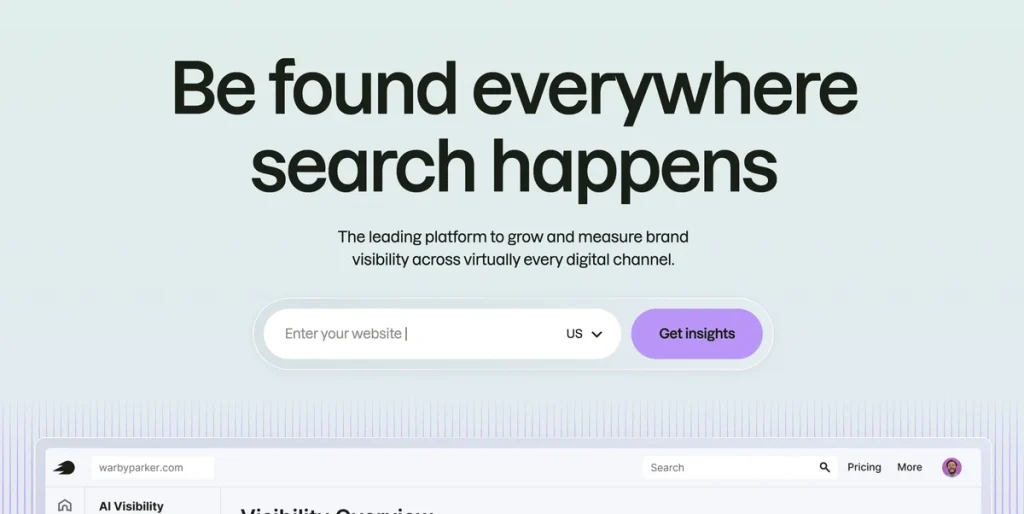
Semrush is a powerhouse all‑in‑one marketing intelligence platform built for agencies that manage complex, multi‑channel client portfolios. Since 2008, it has expanded from an SEO tool into a full-stack platform covering keyword research, technical audits, content, PPC and competitive intelligence, all from one dashboard.
For agencies, the real differentiator is the Agency Growth Kit: a built-in CRM, lead finder, white-label reporting and client portal that eliminates the need for separate project management tools. Pair that with a 25+ billion keyword database across 130 countries and daily position tracking, and you have a platform that scales across a diverse client portfolio without switching contexts.
Key Features
- Keyword Magic Tool with 25B+ keywords and accurate difficulty scoring
- Site Audit crawling up to 1M pages monthly (Business plan)
- Keyword and Backlink Gap analysis for competitive intelligence
- Content Marketing Toolkit with SEO writing assistant
- Agency Growth Kit: CRM, lead generation, white-label reports
| PROS | CONS |
| Broad feature set: SEO, PPC, content and competitive research | Steep learning curve |
| Historical data back to 2012 for trend analysis and algorithm impact tracking | Per-user pricing adds up fast for larger agency teams |
| Agency-specific tooling | Report generation slows noticeably on large enterprise datasets |
Based on G2 Reviews
Semrush delivers powerful, easy‑to‑use SEO data in one platform, though many users feel the onboarding needs work and the pricing can be high for smaller teams.
Pricing
Plans start at $117/month, with a 7‑day free trial available.
2. Mangools
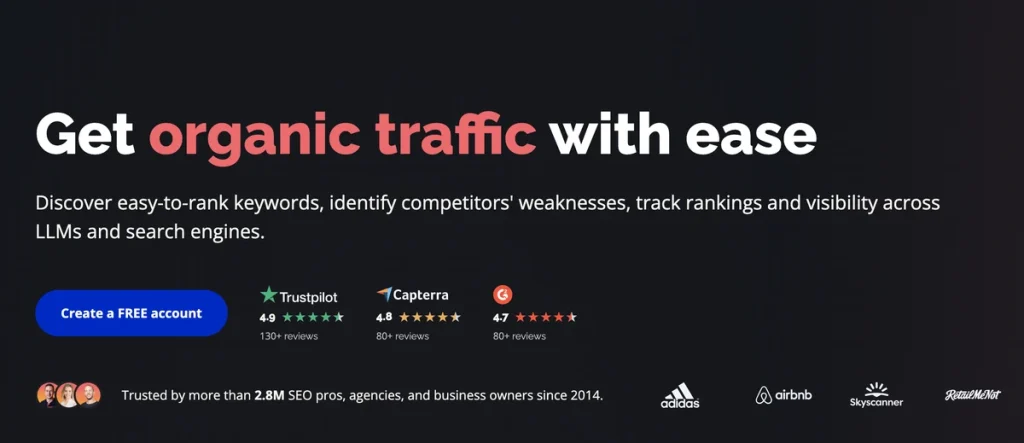
Mangools is a streamlined SEO suite built around the five functions agencies use most: keyword research, SERP analysis, rank tracking, backlink analysis and competitor profiling. As one of the most user-friendly SEO agency tools, Mangools is particularly a good option for mid-sized agencies that want clean data, fast onboarding and solid client-facing deliverables without the complexity overhead.
Key Features
- KWFinder: keyword research with color-coded difficulty scores and low-competition targeting
- SERPChecker: SERP-level analysis of domain authority, link metrics, and ranking signals
- SERPWatcher: daily rank tracking with shareable, white-label interactive reports
- LinkMiner: backlink prospecting and competitor link analysis
- SiteProfiler: authority and citation flow metrics for competitor benchmarking
- AI Search Grader & MCP Server: AI search visibility and direct integration with Claude and Cursor
| PROS | CONS |
| Fastest onboarding in its category; junior team members and clients grasp it immediately | Keyword and backlink databases are smaller than Semrush or Ahrefs |
| KWFinder’s keyword difficulty scores are among the most reliable available | No technical crawl capabilities |
| Affordable Agency plan with daily rank tracking and white-label reports | Reporting is mostly tied to SERPWatcher, not platform-wide |
| Beta MCP server connects Mangools data directly to AI assistant workflows | Daily lookup limits can constrain high-volume agency use |
Pricing
Access to mini tools for free, also covers a free trial, and prices for agencies start from $48.85/month
3. Moz
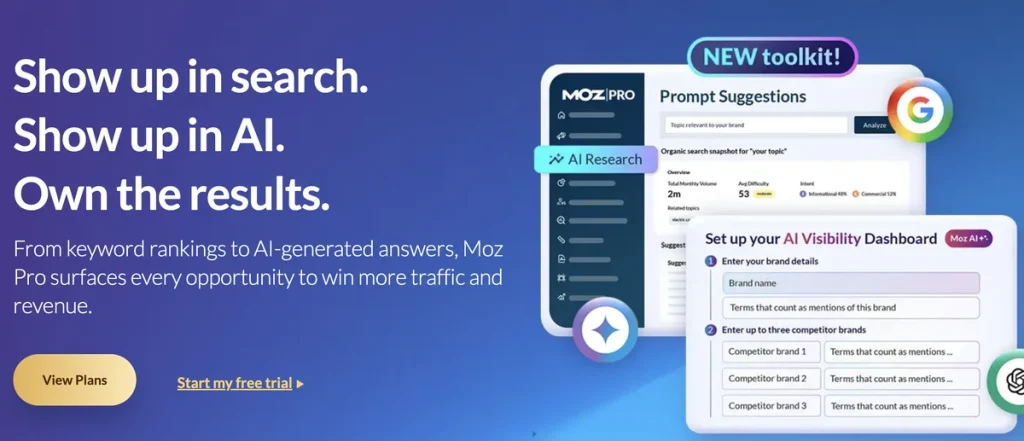
Moz Pro is one of SEO’s original platforms and the creator of Domain Authority, still the industry’s most widely referenced site-strength metric. It covers keyword research, rank tracking, site audits, link analysis and on-page optimization in a single dashboard built for a clear overview.
Key Features
- DA scoring clients immediately understand
- Local rank tracking with Moz Local integration for multi-location clients
- SERP feature monitoring
- Custom branded reports
- A 44-trillion-link index
| PROS | CONS |
| Easiest major SEO platform to learn | Link index updates slower than other similar tools |
| Strong local SEO workflow | Keyword tracking limits |
| Trusted DA metric for client communication | Local SEO tools sold separately |
| 30-day free trial |
Pricing
Starter at $99/month up to Large at $299/month.
4. SE Ranking
SE Ranking is an all-in-one SEO platform covering the complete agency workflow: rank tracking, technical audits, backlink analysis, competitor research, keyword tools and white-label reporting under one roof. It’s a credible alternative to enterprise suites without the enterprise price tag, combining agency-oriented reporting with practical day-to-day SEO tools.
SE Ranking also markets itself to agencies with features like lead generation widgets, client access and support for managing multiple accounts.
Key Features
- Daily rank tracking across 190 countries and 115-parameter site audits
- AI-powered on-page checker and content tools
- Lead generation widget for new business prospecting
- White-label reports with custom domains
| PROS | CONS |
| Exceptional price-to-feature ratio | Small backlink index |
| White-label available on all pricing tiers | Extra costs for Agency Pack |
| Flexible keyword tracking frequency to control costs | Advanced features carry a learning curve |
| AI tools included as standard | |
| Unlimited projects on Business plans |
Based on G2 Reviews
Users say the API and MCP features deliver real value for SEO and GEO reporting, but many also note they’d like to see the newer AI and answer‑engine visibility tools mature further.
Pricing
Pay-as-you-go model, with pricing starting at $45 and a 14-day free trial available.
Best SEO Tools for Backlink Intelligence
1. Ahrefs
Ahrefs is the gold standard for link data. Built on the second-most active web crawler after Google, it maintains a 36+ trillion backlink index updated every 15–30 minutes, which is a freshness no competitor matches.
Site Explorer remains the core weapon: reverse-engineer any competitor’s backlink profile, top-performing content and traffic-driving keywords in one view. Keywords Explorer covers 24 billion keywords across 243 countries; its difficulty scores are, in practice, more accurate than any other tool when it comes to predicting how hard a keyword is to rank for.
Key features
- Site Explorer with real-time backlink index (36T+ links)
- Keywords Explorer with “Lowest DR” filter for uncompetitive keyword discovery
- Content Gap analysis to surface competitor keyword opportunities
- Site Audit crawling up to 2M pages
- Batch Analysis for auditing up to 200 URLs simultaneously
| PROS | CONS |
| Most accurate keyword difficulty scores on the market | SEO-only platform with no other PPC or social tools |
| Near real-time backlink data | Per-seat pricing ($40–80/user) gets expensive fast for larger teams |
| Content Gap analysis that can drive an entire content strategy | Limited white-label reporting compared to agency-focused alternatives |
Pricing
No free trial, but offering free limited access to Site Explorer & Site Audit.
Paid plans start from $129/month.
2. Majestic
Majestic is a dedicated backlink analysis platform, not a generalist SEO suite. This tool is suitable for agencies that need deep link intelligence, auditing link profiles, benchmarking domain authority, prospecting for link opportunities and tracking link history over time.
If link building, digital PR or backlink audits are core to your service offering, Majestic is purpose-built for that work.
Key Features
- Trust Flow & Citation Flow: proprietary metrics for assessing link quality vs. quantity
- Topical Trust Flow: relevance scoring across 800+ categories
- Clique Hunter: identifies shared linking patterns to surface untapped opportunities
- Fresh & Historic Index: tracks new, lost, and historical backlink data
- Author Explorer: content creator analysis for digital PR prospecting
- Multi-domain comparison: side-by-side link profile benchmarking for client pitches
| PROS | CONS |
| Deepest backlink dataset in its category | Link-only scope: has no rank tracking, keyword research or on-page analysis |
| Proprietary link quality metrics are genuinely defensible in client reporting | Steep learning curve for interpreting proprietary metrics |
| Strong for competitor gap analysis and link prospecting workflows | Limited agency management features; usually needs pairing with a broader platform |
| Effective sales tool as it shows prospects exactly how their link profile stacks up |
Pricing
Starts from $46.99/month and goes up to $379.99/month for premium plans that cover full API
Best Tools for Content-Led SEO
1. SurferSEO
SurferSEO is a content optimization platform built around one core job: helping agencies produce on-page SEO content that ranks, consistently and at volume. It analyzes 500+ on-page factors against top-ranking SERP competitors and gives writers and strategists real-time, data-backed guidance, removing guesswork from content production.
Key Features
- Content Editor: real-time optimization scoring for keywords, structure, word count, and semantic terms
- SERP Analyzer: shows what’s working across top-ranking pages for any target keyword
- Content Audit: identifies existing pages with the highest optimization ROI
- Topical Maps: maps content gaps and cluster opportunities
- Surfer AI: generates optimized first drafts on Scale plans
- Brand voice templates: maintain consistency across writers, freelancers, and clients
| PROS | CONS |
| Fastest path from brief to optimized draft in its category | Content-only scope: has no technical crawling, log analysis, or backlink data |
| Levels up junior writers with objective, senior-grade guidance | Usage limits can strain high-volume agencies on lower tiers |
| Integrates keyword research directly into the content workflow | White-labeling and API access locked to the Custom plan (requires a sales call) |
| Affordable prices | Over-reliance on scores can produce over-optimized, unnatural copy |
Based on G2 Reviews
Users love how easy the tool is to use and how much the content editor improves their SEO workflow, though some feel the pricing is high, support could be stronger and certain suggestions lean too much toward keyword stuffing.
Pricing
Starting at 99 EUR per month, with tiered pricing that scales with usage, including enterprise plans featuring white‑label solutions and full API access.
2. Rankability
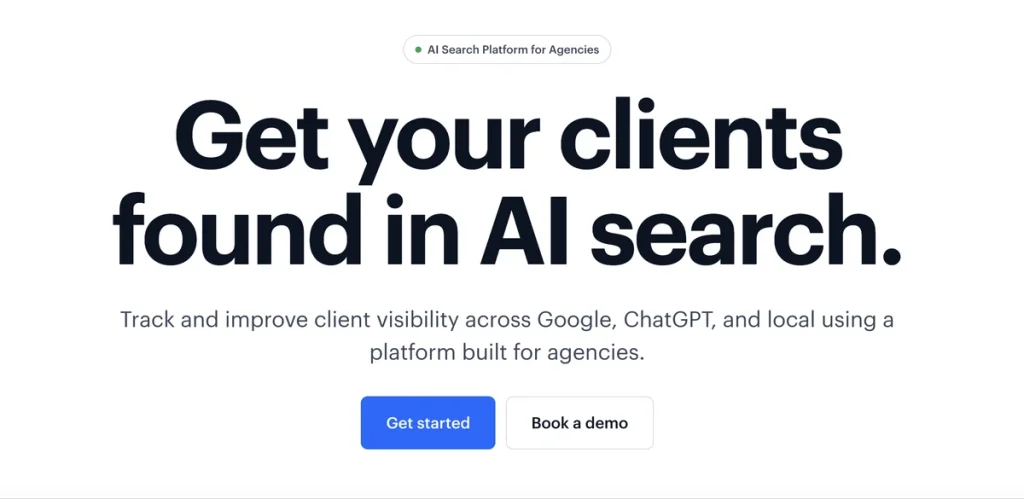
Rankability is an agency-focused SEO platform that combines content optimization, keyword research, rank tracking, technical auditing and AI search visibility into one system. The platform’s core functionality revolves around NLP technology, blending Google NLP, IBM Watson and OpenAI. This allows agencies to create content briefs, outlines and optimization guidance that’s more semantically grounded than standard SERP-scraping tools.
Key Features
- NLP-powered Content Briefs & Optimizer: AI-generated briefs and outlines built for semantic relevance
- Technical Site Auditor: JavaScript-rendering crawler (via Firecrawl)
- Local SEO Auditor: Google Business Profile insights with competitor comparisons and quick AI‑driven fixes
- AI Search Visibility Tracking: brand mentions and share of voice across Google and major LLMs
- Multi-client workspaces: role-based access, branded reports and automated delivery built in
- GSC integration: native connection with long-term data history for accurate performance reporting
| PROS | CONS |
| Consolidates content creation, optimization, tracking and reporting into one workflow | Not a replacement for enterprise crawl platforms for log-file or large-scale architecture work |
| NLP stack is more sophisticated than most content tools | AI visibility tracking is still maturing compared to dedicated GEO tools |
| Local SEO audit module is a genuine differentiator for agencies with SMB clients | Best suited for content-led agencies; less compelling for pure technical SEO shops |
| Agency infrastructure (white-label, roles, automated reports) built in from the start |
Pricing
Tiered plans available, starting from $99/month
Best SEO Tools for Measurement & Reporting
1. SEOTesting
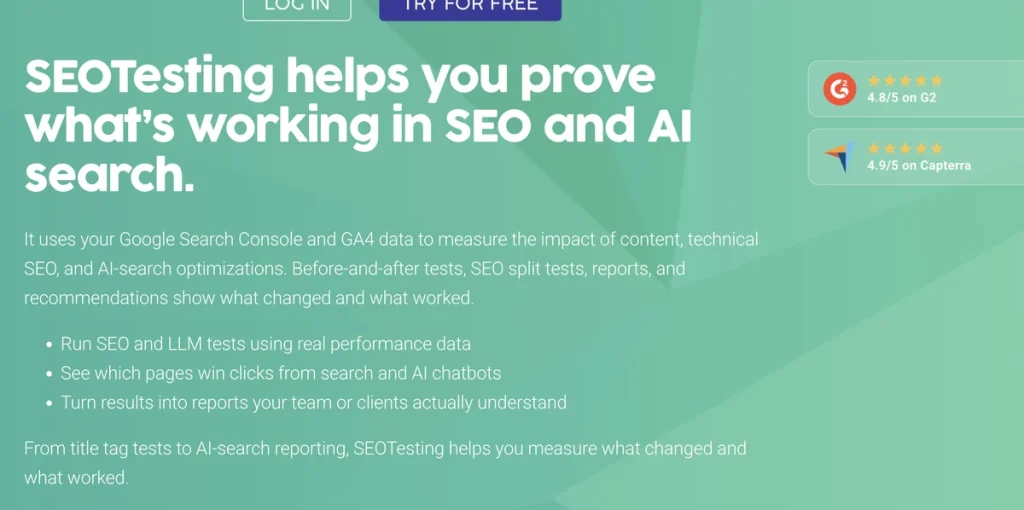
SEOTesting is a testing and measurement platform built around Google Search Console data. It helps agencies run controlled SEO tests, track the impact of on-page changes and generate client-ready reports that prove ROI, without code changes or pixel installs. It’s not a technical SEO auditing tool; it’s a layer that validates whether your SEO work is actually moving the needle.
Key Features
- SEO split testing: test page titles, meta descriptions, content blocks, and templates before sitewide rollout
- GSC-native tracking: connects directly to Search Console; no dev dependency
- Change impact reporting: measures clicks, impressions, CTR, and query shifts per change
- Visual client dashboards: test results presented in report-ready, non-technical formats
- Migration & update tracking: isolates performance signals through major Google updates
| PROS | CONS |
| Makes SEO measurable and defensible, valuable for client retention and upsell conversations | Not a crawler or keyword research tool; requires pairing with audit platforms |
| Zero implementation friction; GSC connection is the entire setup | Insight quality depends on sufficient GSC traffic data |
| Scales across large sites and multiple client accounts | Best value unlocked only when agencies are already running regular optimizations |
| Turns weeks of manual analysis into hours of actionable reporting |
Pricing
Plans start at $50/month. Free trial offered.
2. SEOGets
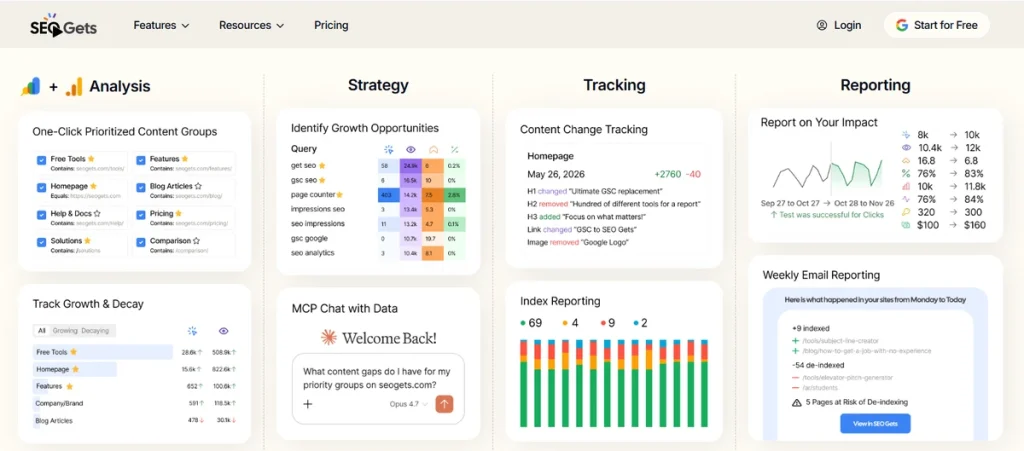
SEOGets is a lightweight analytics platform that centralizes Google Search Console and GA4 data across multiple client sites in one clean dashboard. Agencies and consultants who spend too much time inside native GSC, extending data retention and adding smart segmentation will particularly find this platform attractive.
SEOGets also offers the possibility to turn raw performance data into client-ready insights without regex, Looker builds or manual CSV exports.
Key Features
- Master Dashboard: unified GSC and GA4 view across all client properties
- Content Groups: one-click segmentation by intent, topic, or funnel stage
- Branded vs. non-branded query splits: essential for accurate demand analysis
- Cannibalization & Content Decay detection: surface competing pages and declining traffic before they compound
- Striking Distance: identifies keywords close to top positions for quick wins
- Index Monitoring: tracks up to 5,000 pages with instant drop alerts
- Live Client Portal: real-time performance view; no more rebuilding decks monthly
- MCP Server: pipes GSC data directly into Claude or ChatGPT with context loaded
| PROS | CONS |
| Eliminates the GSC multi-tab workflow for agencies managing many client sites | Not a crawler or technical SEO platform |
| Privacy-friendly read-only access; no risk when working inside client accounts | Insight depth limited to what GSC and GA4 expose |
| SEO testing built in with before/after change tracking | No backlink analysis or keyword research |
| Affordable and fast to deploy for lean agency teams |
Pricing
Start from as low as $39/month and also offers a free trial.
3. Whatagraph
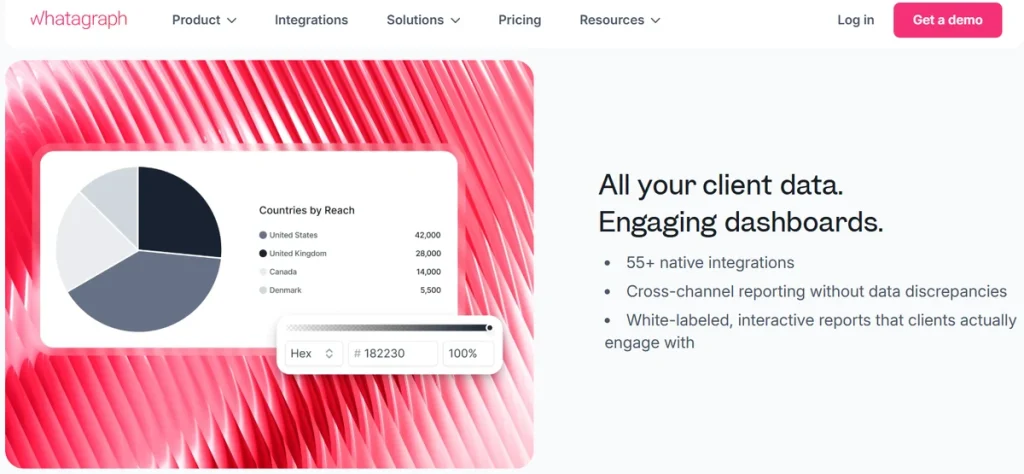
Whatagraph is a marketing intelligence platform built for agency reporting. It connects to 60+ platforms via fully managed native connectors (Google Analytics, Search Console, Ahrefs, Semrush and more), normalizes data into a single governed layer and lets you build branded, automated reports clients actually read.
Key Features
- One metric definition powers every report, dashboard and AI query
- Linked templates cascade changes across all client reports simultaneously
- Whatagraph IQ generates complete reports from a text prompt and writes AI-authored performance summaries
- Native MCP integration, with Claude or ChatGPT that query your actual governed metrics
| PROS | CONS |
| 99.95% uptime, sub-10-second report loads | Premium pricing scales steeply with roster size |
| True white-label with custom domains | Limited for deep technical SEO auditing; this is a reporting layer, not a crawler |
| BigQuery/Looker Studio export | AI features feel more like add‑ons than built into the product. |
| Genuine agency scalability via Spaces, Tags and linked templates |
Based on G2 Reviews
With a 4.5 score, Whatagraph is praised for its easy, customizable reporting and quick visuals, though some users point out limited integrations and occasional data inconsistencies.
Pricing
Tiered model, starting from 199 EUR/month.
Best SEO Tools for Data Infrastructure
1. WebCEO
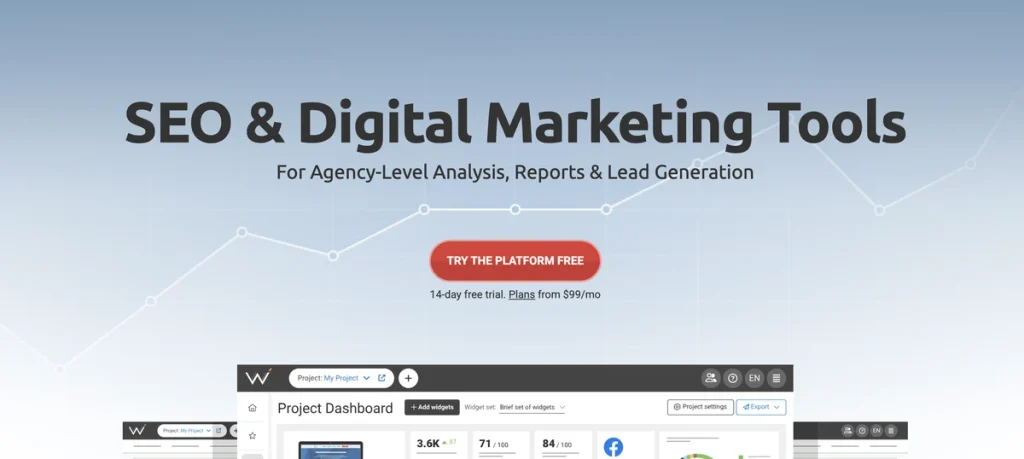
WebCEO is an SEO agency tool built around one defining capability: true white-label hosting. Clients log into what looks like your software. Beyond branding, it covers rank tracking across 370+ search engines, technical audits, backlink analysis, competitor research, local SEO and a built-in lead generation widget that captures prospects via free site audits.
Key Features
- Full platform white-labeling on custom subdomains
- 90+ pre-built branded reports
- Task manager for team delegation
- SEO content assistant
- Integrations with Majestic, Moz, Google Analytics and Search Console
| PROS | CONS |
| Deepest white-label control in its class | Dated interface |
| Generous keyword tracking limits | Steep learning curve |
| Strong multi-user collaboration | AI capabilities lag behind competitors |
| Complex add-on pricing |
Pricing
Agency Unlimited starts at $99/month and they even cover a solo plan at $36/month. 14-day free trial available.
2. DataforSEO
DataForSEO is an API-first SEO data layer that delivers structured SERP data, keyword metrics, backlink analysis, rank tracking and on-page signals across 170+ countries via direct API calls. You can feed it into Google Sheets, Looker Studio, n8n, Make.com or custom client portals, making DataForSEO platform extremely flexible.
It also covers a predictable pay-per-use pricing model plus 24/7 support. That makes it appealing if you want to control costs while powering multiple client workflows from one data source.
Key Features
- Real-time SERP data across Google/Bing/Amazon
- DataForSEO Labs for keyword clustering at scale
- On-page crawling for 100+ technical factors
- 17-second median support response time
| PROS | CONS |
| 70–90% cost savings over similar tools at equivalent usage | No native UI, with a raw JSON output that requires visualization tooling |
| Unused credits roll over indefinitely | Significant setup overhead |
| Sandbox environment for testing before committing | Live queue costs 3.3x more than standard batch processing |
Pricing
Pay-as-you-go from a $50 minimum deposit to start.
Conclusion
There’s no universal answer to the best SEO tools for agencies and that’s the point. If you want to get the most out of your tooling, make deliberate choices: one tool for technical depth, one for content, one for reporting and nothing duplicated in between.
Our tool is worth calling out specifically. JetOctopus has quietly expanded well beyond traditional technical audits. Its crawl analysis and log file intelligence were already strong, but AI Search Visibility, AI Internal Linker and SEO Recommender change the conversation. At a time when LLMs are reshaping how content gets discovered and cited, being able to monitor how your clients appear in AI-generated results and optimize internal linking through machine learning isn’t a nice-to-have. It’s the kind of forward‑looking capability agencies will need from now on, not the older playbooks people were still using in 2022.
If you took anything from this guide, let it be this: audit your stack the same way you’d audit a client site. Cut what’s redundant, replace what’s underperforming and invest where the work actually happens.
The categories here give you a framework to do exactly that, so your tools prove their value every month.